Quick Take
- Narration: Timothy Andrés Pabon is a polished narrator whose natural fluency makes the academic economics content feel like engaged conversation rather than a lecture transcript.
- Themes: Entertainment economics, digital disruption, data-driven content strategy
- Mood: Analytical and readable, academic research worn lightly and with confidence
- Verdict: A genuinely illuminating book about how entertainment industries actually work in the streaming era, built on rigorous research and written to be read rather than tolerated.
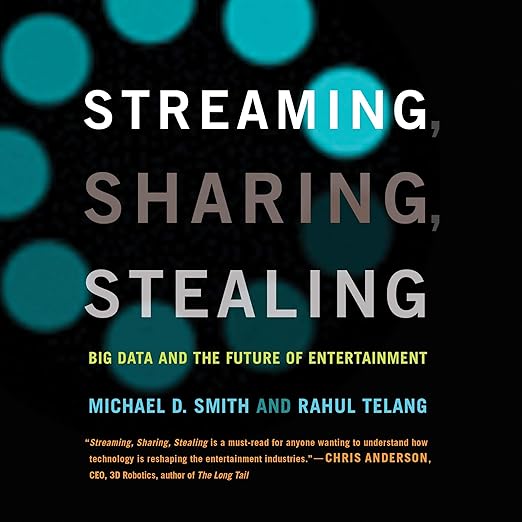
I picked this one up originally because I was curious about the Netflix House of Cards story, specifically the claim that Netflix’s commissioning decision was driven purely by subscriber preference data rather than the pilot-and-evaluate process that had governed television development for decades. I ended up finishing it in a single Sunday, listening across a long afternoon walk and then continuing through the evening, because Smith and Telang turn out to be exactly the kind of academics who know how to write for a general audience without diluting their arguments.
Michael Smith is a professor at Carnegie Mellon’s Heinz College, Rahul Telang holds a joint appointment between Heinz and CMU’s business school, and both have spent careers studying the economics of digital goods and entertainment markets. The book draws on that research base, but it reads nothing like a journal article. The House of Cards opening is genuinely well-chosen as a framing device, it captures in a single example the structural shift the book is about, from intuition-driven development to data-driven commissioning, and the implications of that shift ripple through every subsequent chapter.
The Piracy Argument That Most Entertainment Executives Missed
The most counterintuitive section of the book, and the one most likely to generate genuine disagreement, is the treatment of piracy’s actual effect on entertainment industry revenues. Smith and Telang present research suggesting that the causal relationship between piracy and revenue loss is significantly weaker than industry lobbying efforts have claimed, and that the more important variable is windowing strategy. When studios insist on long gaps between theatrical release and digital availability, they are not protecting revenue, they are creating demand for piracy by denying legal access during the period of maximum consumer interest.
This argument is presented with specific data from natural experiments (cases where legal access was either extended or restricted for exogenous reasons, allowing comparison) rather than just theory. It is one of the places in the book where the academic rigor that Smith and Telang bring to popular writing is most visible, and it is the section most likely to change how an informed reader thinks about the entertainment industry’s relationship to its own consumers.
The Long Tail, Price Discrimination, and Why Niche Actually Works
The discussion of the long-tail dynamics in streaming catalogs is more nuanced than the Chris Anderson version of the same argument. Smith and Telang acknowledge Anderson’s core insight, digital distribution makes it economically viable to serve niche audiences that brick-and-mortar retail couldn’t accommodate, but they add an important correction: the economics of long-tail content only work if the discovery infrastructure allows niche content to find its audience. Recommendation systems are not a nice-to-have feature; they are the mechanism that makes long-tail inventory commercially viable.
The price discrimination chapter is one of the more technically interesting sections for readers with an economics background. The authors explain how streaming services use behavioral data to approximate willingness-to-pay at the individual level, and how this differs from the blunter geographic price discrimination that has historically characterized entertainment pricing. The connection to the “moneyball” analogy, treating consumers as statistical populations rather than intuitions, is made explicit and well-argued.
Timothy Andrés Pabon’s Performance
Pabon is a particularly good match for this material. He has a voice that communicates intelligence and engagement without taking itself too seriously, the right register for a book that is making rigorous academic arguments in accessible language. When the text moves through a statistical finding or a market experiment description, Pabon’s delivery keeps it moving without losing precision. The 6-hour runtime feels efficient rather than compressed, which is a compliment to both the authors’ writing and his performance.
One reviewer from Arun Sundararajan, a recognized scholar in this field himself, calls it “refreshingly readable” and notes that the backing research spans decades of consistently interesting work. That endorsement from a peer carries more weight than most blurb coverage. The reviewer from Ian Mann adds the observation that it “changes the way you think about an industry,” which is the appropriate bar for a book like this.
A Note on the Companion PDF
Audible includes a companion PDF with this title, which contains the references and data sources for the research discussed in the book. For casual listeners, the audio is self-contained. For listeners who want to explore the underlying research, which is well worth doing given the quality of the work, the PDF provides the academic citation layer that the narrative rightly keeps out of the main text.
Frequently Asked Questions
Does this book cover the music industry, book publishing, and film as well as television, or is it primarily a Netflix-era TV analysis?
It covers all major entertainment sectors: film, television, music, and book publishing. The Netflix House of Cards example is the frame, but Amazon’s entry into publishing and music streaming disruption receive substantial treatment. The authors use multiple industries to test whether their arguments are generalizable rather than TV-specific.
How current does the research feel given that the entertainment streaming landscape has shifted significantly since publication?
The core arguments, about data-driven commissioning, the economics of piracy, windowing strategy, and long-tail discovery, remain structurally relevant even as specific examples have aged. The book is better read as a framework for understanding the economics of digital entertainment than as a current state description of any specific platform’s strategy.
Is the economics content accessible to readers without a background in microeconomics, or does it require that foundation?
It is written for a general educated audience. The economic concepts, price discrimination, willingness-to-pay, externalities, long-tail distribution, are introduced and explained rather than assumed. Readers with economics training will recognize the underlying models quickly; readers without that background should follow comfortably from the explanations given.
Does Timothy Andrés Pabon’s narration suit the academic-popular writing style, which sits between a textbook and a trade nonfiction book?
Yes, Pabon handles the hybrid register well. He’s not performing drama, but he’s not reading a technical manual either. The natural conversational quality of his delivery is a good match for authors who write academic research in an accessible prose style.