Quick Take
- Narration: Jonathan Todd Ross brings the measured, professional delivery that HBR anthology content requires, navigating the essay-collection format with consistent authority.
- Themes: Analytics strategy, competitive advantage through data, organizational adoption of AI
- Mood: Brisk and executive-level, with the intellectual density of collected HBR articles
- Verdict: A useful orientation for leaders approaching analytics strategy for the first time, though the uneven article quality and short runtime mean it works better as a starting point than a complete framework.
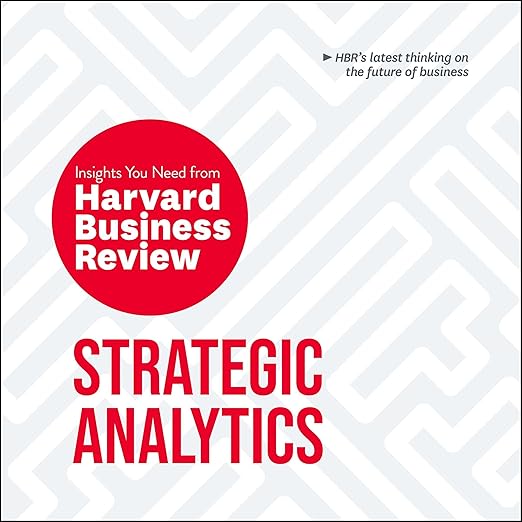
I started Strategic Analytics on a Monday morning commute, which turned out to be precisely the right context. This is an HBR Insights series entry, which means it is designed for the time-constrained executive who needs conceptual grounding on a fast-moving topic without the commitment of a full-length treatment. At three hours and three minutes, it delivers what that format promises, and not always more than that.
The Harvard Business Review Insights series has a consistent architecture: curated articles by various contributors, organized around a theme, with the implicit endorsement of the HBR brand lending them collective authority. This entry covers what data analytics are capable of, how organizations can adopt them effectively, and what the competitive stakes look like for companies that get this right versus those that don’t. Jonathan Todd Ross narrates with the kind of assured, steady delivery that makes dense professional content listenable without making it feel simplified.
The Article-Collection Format in Audio
What you are listening to here is not a sustained argument by a single author but a sequence of expert perspectives edited into thematic coherence. That structure has advantages and costs that are specific to the audio format. The advantage is variety: different contributors bring different frameworks, and the listener gets a range of analytical lenses rather than a single authorial worldview. The cost is consistency: the quality of individual articles varies, and audio listeners cannot skim past the weaker pieces the way a print reader can.
The reviewer who noted that the second half of the book is better than the first is describing a pattern that appears frequently in HBR anthology volumes. Earlier articles tend to cover higher-level conceptual ground that can feel abstract without sufficient case grounding, while later pieces often drill into more specific strategic questions. Audio listeners do not have an easy way to jump ahead, which means the first half’s relative abstractness has to be sat through rather than navigated around.
Where the HBR Brand Adds Genuine Value
At its best, this collection does what the HBR Insights series is designed to do: it captures expert thinking at a specific moment in a rapidly developing field and organizes it around practical business questions. The articles on organizational adoption of analytics, the governance challenges of data-driven decision-making, and the strategic implications of becoming a company whose competitors have better analytics capabilities than you do are all worth the listener’s time.
The section that addresses what analytics are actually capable of in practice, as distinguished from what vendor marketing suggests, is particularly useful for executives who have been on the receiving end of technology presentations and struggled to translate the capability claims into operational reality. HBR contributors are generally good at that translation work.
The Three-Hour Scope and Its Implications
Three hours is not enough time to build a complete analytics strategy framework. The 54 reviewers have given this a 4.1 average, which is modest for an HBR title and reflects the mixed-bag quality acknowledged in the review record. The reviewer who noted that “I was expecting more given that it was from Harvard” is articulating a real expectation gap that the format creates.
The companion PDF is included with the Audible purchase and contains any visual content referenced in the articles. For a collection primarily built on written argument rather than data visualization, the PDF is supplementary rather than essential, though it may be useful for the framework summaries that appear in some HBR articles.
Listen if you want a rapid orientation to analytics strategy at the executive level, and you plan to follow this up with more detailed treatment of specific topics that prove most relevant to your context. Listen if you appreciate the variety of perspectives that an anthology format provides. Skip this one if you need a coherent, sustained framework from a single voice; the article-collection format and the three-hour runtime mean this is a starting point rather than a destination.
Frequently Asked Questions
Is Strategic Analytics from the HBR Insights series the same as other HBR data analytics books?
The HBR Insights series publishes multiple volumes on related topics, and there is some overlap in contributor perspectives across the series. This specific volume focuses on analytics strategy and competitive advantage rather than data visualization or machine learning implementation. It’s a standalone entry that can be listened to without familiarity with other volumes in the series.
How does Jonathan Todd Ross handle the transition between different article contributors?
Ross maintains a consistent narrative voice throughout, which is the right approach for an anthology that is edited for thematic coherence rather than presented as distinct author perspectives. The transitions between articles are marked clearly enough that listeners can track the structure without the experience feeling disjointed.
At three hours, is this more like an introduction or a complete treatment of analytics strategy?
It is firmly an introduction. Three hours is enough to build familiarity with the conceptual vocabulary and strategic framing around analytics, and to identify which areas are most relevant to a specific organizational context. It is not a comprehensive framework. HBR Insights titles are explicitly designed as orientation tools for time-constrained leaders.
The reviews mention uneven quality across articles. Are there ways to identify which sections are strongest before listening?
In audio format, you cannot easily preview individual articles. Based on the review pattern, the second half of the collection is generally regarded as stronger than the first. Listeners who find the early sections too abstract may want to stick with it, as the later articles tend to move toward more specific strategic application.