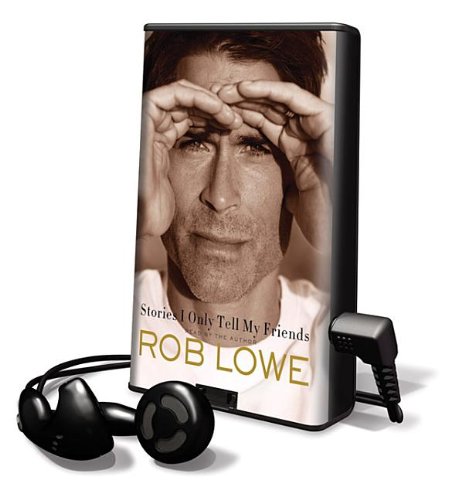
Rob Lowe reading his own memoir is exactly the audiobook experience it promises to be, and then some. The craft that makes Stories I Only Tell My Friends work on the page is amplified considerably when Lowe himself delivers the lines, because the timing and self-deprecating warmth that animate the prose become performance rather than inference. Over nine hours and ten minutes, he reconstructs a life that unfolded almost entirely in public while managing to reveal things that somehow stayed private, and the result is warmer, funnier, and more honest than the celebrity memoir genre typically manages.
A Witness to the Brat Pack Years
Lowe does something smart from the opening pages: he positions himself as a witness to a particular moment in American cultural history rather than simply the protagonist of a personal success story. His arrival in Malibu in the mid-seventies, as a painfully earnest kid from Ohio transplanted into the counterculture scene, gives him a vantage point from which to observe a world in transition. He was young enough to absorb it all without cynicism, and reflective enough now to understand what he was seeing.
The Brat Pack years are handled with the mixture of affection and clarity that their cultural moment deserves. Lowe was central to that cohort, and his relationships with figures like Tom Cruise, Emilio Estevez, and others are described with genuine fondness rather than competitive score-settling. He is honest about the excesses of the period without performative regret, which is a difficult balance to strike.
Sobriety and Fatherhood as a Process
The West Wing chapters are among the book's best. Lowe's account of the show's political world and its intersection with actual White House culture is specific and entertaining, and his perspective on the nexus of entertainment and politics carries weight from someone who lived in both spaces. The decision to leave the show when he did is discussed with characteristic directness.
The passages on sobriety and fatherhood are the most personally revealing, and Lowe handles them without melodrama. He describes the shift from the excesses of his twenties to the discipline of his later life as a process rather than a revelation, which rings more honestly than conversion narratives typically do.
Leesa on How Distinctly His Voice Suits It
The self-narration is the primary reason to choose the audio format for this particular book. Lowe's professional instincts as an actor inform the delivery in ways that are consistently apparent: he knows where the rhythm of a sentence lives, when to slow down for effect, and when to let a deadpan observation land without underlining it. Leesa's review captures something real when she notes how distinctly his voice suits the material. The effect is collaborative in the best sense, as though you are getting the story the way Lowe would tell it to someone he actually trusted.
Four Decades of Recognizing That Voice
The cultural history embedded in the memoir is also a genuine draw. Lowe was present at enough inflection points in American entertainment to make the anecdotal material feel like social history as well as personal narrative. His account of The Outsiders in particular, and what that production meant for a new generation of actors, carries historical weight beyond the personal story.
The humor throughout the nine hours is consistent and never mean-spirited. Lowe is a self-aware narrator in the best sense: he knows he has lived an improbable life and does not pretend otherwise, but he frames the implausibility with wit rather than bragging. The book never mistakes access to famous people for wisdom, which keeps the name-dropping from becoming grating.
For listeners who grew up watching Lowe's work across four decades, the audio format adds a layer of intimacy that the written word cannot fully replicate. Recognizing his actual voice through the anecdotes makes the retrospective dimension of the memoir feel more present and immediate.
Stops Before Parks and Recreation Even Starts
The book covers a specific arc and stops well before the present day. Listeners hoping for extended coverage of Lowe's work on Parks and Recreation or his more recent projects will find those years mostly outside the scope. The narrative focuses heavily on the 1970s through the 1990s, with the West Wing years serving as a kind of closing chapter rather than a midpoint.
Some episodes are sketched rather than fully developed. The format of episodic anecdotes means that certain relationships and periods receive brief treatment, and listeners who want deeper excavation of particular moments in Lowe's career may find the pace moves on before they are ready. This is a characteristic of the genre rather than a specific failure, but it is worth noting.
Compressed Rather Than Relitigated
The notorious events that ended Lowe's run as one of the most bankable actors in Hollywood in the late 1980s are addressed, but with a compression that reflects his apparent desire to contextualize rather than relitigate. Listeners who are hoping for extended reflection on that period may find the treatment briefer than expected.
The book is candid without being exposing of others. Lowe declines to use the memoir as a vehicle for settling scores or revealing damaging information about people still living. For readers who prefer more conventional celebrity-memoir candor about the behavior of famous acquaintances, the restraint may feel like evasion.
Self-Narration Is the Reason to Choose Audio
This audiobook is ideal for anyone who grew up with Lowe's work and wants the context behind what they watched. The Brat Pack generation in particular will find the material richly detailed. The self-narration makes it worth choosing over the print version for almost any listener, since the audio adds a dimension the text cannot provide.
Listeners interested in the mechanics of a long Hollywood career will find Lowe's account of navigating the industry across decades genuinely instructive. He discusses the business side, the craft side, and the personal side without pretending they are separable, and the picture that emerges is more nuanced than most entertainment industry memoirs manage.
For fans of long-form celebrity memoir who appreciate restraint and wit over revelation and score-settling, Stories I Only Tell My Friends delivers across its nine hours without overstaying its welcome.
Key Details
- Narration: Rob Lowe reads his own memoir with timing and warmth that no hired narrator could replicate, turning every anecdote into something closer to a conversation.
- Themes: Fame, identity, ambition, sobriety, fatherhood, and the peculiar demands of a life built entirely in the public eye.
- Mood: Wry, candid, and at times genuinely moving, without the score-settling tone that mars so many celebrity memoirs.
- Verdict: One of the stronger celebrity autobiographies of its era, and a genuinely superior listen precisely because Lowe narrates himself.
Before You Listen
Does Rob Lowe narrate this audiobook himself?
Yes, and that is the primary reason to choose the audio format. Lowe's timing and delivery transform the already engaging prose into something closer to a direct conversation with the reader.
Is this audiobook appropriate for listeners unfamiliar with Rob Lowe's work?
Yes, though fans of his films and television work will get more from the specific anecdotes. The cultural history he witnessed makes it engaging even for listeners who came to his name late.
At nine-plus hours, does the audiobook sustain its energy across the full runtime?
Consistently. The episodic structure means each chapter functions as a self-contained story, and Lowe's performance keeps the pace lively throughout. Few celebrity memoirs sustain the format as well over a comparable runtime.