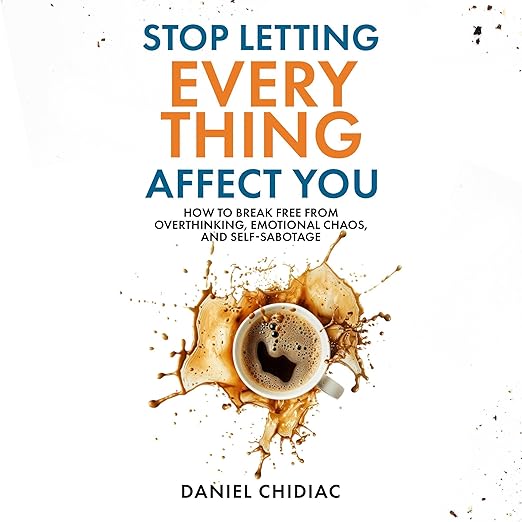
I picked up Stop Letting Everything Affect You on a recommendation from a reader who described it as the self-help book that said clearly what a dozen other books had danced around. That's a high bar, and I was prepared to disagree with the assessment. Three and a half hours later, I understood what she meant. Daniel Chidiac writes about the interior experience of an overthinker, the replayed conversations, the absorbed emotions, the guilt that arrives from nowhere, the perpetual cycle of things spiraling out before you've caught them, with a specificity that most personal development writing avoids. He's not describing the problem from the outside. He's describing it from inside the experience, and that difference shows.
Chidiac is the author of Who Says You Can't? You Do and The Modern Break-Up, both of which built his reputation in the personal development space. Stop Letting Everything Affect You is positioned as the next logical step in his work, taking the empowerment framework of those earlier books and applying it specifically to the emotional reactivity problem that keeps many people from benefiting from empowerment rhetoric in the first place. If you know you're supposed to feel better but you keep getting knocked sideways by small things, this is aimed at that gap.
Real Guilt Versus the Kind Others Impose
The book's most valuable distinction is what it does with guilt. Chidiac separates real guilt, the kind that signals you've actually done something inconsistent with your values and deserves your attention, from manufactured guilt, which is what you feel when someone else has deployed guilt as a management tool. That distinction sounds obvious when stated plainly, but for people who default to absorbing guilt reflexively, hearing it articulated with this clarity is not obvious at all. Multiple reviewers describe reacting to this as the thing that explained what they'd been experiencing for years without a vocabulary for it.
The section on emotional detachment is similarly careful. Chidiac is explicit that the goal is not to become cold or unresponsive, it's to develop the capacity to observe and choose your response rather than be determined by your immediate emotional reaction. The framing of this as a skill rather than a personality trait is the move that separates this book from the "just don't care" school of self-help, which is both psychologically inaccurate and practically useless for the audience this book is targeting.
Chidiac Reads His Own Book Like a Conversation
The author-narrated format is a genuine asset here. Chidiac's voice is unhurried and direct, and the experience of listening to him read his own material feels consistent with the conversational quality reviewers describe, one notes it feels "like a thoughtful conversation rather than a lecture," which is accurate. At three hours and 44 minutes, this is a comfortable single-day or two-session listen, and the pace allows the ideas to land without feeling rushed or padded.
The reviews collected here are unusually specific in their accounts of personal application. One reviewer is an overthinker who describes the book as eye-opening enough that she immediately purchased copies for two nieces and began planning a reread with highlighting. Another describes having seen multiple psychologists and finding Chidiac's explanations more practically useful than years of professional consultation, a claim worth reading with appropriate skepticism, but which points to how the book's directness and actionability land for a certain kind of reader. A third describes the solutions as "realistic," which is meaningful in a genre where advice often requires life circumstances the reader doesn't have.
Five Topics Compressed Into Under Four Hours
At under four hours, this is a short audiobook for a self-help title, and the brevity means some topics are treated more efficiently than exhaustively. Chidiac covers a significant range, self-sabotage, boundary-setting, toxic relationship patterns, overthinking, victimhood versus self-empowerment, and the treatment of each is necessarily compressed. Listeners who want extended clinical depth on any particular topic should supplement with more specialized reading. This functions as a clarifying framework, not a comprehensive therapeutic resource.
The book's warm, conversational directness is its strength, but it also means it doesn't build elaborate theoretical scaffolding. If you need extensive academic citation or formal psychological models, you'll find the format too accessible and informal. Chidiac's approach is to speak plainly about recognizable inner experiences and offer practical tools, not to position his work within academic literature.
Chronic Overthinkers Get a Direct, Practical Book
Listeners who recognize themselves as chronic overthinkers, who replay conversations, absorb other people's emotional states, get derailed by small things, and feel guilt they can't always account for, will find this book directly and practically useful. The author-narrated format makes the three-hour-plus runtime feel like a sustained conversation, and the actionable framing of each concept gives listeners something concrete to work with after the listen ends. Those looking for clinical depth, theoretical complexity, or evidence-based psychological frameworks should pair this with more specialized material.
In Brief
- Narrator: Daniel Chidiac reads his own work, which gives the material an intimacy and directness that suits its conversational tone, this is one of those self-narrated titles where the match between voice and content feels genuinely earned.
- Subjects: Emotional detachment without coldness, breaking overthinking cycles, distinguishing real guilt from manipulation
- Tone: Direct and compassionate, structured more like an ongoing conversation than a lecture
- Bottom line: A practical and emotionally intelligent self-help audiobook that earns its enthusiastic reception, Chidiac writes with clarity about difficult inner experiences without reducing them to formulas.
What makes Stop Letting Everything Affect You different from other self-help books on overthinking?
Chidiac's specificity about interior experience, particularly his distinction between real guilt and manufactured guilt, and his framing of emotional detachment as a learnable skill rather than a personality trait, is what reviewers consistently identify as the differentiating quality. He's describing recognizable experiences from the inside rather than diagnosing them from outside.
Is the author-narrated format an advantage or disadvantage here?
An advantage. The conversational directness that reviewers describe, feeling like a thoughtful dialogue rather than a lecture, is amplified by Chidiac reading his own material. His pace and warmth feel authentic rather than performed, which suits content about vulnerability and inner experience.
At 3 hours and 44 minutes, is this audiobook long enough to cover its topics substantively?
It covers a significant range, overthinking, self-sabotage, guilt, emotional detachment, toxic patterns, boundary-setting, with practical directness but not exhaustive depth. Think of it as a clarifying framework for recognizing and beginning to change these patterns, not a comprehensive psychological treatment of any single topic.
Is this book appropriate for someone who has tried therapy without finding it useful for emotional reactivity?
Several reviewers make exactly this comparison, describing the book as articulating things clearly that years of professional consultation had not. That's not a claim to take as a replacement for therapy, but it suggests Chidiac's directness and practical orientation land well for people who find therapy's framework less immediately applicable than they hoped.