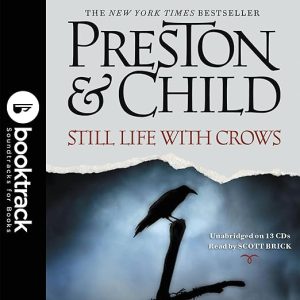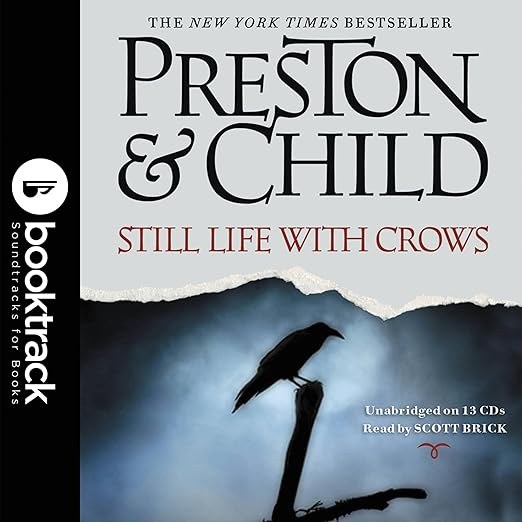
I am a habitual Preston and Child listener, which means I came to Still Life with Crows having already spent considerable time with Aloysius Pendergast in other entries. My sister, who had never encountered the character, started this one on my recommendation while visiting, and her reaction partway through told me something useful: she found the Kansas setting unsettling in a way she had not anticipated from what she assumed would be a standard crime thriller. That quality, the way the novel turns American heartland geography into something quietly malevolent, is what distinguishes this book within the series.
Scott Brick narrates, as he has throughout the Pendergast series, and his voice is by now inseparable from the character for long-term listeners. The Booktrack Edition mentioned in the product description adds a musical score, but this review addresses the narration as a performance independent of that feature.
This is the fourth Pendergast novel, and it marks a conscious departure from the New York-centric settings of the first three books. Preston and Child drop their FBI agent into Medicine Creek, a dying Kansas farming town where a series of elaborate, ritualistic murders have begun terrifying the population. The isolation is total, the cornfields stretch to the horizon, and the novel uses this geography with real skill, the Midwest flatness becomes a kind of psychological pressure, a landscape with nowhere to hide.
Pendergast arrives by bus rather than limousine, which is itself an unusual choice, and spends much of the novel operating obliquely, seeming to understand more than he reveals to both the reader and the other characters. This controlled withholding is one of Preston and Child's reliable pleasures, and Brick performs it perfectly, his Pendergast pauses carry weight.
What Douglas Preston Gets Right
Reviewer P. Giorgio, who describes this as his first Preston and Child book, calls it five stars within its genre, and that framing is useful: this novel does not aim to be literary fiction and does not pretend to. It aims to be a precisely crafted Gothic procedural with a memorable central character, and it succeeds at that. The horror element Giorgio mentions as palpable but not nightmare-inducing is accurate, this is horror that operates through atmosphere and implication rather than graphic content, which makes it accessible to listeners who find pure horror audiobooks too much but want something darker than a standard mystery.
The female character Corrie Swanson, introduced in this entry and returning in later books, is worth paying attention to. She functions initially as a reluctant local guide for Pendergast and develops into something more interesting as the novel progresses. Her dynamic with Pendergast is one of the more entertaining relationships in the series.
Where Douglas Preston Loses Some Ground
The ending is the point of sustained critical debate among series fans. Reviewer Jake Mohlman, a long-term Preston and Child reader, notes that the resolution leaves some holes and does not quite match the quality of the buildup. This is a fair observation. The final act relies on an explanation that requires a degree of suspension of disbelief beyond what the novel has been asking of you up to that point. Listeners who need their resolutions tidy may find this frustrating.
The Booktrack musical score is a format experiment that some listeners find immersive and others find intrusive. If the version you access includes the music, it is worth giving it several chapters before deciding, reviewers are genuinely split, and your tolerance for ambient scoring during narration is likely to predict your reaction.
Who Douglas Preston Is Writing For
This is an entry point for new Pendergast readers as much as a continuation for existing fans. The Kansas setting is self-contained, and while it rewards familiarity with the character, it does not require it. Listeners who enjoy Jeffery Deaver's Lincoln Rhyme series or Tana French's Dublin Murder Squad will find the atmospheric procedural approach familiar territory.
Listeners who want relentless action and minimal atmosphere should start elsewhere in the Pendergast catalog. This is a slow-burn novel, and its best qualities, the landscape, the dread, the character work, require patience.
Questions Listeners Ask
Is Still Life with Crows a good starting point for someone new to the Pendergast series?
Yes. While it is the fourth book in the series, it functions largely as a standalone story set in a new location with a new case. Listeners who start here will get a complete mystery without needing knowledge of the earlier books, though some of Pendergast's backstory will carry more weight if you return to the earlier entries afterward.
What is the Booktrack Edition and does it significantly change the listening experience?
The Booktrack Edition adds a synchronized musical score that plays underneath Scott Brick's narration. It is the same narration as the standard audiobook with music layered in. Listener reactions are divided, some find it cinematic and immersive, others find it distracting. The standard non-Booktrack version is also available if you prefer narration without scoring.
Does Scott Brick's narration work for the supernatural or horror elements, or is he better suited to procedural scenes?
Brick handles both registers well. His Pendergast voice has an unhurried, slightly theatrical quality that suits the novel's Gothic atmosphere, and he modulates pace effectively during tenser sequences without resorting to melodrama. The horror elements in this book are atmospheric rather than graphic, which plays to his strengths.
Is the ending satisfying, or does it require too much suspension of disbelief?
Reader opinion is genuinely split. Long-term series fans tend to find the resolution somewhat weaker than the buildup, with a few unexplained plot threads. New readers arriving without expectations for how Preston and Child typically close their novels may find it more satisfying. If tight, fully resolved mysteries are important to you, this is worth knowing going in.