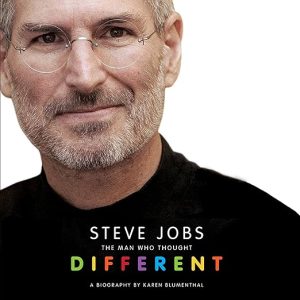
A commencement speech frames this audiobook, and the description says so outright: Karen Blumenthal builds the life around the address Steve Jobs delivered at Stanford. That structural choice matters more in audio than it does on paper, because a book organized around a spoken text and then delivered as spoken text has a shape you can follow without a page in front of you. Steven Yoshida's response confirms the design from the reader's side, describing the three stories from that address doing service as the book's themes. Five hours and fifty-three minutes is the whole of it, read by Sean Runnette.
Our Take on Steve Jobs: The Man Who Thought Different
Most of the disagreement in this column is about depth rather than quality. TC, holding the only four-star grade on the page, calls the book researched well enough, well written, and mostly interesting, then names the limitation without hedging: mostly a surface rendering, overlapping heavily with the Isaacson biography in the way it tells the story. Steven Yoshida arrives somewhere similar and treats the same quality as the point, describing a book that resembles a parable for young readers, written throughout in language chosen for that audience.
Anyone browsing this page should read the category line before buying. The listing files it in the teen and young adult category, and for once the shelving is accurate rather than accidental. Fran, who ordered it at fifty-four without realizing who it was written for, reports that the intended age made no difference at all and left five stars anyway. That is a useful signal in both directions. The prose holds an adult's attention, and it was not constructed for one. Anyone shopping for a definitive account should register that now rather than four chapters in.
Once you know the frame, the material sorts itself quickly. The description covers adoption at birth, a single semester of college, Apple assembled in a garage at twenty with a friend the listing spells Wozniack, and then the perfectionism, the counterculture instincts, the decade of illness, and the taste that turned into a commercial advantage. Blumenthal is also, by the description's own account, tracking the evolution of computers alongside the man. That is a second subject folded into under six hours, which tells you how the pacing has to work.
Why Listen to Steve Jobs: The Man Who Thought Different
Karen Blumenthal is attempting something harder than it looks: writing about a difficult person for readers young enough to still be forming their opinions about difficult people. chaskovec puts the achievement precisely, saying the book attempts to portray him with as little judgement as possible and leaves the reader to decide how to feel about his moral compass and his genius. Restraint of that kind is uncommon in a biography of a famous figure, and it is the strongest single argument for choosing this one over something thicker.
Listeners with a teenager in the house have an obvious use for it. Under six hours is one long car journey or a handful of evenings, the framing device gives the whole thing an arc a young listener can hold onto, and the subject is someone most of them have already met through the objects in their pockets. Yoshida's summary, a life of searching, striving, resilience, and maturation, describes exactly the shape a fourteen-year-old can actually use.
Fran's response is the one I would point an adult buyer toward. It remembers the Macintosh as the little funny box with a hard disk drive in the front, and the first mouse ever encountered, then reports that the book was very well written and interesting regardless of who it was aimed at. Somebody who lived through the products is getting real value from a book written for people who did not, and that says something about the quality of the writing rather than the novelty of the subject.
What to Watch For in Steve Jobs: The Man Who Thought Different
Five people have left written responses here. The counter sitting above them reports a single vote, while the badge reports 4.6, a figure no lone whole-star rating can produce however you round it. The five you can actually read carry four fives and a four between them. Whatever has gone wrong upstream of that display, the badge is not summarizing the column underneath it, and the column is the part worth your attention.
By the time you reach the second response, the page has a different problem. The entry from booklover carries the complete review in the headline slot, several lines of it, and then a second, near-identical version in the body underneath. Same argument, same closing line about a stunning book, slightly different wording between the two. It reads as a duplicated record rather than as a review with a title, and it makes a five-response column look fuller than it really is. A thin sample gets thinner once you notice the duplication.
Whether the depth is sufficient is the real question, and TC's four stars are the honest warning on the page. Anyone who has already read a long life of Jobs will find familiar ground here. Anyone who wants the business history, the internal politics at Apple, or the technical detail behind the products is looking at the wrong book, because this one runs under six hours and organizes itself around a speech. The description promises the core of a complicated man, not the complete record of one.
Who Should Listen to Steve Jobs: The Man Who Thought Different
The natural buyer is a young listener, or the adult buying for one. Yoshida's phrase about a parable for young readers is not a complaint in that context, it is a specification, and Blumenthal appears to have written to it on purpose. Teachers and parents hunting for something a fourteen-year-old will actually finish have a strong candidate at five hours and fifty-three minutes, with a subject who supplies the inspiration and the cautionary half in the same story.
That second half matters more than the marketing usually admits. The description declines to sand the man down, and by chaskovec's account the book does not either, which is why it survives adult reading. Anyone who has been through the longer biography should expect familiar territory covered with a lighter touch, and anyone after a technical or corporate history should keep looking elsewhere. Younger listeners meeting Jobs for the first time are exactly who this was built for, and under six hours is a fair first pass at a complicated life.
- Voice: Sean Runnette reads a biography built around a spoken address, a structure that suits the format
- Big ideas: adoption and reinvention, perfectionism as method, the rise of the personal computer, a life told for young readers
- Atmosphere: Brisk, admiring, unwilling to flatter
- Worth it?: The right length and register for a teenage listener, thin for anyone who has read a longer life