Quick Take
- Narration: Dylan Baker’s performance is assured and controlled, he brings gravitas to the material without editorializing, which is the correct call for a subject this contested.
- Themes: Innovation and obsession, the cost of perfectionism, the relationship between character and product
- Mood: Dense and propulsive, with the energy of a long-form magazine profile taken to its absolute limit
- Verdict: Still the definitive account of Jobs’s life, made more valuable by the full-access nature of Isaacson’s research and the candor it produced.
I was somewhere in my early twenties when the print edition of this came out, and I remember thinking that the timing of the biography, Jobs died on October 5, 2011, and the book appeared October 24, gave the whole enterprise a strange weight. Reading it then felt like standing too close to something still warm. Listening to Dylan Baker’s narration of the same text years later, with more distance on what Jobs actually built and what was lost after him, is a different experience: cooler, more appraising, and in some ways more useful.
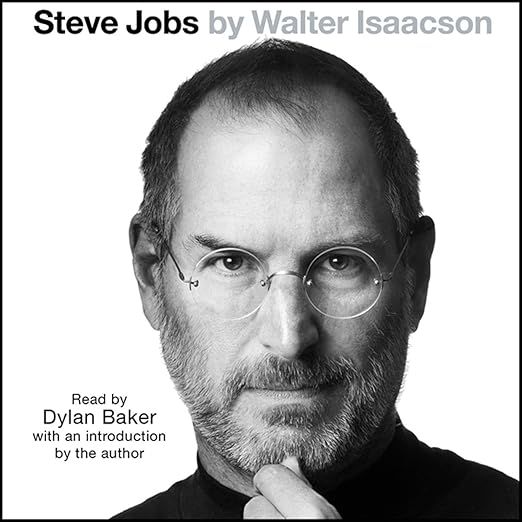
Walter Isaacson’s biography of Apple’s cofounder is, at twenty-five hours and eighteen minutes, the kind of audiobook that reorganizes your listening schedule for a week. Published by Simon and Schuster Audio with Dylan Baker as narrator, this is the 2012 Audie Award finalist that drew on more than forty interviews with Jobs himself and over one hundred with his family, friends, rivals, and colleagues, all conducted without editorial interference from the subject.
Our Take on Steve Jobs
What Isaacson understood, and what the book delivers, is that Jobs’s personality and his products were not separate things. The integration of hardware and software that defined Apple’s philosophy reflected something genuine about how Jobs thought about the world: he could not tolerate the seam between vision and execution. The biography examines this with more psychological honesty than most authorized accounts allow, partly because Jobs himself apparently encouraged the people around him to speak without censorship. The portrait that results is instructive precisely because it is not flattering.
Jobs comes across as someone who drove people to despair and fury, who could be casually cruel and almost supernaturally compelling in the same hour. Isaacson does not smooth this into a story of a genius who was also occasionally difficult. The difficulty is structural to what Jobs achieved, and the book makes that case convincingly across twenty-five hours. It is not a hagiography, and that is its primary strength.
Why Listen to Steve Jobs
Dylan Baker handles a twenty-five-hour biography with the composure that the length demands. His narration is deliberate without being slow, and he differentiates between the interview-drawn voices and Isaacson’s own analysis without the kind of theatrical register shifts that can distract in long-form nonfiction. A reviewer who found Isaacson’s Einstein biography excellent preparation called this one equally captivating. Baker serves the text rather than competing with it, which over more than a day of listening time is the only approach that works.
The chronological structure, Jobs’s adoption and early life through the Apple I, the NeXT years, the Pixar chapter, the triumphant return and the iPhone era, gives the biography a narrative momentum that compensates for some of the sections that read more like business reporting. The Pixar chapters in particular are among the most revealing, partly because that story has been underreported relative to the Apple narrative most people know.
What to Watch For in Steve Jobs
The biography was published in 2011, which means it was written while Jobs’s legacy was still raw and his successors had barely begun their tenure. Some of the forward-looking assessments Isaacson makes or implies have not aged evenly. The book is a historical document as much as a biography, and listening to it now means you are occasionally reading tea leaves that you already know the outcome of. That is not a flaw in the book but a condition of its reading.
Listeners who come expecting a straightforward celebration of Silicon Valley innovation may be unsettled by how unflinching the book is about Jobs’s personal failures. The relationship with his daughter Lisa, the treatment of employees who displeased him, the capacity for what Jobs himself called the reality distortion field, Isaacson reports all of it without softening. For some listeners, this makes the book essential. For others, it is more than they signed up for.
Who Should Listen to Steve Jobs
This is essential listening for anyone working in technology, product design, or business leadership who wants to understand the personality behind the most influential consumer electronics company of the twenty-first century. It works equally well for people with no particular interest in Apple who want a serious study of how character and creative vision interact at the highest levels. The twenty-five-hour length is a genuine commitment, but it is the right length for the subject, shorter treatments of Jobs’s life invariably lose something important. Listeners who want a tight, selective portrait rather than comprehensive biography would be better served by shorter documentary treatments.
Frequently Asked Questions
Did Steve Jobs have any editorial control over Isaacson’s biography?
No. Jobs cooperated with the interviews and actively encouraged the people around him to speak honestly, but he requested no control over the content and put nothing off-limits. Isaacson’s account reflects that unusual access.
How does Dylan Baker handle the twenty-five-hour runtime?
Baker’s narration is measured and steady throughout. He avoids the theatrical register shifts that can make long nonfiction audiobooks exhausting, and his ability to differentiate between interview-sourced voices and Isaacson’s analysis is consistent over the full runtime.
Is this biography balanced or does it read as a celebration of Jobs?
It is more balanced than most tech biographies. Isaacson reports Jobs’s cruelty, his failures as a father, and the human cost of his management style with the same directness he brings to the innovation narrative. The book is instructive precisely because it is not flattering.
Does the 2011 publication date make the biography feel outdated?
In some respects. The forward-looking assessments Isaacson makes were written before the full arc of the post-Jobs Apple era. Listeners today will occasionally know how the stories he describes played out, which adds a retrospective dimension rather than an anticipatory one.