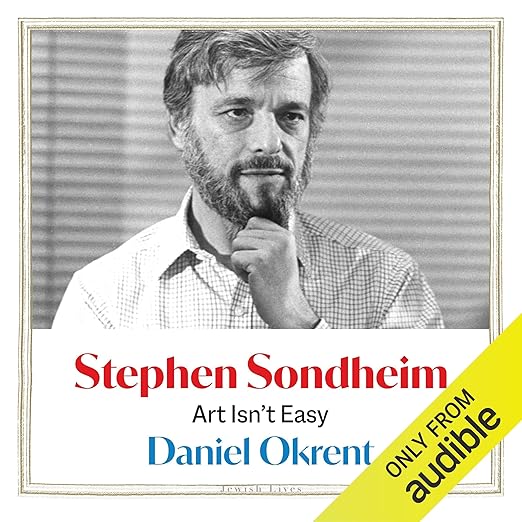
Biography usually announces itself with a subtitle. This one carries none: the title field on this audiobook reads Stephen Sondheim and stops, which is exactly the string a shopper types when they want a cast recording, a lyric collection, or somebody else's book about the same man. Daniel Okrent's account runs eight hours and twenty-one minutes, arrived from Blackstone Publishing in March 2026, and takes on a life that spanned 1930 to 2021 and a catalog holding Company, Sweeney Todd and Into the Woods.
Ninety-One Years Compressed Into Two Arcs
Eight hours and twenty-one minutes is a deliberate choice rather than an accident of the material. Ninety-one years, eight Tony Awards, a Pulitzer, an Academy Award and a run of shows that reset what a Broadway score could carry, folded into roughly five hundred minutes of listening, works out at a little over five minutes for every year lived. Nobody writes a definitive life at that length. What arrives instead is an argument, and the copy states it plainly: two parallel arcs, alienation to connection and ambivalence to resolution.
One Name Listed as Author and Narrator
The reader slot repeats the byline exactly. Okrent is listed as author and as narrator, which would make this an author-read edition, and nothing else on the page confirms that reading. That arrangement is common enough in nonfiction, and it is also exactly what a listing looks like when one field has been copied from the line above it. A sample settles the question in ten seconds. The record does not settle it at all.
That missing subtitle costs more than it appears to. Search for the man and you get the man; search for the book and you already need the author's name, which assumes you knew a book existed. Blackstone put this out on March 17, 2026, and in the months since, a title about a Pulitzer winner has attracted neither a grade nor a written line. Discovery rather than quality is the likeliest reading of that silence.
An Oral History Closed Until His Death
Access is what separates this from the shelf of Sondheim books already in print. Okrent worked from correspondence, naming Hal Prince, Leonard Bernstein and Arthur Laurents among the letter writers, from interviews with collaborators including James Lapine and John Weidman, and from Sondheim's own oral history, which stayed closed until his death. The last of those is the one that counts. An oral history is a subject talking about himself at length, unpoliced by a publicist, and no earlier biographer had it to work from.
Reopening the Letter From Sondheim's Mother
He also reopens the letter. The description calls it infamous, which is its way of conceding that the story is already familiar: a note from Sondheim's mother that left him believing she regretted his birth. Okrent promises a previously unknown and, in the copy's own word, crucial aspect of it. Whether that reframes the anecdote or simply dates it, the page declines to say, but it is the one specific new claim on offer and it is fair to hold the book to it.
Reading a lyricist aloud is the real case for choosing this format. The method here, by the description's account, treats the music and the lyrics as expressions of the inner man, and lyrics are built to be heard rather than scanned. A voice can put the pause exactly where Sondheim put it, and a page cannot. Whether any of the songs themselves appear on the file is not stated anywhere, which is the single most useful thing a listing for a musical theater biography could clarify.
No Music, but a Full Psychological Case
Assume no music until you hear otherwise. Nothing in the description, the runtime or the credits suggests that a recording, a performance or a sung excerpt has been included, and an eight-hour life of a composer that never lets you hear a bar of the work asks a great deal of your memory. If you cannot summon those scores unaided, keep a way to play them alongside the file.
Darker inventory is handled openly by the copy: a childhood shaped by his parents' divorce, wavering self-confidence, alcoholism. That material is the spine of the book rather than a footnote to it, and a listener arriving for backstage anecdotes about how Company came together will meet a psychological argument instead. The shows function as evidence in that case, not as the case itself.
Familiarity Assumed, and Beloved Oversold
Familiarity is assumed throughout. Company, Sweeney Todd and Into the Woods are named without explanation, as though their plots were already in the room; Hal Prince, Arthur Laurents, James Lapine and John Weidman arrive as names rather than introductions. For the audience this book wants, that is the right call. It does leave a newcomer starting two steps back, with no glossary and no easy way to flip to a cast list mid-chapter.
One stretch of the page deserves a skeptical ear. The description opens on a revelatory look at the complex inner world of one of the twentieth century's most beloved theatrical composers, which is jacket language doing jacket work. Beloved is not the adjective most arguments about this composer reach for, and a complex inner world describes roughly every biography ever published. Judge the book by the specific claims further down instead.
Emotional Weather Over Opening-Night Stories
Following a career through its emotional weather rather than its opening nights is what this offers, and it suits the listener who already knows the shows and wants the man behind them. Theater people, readers of the letters-and-archives school of biography, and anyone who has ever argued about whether Sondheim was cold will find that argument taken seriously and answered at length. Eight hours is a short haul for a life, and a merciful one for a subject this internal.
Pass on it if you came for making-of stories, rehearsal room warfare and out-of-town disasters, because the description points somewhere else entirely. The same goes if you need the music present rather than described. The reading credit is worth checking with your ears rather than your eyes, since the page prints one name in two places and offers no way to tell a production decision from a copied field.
Questions Listeners Ask
Does the author narrate the Stephen Sondheim audiobook?
Both the byline and the narration field read Daniel Okrent. That pairing usually signals a writer voicing his own work, and no other field on the record backs it up, so treat the reading credit as unconfirmed and let a sample tell you who is actually speaking across those eight hours.
How long does it run, and when was it published?
Eight hours and twenty-one minutes, released by Blackstone Publishing on March 17, 2026. For a life running from 1930 to 2021 that is a compressed treatment, closer in shape to a long interpretive essay than to the multi-volume theatrical biographies this subject usually attracts.
Are any of the songs included in the audiobook?
The listing does not say. No music is mentioned in the description, no bonus material is listed, and the runtime is consistent with straight narration. Plan on hearing lyrics discussed rather than performed, and keep the scores within reach if you want to follow the analysis closely.
Which sources does the book draw on that earlier accounts could not?
Three streams, by the publisher's account: private letters exchanged with Broadway figures including Prince, Bernstein and Laurents; fresh conversations with collaborators such as Lapine and Weidman; and the subject's own recorded oral history, kept under seal until 2021. That last source is the access claim the whole book rests on.