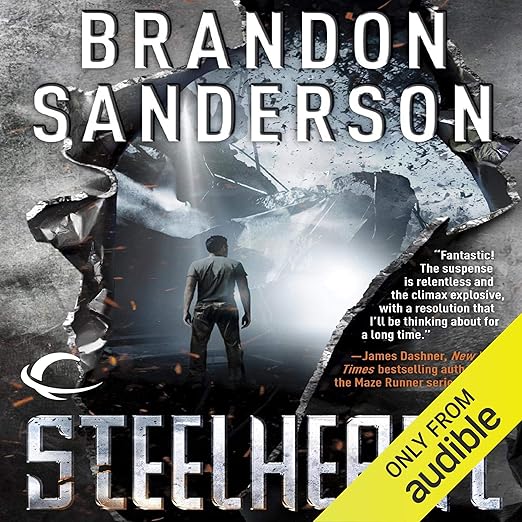
Steelheart earns its reputation as one of Brandon Sanderson's most propulsive audiobooks, and it does so in the first twenty minutes. MacLeod Andrews narrates with a relentless forward energy that matches the novel's premise: a world ten years after an event called Calamity gave ordinary people extraordinary powers, and those powers made every single one of them a tyrant. Ordinary humans called Reckoners study Epics, find their weaknesses, and kill them. Teenage David wants in, because Steelheart, the most powerful Epic alive, killed his father. And David has seen something no one else has: Steelheart bleed.
That hook is clean, fast, and earned. Sanderson knows how to build a system, and the rules governing Epics, their weaknesses, their hierarchies, walk a line between superhero fiction and post-apocalyptic thriller that this audiobook navigates with genuine confidence. As one reviewer put it, Sanderson 'walks the line of YA/Adult' here, and that observation is accurate. The violence is real, the stakes are adult, but the protagonist's voice has the earnest urgency of someone who has spent years planning a moment he is not sure he will survive.
Steelheart's Absence and David's Awkward Charm
What Sanderson does brilliantly in this opening Reckoners volume is make the Epics feel genuinely frightening without reducing them to cartoon villains. Steelheart himself barely appears in the book, yet he dominates every scene through his absence and his architecture. He has literally rebuilt Newcago, the former Chicago, in steel, and this visual conceit gives the audiobook a striking, consistent image of what absolute power does to a city and to the people who live beneath it.
David's character is where some readers have expressed mild reservations. His metaphor-making is a running gag that the book leans on hard, and Sanderson clearly enjoys the joke. Listened to rather than read, these moments depend heavily on Andrews' delivery, and he commits to them with a slightly exasperated timing that saves the bit from overstaying its welcome. David is not a cool protagonist. He is obsessive, awkward, and occasionally embarrassing. For the right listener, this is the point. The character's earnestness is what distinguishes him in a genre populated by protagonists who are accidentally exceptional; David is the person who became exceptional through years of grinding, solitary obsession.
MacLeod Andrews Anchors a Lean Sanderson Entry Point
MacLeod Andrews is an excellent choice for this material. His reading of David carries an undercurrent of controlled desperation, a young man who has rehearsed his revenge scenario so many times it has calcified into something close to faith. The Reckoners ensemble, including the coolly competent Prof and the sharp-tongued Megan, get differentiated vocal treatment that makes the group dynamics legible even at the audiobook's pace.
At just under thirteen hours, Steelheart sits at a comfortable mid-length for a fantasy audiobook. It does not sprawl. Sanderson keeps the action moving and the reveals coming at a consistent clip. The climactic sequence, in which the Reckoners finally move against Steelheart himself, builds with genuine structural tension. Even if you have read the book before, hearing Andrews deliver the final act carries momentum that rewards the investment of the earlier hours.
For fans of Sanderson's other work, Steelheart is deliberately leaner than the Mistborn trilogy or The Way of Kings. The worldbuilding is more focused, the magic system more constrained, and the thematic canvas smaller. A reviewer who loved Elantris and Way of Kings called this 'more of the same' but meant it affectionately: the story flow is familiar because Sanderson's structural control is consistent. For listeners new to Sanderson, this is arguably the best entry point because the premise is immediately graspable and the payoffs arrive quickly.
This Mystery Rewards Listeners Who Cannot Flip Back
The book's central mystery, the nature of Steelheart's weakness, is the structural spine of the entire first act. Sanderson plants clues early, and the audiobook format has an interesting effect here: it is harder to flip back and re-examine earlier scenes, which means the reveal lands with more surprise for first-time listeners than it might for readers. Andrews' voice work in those payoff moments benefits from this forward momentum.
One thing to prepare for is the book's deliberate setup function within a series. Steelheart resolves its central conflict fully, but it also establishes characters and a world that the sequels Firefight and Calamity develop further. Listeners who go in expecting a completely self-contained experience will find the ending satisfying but may notice the connective tissue pointing toward what comes next. This is not a flaw so much as a design choice that becomes clearer in retrospect.
The alternate history version of Chicago Sanderson builds is evocative enough to sustain the book's running time. Steel streets, steel buildings, underground tunnels where humans hide from Epics who patrol overhead: it is a specific and imaginative cityscape that Andrews' narration keeps vivid throughout. The world functions as a character in its own right, a city shaped entirely by the personality of the man who conquered it.
Action Fans Enter Here Without a Doorstopper Commitment
This audiobook is well suited to listeners who enjoy action-driven fantasy with a clean internal logic, teens and adults alike who want something with genre energy but without the density of epic fantasy doorstoppers. Fans of superhero fiction who want a version where the superheroes are the villains will find this premise immediately satisfying. Skip it if you need morally complex protagonists or slow-burn character development as your primary draw; David is earnest and mission-focused, and the book does not linger. For anyone looking to enter the Sanderson catalog without committing to a 700-page opener, this is the right place to start.
A Few Questions About Steelheart
Is this audiobook suitable for younger teen listeners, or is the content too mature?
Steelheart is marketed as young adult but pushes toward the upper edge of that category. The action includes significant violence and themes of loss and revenge. Most reviewers suggest it is suitable for teens 13 and up, with the content leaning more adult than many YA titles.
Do I need to read other Brandon Sanderson books before this audiobook?
No. Steelheart is set in its own standalone universe, separate from the Cosmere. You can begin this audiobook with no prior knowledge of Sanderson's other work, though fans of Mistborn and Way of Kings will recognize his structural fingerprints immediately.
How does the audiobook handle the novel's running joke about David's bad metaphors?
MacLeod Andrews plays the metaphor gag with a slightly deadpan exasperation that makes it land better in audio than it might seem on the page. The timing works, and the joke does not wear out its welcome before the book moves past it.
Is Steelheart a complete audiobook or does it end on a cliffhanger requiring the next installment?
The central conflict with Steelheart himself is fully resolved. The book has a satisfying standalone ending, though it also sets up the world and characters for the sequels Firefight and Calamity. It reads as complete rather than a truncated first act.