Quick Take
- Narration: Deepti Gupta brings the right authority and warmth to Razia’s voice, a performance that respects both the epic fantasy world-building and the intimate emotional stakes.
- Themes: Trans identity and self-determination, political intrigue, found community
- Mood: Immersive and propulsive with genuine emotional weight
- Verdict: A debut epic fantasy rooted in Mughal-inspired world-building that earns its emotional ambitions through specific, well-observed character work.
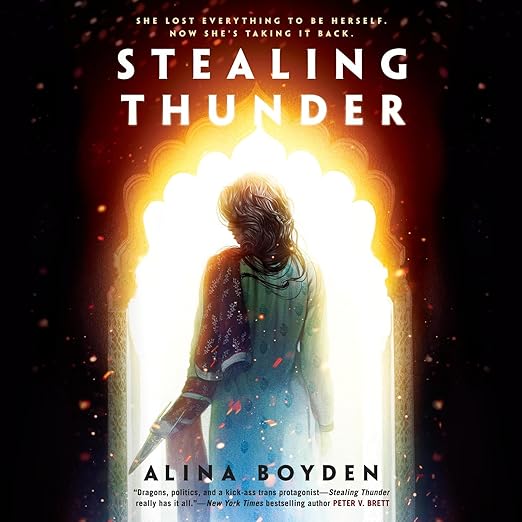
I started this one expecting to be mildly entertained and ended up finishing it in a single long stretch, which says something real about its pull. Alina Boyden’s debut draws on Mughal Empire history and the culture of the hijra community to build a world that feels neither generic nor over-explained. Razia Khan, raised as the Crown Prince of Nizam and now living as a dancer and thief among the hijras of Bikampur, is a protagonist whose situation is specific enough that the political stakes feel genuinely personal rather than abstract. That specificity is what separates Stealing Thunder from a lot of fantasy fiction that gestures at identity without grounding it in the material realities of a character’s daily life and relationships.
The plot mechanics, stolen item, crossed paths with a prince, political entanglement, are familiar enough that Boyden can concentrate on what she actually cares about, which is the texture of Razia’s life and the community she has built among the hijra dera. The romance between Razia and Prince Arjun Agnivansha develops without being rushed, and the political war that surrounds it gives the relationship real consequences rather than just backdrop tension. One reviewer noted that the zahhaks, the dragon-like creatures native to this world, were a particular delight, and that tracks: Boyden uses them not as decoration but as a functioning part of the world’s power structures and its social hierarchies, which is the mark of a writer thinking systemically about her world rather than just dressing it.
Our Take on Stealing Thunder
Deepti Gupta’s narration is a genuine asset here. She handles the range of the material, from the delicacy of Razia’s personal history to the momentum of the action sequences, with composure and skill. The world-building is immersive without becoming a lecture; Boyden trusts her readers to absorb the context without stopping to explain every institution and custom. For listeners who have found other fantasy worlds too derivative of Western European medieval settings, this one will feel like a genuine change of scenery, brought to life by a narrator who clearly understands the cultural specificity of the world Boyden is building and voices it accordingly.
Why Listen to Stealing Thunder
The book earns its emotional moments because it has done the work of establishing who Razia is before asking the reader to care about what happens to her. Her relationship with her father, the source of her original flight from Nizam, is not presented as backstory but as a living wound that shapes her choices throughout the narrative. The climax, which brings her face to face with that history and everything she lost and left behind, lands because of this careful groundwork. One reviewer who went in skeptical about the trans protagonist framing ended up finishing in under twenty-four hours, which is the kind of testimony that cuts through the noise. Another found it just as enthralling on a second reading, pulled back in despite already knowing how it ends.
What to Watch For in Stealing Thunder
The pacing is strongest in the first two-thirds. Some readers have found the political machinations in the final stretch harder to track, where the number of factions and their competing interests can blur. Listeners who want their fantasy politics spelled out clearly may need to pay closer attention here than the narrative always makes comfortable. The romance also develops quickly for a fantasy of this scope, which works for some and feels accelerated for others. These are minor complaints against a debut that succeeds at the things that matter most to the kind of reader it is written for.
Who Should Listen to Stealing Thunder
Readers who enjoy N.K. Jemisin or Foz Meadows, writers who bring real anthropological care to their world-building and centre marginalized perspectives without making the book feel like a political argument, will find Boyden a natural fit. Those who require extensive hard magic systems or military strategy detail may find the book’s priorities elsewhere than their own. Listeners new to the sub-genre of non-Western-inspired epic fantasy will find this a strong and emotionally rewarding entry point, with a protagonist whose story earns its resolution and deserves whatever comes next in the series.
Frequently Asked Questions
Does the trans identity theme feel integrated into the story or treated as a separate issue?
It is thoroughly integrated. Razia’s identity shapes her relationships, her political vulnerability, and the specific form her courage takes. The book does not treat transness as a lesson to be delivered but as one of many facts about who Razia is.
Is Stealing Thunder the start of a series, and does this first book stand on its own?
It is the beginning of a series. The first book resolves its central conflict satisfyingly while leaving room for what follows. It functions as a complete story, though the world clearly has more to offer.
How does Deepti Gupta handle the South Asian linguistic and cultural elements in the narration?
Gupta brings an ease and authority to the names, titles, and cultural details that a narrator unfamiliar with the material would struggle to replicate. Her performance suggests genuine familiarity with the world Boyden is building.
Are the dragon-like zahhaks a significant part of the story or mostly background?
They are genuinely significant. The zahhaks function as military assets, symbols of status, and objects of affection, and Boyden uses them as part of the world’s power structures rather than just as visual spectacle.