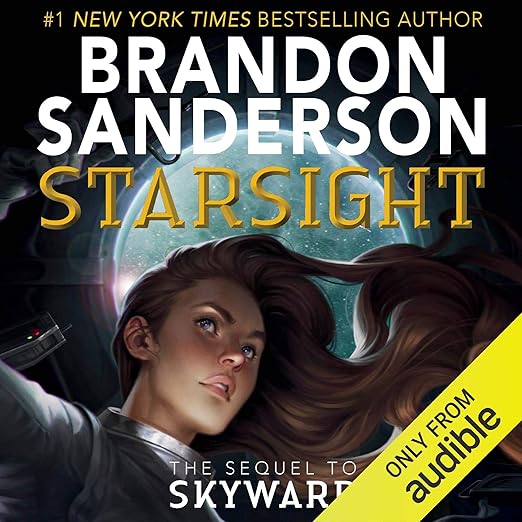
Three pull quotes close the description on this record, and all three of them praise a book that is not this one. Kirkus is quoted calling it a "nonstop, highflying opener." Publishers Weekly is quoted on "this action-packed trilogy opener." Starsight sits at number two in the Skyward series, which means the audiobook you are weighing up arrives wearing the notices its predecessor earned. Publishers do this constantly and it is not deception, but it does mean the quoted praise tells you nothing about the 14 hours and 30 minutes actually on offer, and a buyer who reads those lines as a verdict on the sequel has been pointed at the wrong book.
Spensa's Father, a Lie, and the Sound of Stars
Spensa's problem is stated without any softening. Her father deserted his flight during the battle against the Krell and then turned on his own team, and she has decided the record cannot be left where the rumors left it. The description adds that when she made it past the protective shell around her planet she heard the stars, and that the sound of them terrified her. Those two threads, a family disgrace she refuses to accept and a noise nobody else seems to hear, are what the second volume is built to pay off, and the copy is honest enough to say that everything she has been taught is a lie.
How much of book one you need is a fair question, and the entry headed Outstanding! answers it better than the sales copy does. That response picks up six months after the first novel closes, with the human prison planet of Detritus still standing after the bombing attempt, and it explains that the enemy turned out to be a conglomeration of species answering to something called the Superiority. If none of that is familiar, the opening hours will feel like a briefing you arrived late for, and the story does not stop to catch you up.
Suzy Jackson Narrates Solo for a Widening Cast
Suzy Jackson takes the sole narrator credit here, for a book whose cast expands steadily as Spensa moves outward from everything she knows. Audible Studios released the recording on November 26, 2019, and it is shelved under teen and young adult with a Literature and Fiction tag, the placement Sanderson tends to get when a book is written for younger readers and bought by everyone else as well. Nothing else comes attached: no cast list, no extras, no content note.
Leaving Detritus Turns a War Story Political
Scale is the honest selling point. One five-star, headed Spensa Takes To The Stars, calls this the author's "best non-Cosmere work" and puts a finger on why: "now that the world has opened up a little bit" the writing has room it never had inside a single besieged cavern. The same response argues that Sanderson turns to these books to stay fresh between the larger projects, and that the enjoyment of writing them comes through on the page.
Anyone who found the first book claustrophobic will feel the difference within an hour. Detritus was a hole in the ground with a sky full of enemies above it, and the tactical problem was always local. This one leaves the planet, which turns a war story into a story about who is running the war and what they want from it, and the description's promise that Spensa will travel to the end of the galaxy if she needs to gets met in the literal sense rather than the figurative one.
SLJ is quoted describing a "cinematic adventure" that weighs the individual against the society, and as a summary of the shape that holds up. The extra length gives the political material room to breathe without stalling the flying, and the flying is still the thing this series does better than almost anything else aimed at this age group. If you want space opera that keeps moving while it thinks, the recommendation is uncomplicated.
Nineteen Ratings and a Recurring Disorientation Complaint
Disorientation is the recurring complaint, and it is worth taking seriously. A four-star headed Answers and lots of questions describes the new setting as "crawling through, blind in the dark," with a great deal happening and very little of it explained while it happens. The same response still calls the story captivating and singles out the kitsune as a favorite, so this is frustration from somebody enjoying themselves rather than a dismissal, but a listener who cannot rewind easily should know that going in.
Nineteen ratings is a slight badge for an author the copy introduces as a number-one bestseller, and only five written responses sit underneath it. Two of those five were filed outside the United States, one of them written in Italian, which is worth knowing before you read the 4.7 as a settled verdict from English-language listeners. The written grades themselves run from four stars to five with nothing lower, so the sample is consistent, just very small.
Which brings us back to those cover quotes. An opener, a trilogy opener, a starred notice for a debut: none of that was written about this volume, and the SLJ line about fans not being disappointed is the only one that survives the move to a second book intact. Read them as advertising for the series rather than as evidence about the sequel and you will not be misled, which is more than can be said for a buyer skimming the page in a hurry.
Newcomers Should Sample Book One Before This Sequel
Series readers who finished Skyward and want the story to get bigger should go straight in. Newcomers should not, because the sequel assumes the Krell, the Superiority and the exact shape of Spensa's inherited disgrace, and the description assumes them too. A four-star filed from the Netherlands in July 2023 calls this "less emotional than the first book" while praising the politics and the science, which tells you what the trade actually is: feeling gives way to worldbuilding, and the ratio shifts hard.
Listeners who want their science fiction engineered rather than hand-waved get real value here, since the detail is dense enough to read as researched rather than gestured at. Anyone hoping for the cavern-level intimacy of the first book will find less of it, and anyone who needs a plot explained while it unfolds should sample the first hour before committing. Book one first, always, and then this one with a clear run at it.
At a Glance
- Narration: One voice for a story that keeps adding species, ships and political factions, and no cast is credited beside Suzy Jackson.
- Themes: A father's disgrace, alien politics and first contact, coming of age inside a war
- Mood: Propulsive, and steadily widening in scope
- Verdict: Excellent second volume if you have read Skyward, and close to impenetrable if you have not.
Frequently Asked Questions
Do I need to hear Skyward before this audiobook?
Yes. The description opens by calling it the sequel, and it assumes you already know what the Krell are, what Spensa learned about her father, and why leaving the planet matters at all. Skyward is named in the series field with this volume numbered two, and no recap, prologue or catch-up note appears on the record.
Who is credited on the audiobook, and how long does it run?
Suzy Jackson is credited as the only reader, across 14 hours and 30 minutes, with Audible Studios releasing it on November 26, 2019. No full cast, no bonus content and no companion material are listed in any field, so the purchase is one voice across a single long recording.