Quick Take
- Narration: Barry Fike delivers a clean, accessible reading that matches the book’s intent to demystify rather than intimidate, a measured pace that suits first-time database learners.
- Themes: SQL fundamentals for career changers, database literacy, data analysis workflow
- Mood: Encouraging and practical, like a well-organized online course
- Verdict: A solid entry-level SQL overview with a useful PDF companion, best suited to career changers and beginners who want orientation before committing to more technical resources.
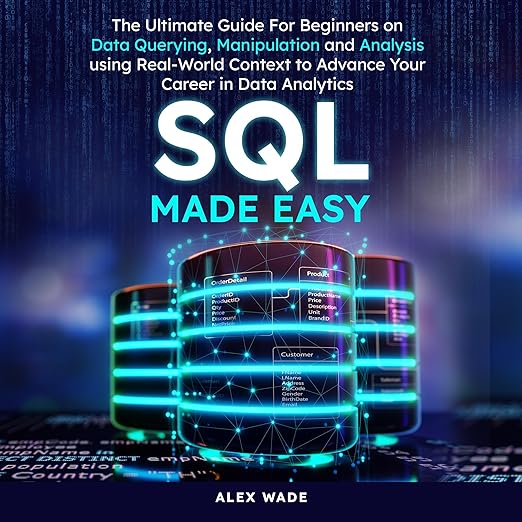
I spent a Tuesday evening going through the SQL Made Easy PDF companion after listening to the first three chapters on my walk home. I’d been curious about the audiobook partly because SQL guides are genuinely hard to produce well in audio format, the gap between listening to someone explain a SELECT statement and actually writing one is enormous, and I wanted to see how Alex Wade had navigated that tension. The answer, it turns out, is through careful audience selection. This book knows exactly who it’s for, and it doesn’t try to be anything else.
The target listener is someone considering a move into data analysis who hasn’t yet committed to any particular technical path. Wade begins by making the case for SQL’s continued relevance, which might seem like preaching to the converted, but the argument is actually more pointed than it appears. In a landscape where Python and R get most of the beginner attention, Wade positions SQL as the foundational layer that every data professional needs regardless of which other tools they use. The framing works because it’s accurate: SQL remains the query language of choice at Netflix, Facebook, Amazon, and essentially every other company with a serious data infrastructure.
The History That Opens the Book
Reviewers consistently single out the opening chapters on SQL’s history as the book’s most engaging section, and I agree with that assessment. Wade traces the development of relational database theory from E.F. Codd’s original 1970 paper through the commercial development of SQL as a standard, and the narrative grounds the technical content that follows in a way that most programming books skip entirely. Understanding why SQL was designed to express what rather than how gives you a genuine mental model for thinking about queries rather than just memorizing syntax. This is the kind of framing that the best technical educators provide and that textbooks frequently omit.
Barry Fike’s narration carries this section well. He has a calm, measured delivery that signals this is accessible rather than intimidating material, and he maintains that register even when the content becomes more technically dense in the later chapters.
From Basics to Intermediate Without Losing the Thread
The book’s structural arc moves from SQL history through basic commands, dialect selection, and database setup, into intermediate techniques including subqueries, window functions, and performance optimization. Wade covers this ground efficiently without the false simplicity that plagues some introductory tech books, which promise easy mastery and then leave you facing a real-world query with none of the tools to write it.
The chapter on SQL dialects is noted by at least one reviewer as particularly interesting, and it addresses a genuine pain point for beginners: SQL is not one language but a family of related dialects including MySQL, PostgreSQL, SQLite, Microsoft SQL Server, and BigQuery, each with meaningful differences in syntax and functionality. Wade explains how to choose the right dialect for your context, which is exactly the kind of practical orientation a career changer needs before committing to a learning path.
The PDF Companion and What It Contains
The accompanying PDF is included with this Audible title and contains the code examples, cheat sheets, and reference materials referenced in the audio. For SQL Made Easy, this companion is genuinely useful rather than supplementary. Following along with SQL syntax while listening is significantly more effective than trying to hold query structures in working memory. One reviewer spent time with both formats across a two-week learning period, using the audio for conceptual orientation and the PDF for reference. That’s probably the optimal approach for anyone using this as a genuine study resource rather than background listening.
Who Should Listen, Who Should Skip
SQL Made Easy is well matched to career changers, non-technical professionals who need to understand data workflows, and beginners who want conceptual grounding before committing to a more technical course or textbook. The coverage through intermediate techniques means it has more range than a pure introductory guide, though experienced data analysts will find it covers familiar ground. At four hours and thirteen minutes, the runtime is appropriate for the scope, this is a starting point, not a comprehensive reference, and it doesn’t overstate its own ambitions.
Frequently Asked Questions
Does SQL Made Easy include hands-on exercises, or is it purely explanatory?
The synopsis mentions exercises, cheat sheets, and resources, and the PDF companion contains practical reference materials. The audio component is primarily conceptual and explanatory, you won’t be writing queries while listening. The intended workflow is to use the audio for orientation and the PDF for hands-on practice. Listeners serious about learning SQL will need a database environment to actually practice the techniques described.
Which SQL dialect does the book focus on?
Wade covers multiple dialects and includes a section on how to choose between them based on your use case. The book doesn’t commit exclusively to one dialect, a deliberate choice given that beginners often don’t yet know which environment they’ll be working in. The fundamentals covered apply across MySQL, PostgreSQL, and the major commercial databases, with notes on where dialects diverge.
Is this book appropriate for someone with no prior programming experience?
Yes, Wade explicitly addresses this in the synopsis, positioning SQL as accessible to people without a programming background. The book’s opening sections assume no prior technical knowledge and build from database fundamentals before introducing query syntax. Multiple reviewers confirm it works as a genuine beginner resource. That said, total beginners will benefit from also doing hands-on practice in a free SQL environment to reinforce what they hear.
How does SQL Made Easy position SQL against Python and R for data analysis?
Wade makes an explicit argument for SQL’s continued primacy over Python and R in certain analytical contexts, particularly for data retrieval, transformation, and aggregation at scale. The book frames SQL not as a competitor to Python but as a prerequisite layer, the ability to get data out of databases cleanly is necessary before any Python analysis can happen. This framing reflects mainstream industry practice at data-heavy companies.