Quick Take
- Narration: Barry Fike narrates competently, but no narrator can compensate for source material that reviewers describe as circular and example-free
- Themes: SQL fundamentals, data analytics for business, statistical analysis concepts
- Mood: Aspirationally accessible but ultimately frustrating, the promise exceeds the delivery
- Verdict: Multiple critical reviews identify the same core problem: the book describes SQL’s importance at length without demonstrating it through concrete code or business examples. Proceed with caution.
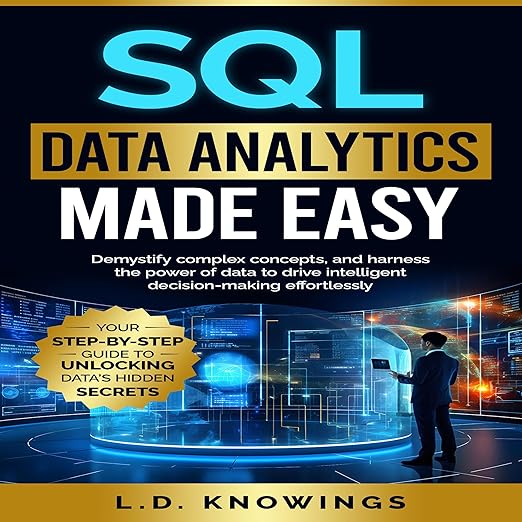
I want to give SQL Data Analytics Made Easy a fair hearing, because the topic is genuinely important and the audience it claims to serve, people who want to move from data overwhelm to data confidence using SQL, is real and underserved. Barry Fike narrates with professional competence. The production quality is unremarkable in the best way. None of this is the problem.
The problem is what multiple independent reviewers, writing separately and with clear frustration, have identified about the content itself. Scott Fletcher’s review calls it a masterwork of saying the same thing a hundred different ways without any concrete SQL code or business use cases. Larry Silverstein notes that the positive reviews appeared in a suspicious cluster over three days and all sound similar, then describes the actual content as a few decent examples buried in pages of repetition. Nathan N calls it outright fraud for presenting itself as SQL instruction while containing almost no actual SQL. That is a meaningful signal, and I would be doing readers a disservice to underweight it.
What the Book Promises and What It Delivers
The synopsis is ambitious. L.D. Knowings claims the guide covers foundational principles of data analytics, hands-on exercises, data cleaning and integration techniques, advanced SQL queries for extracting meaningful insights, statistical analyses including hypothesis testing and regression, and data visualization from SQL outputs. For a four-hour-and-twenty-four-minute audiobook, delivering all of that at any useful depth would require very efficient pacing. The critical reviewers suggest the book does not deliver on any of these specific promises at a practical level.
The distinction between conceptual framing and technical instruction is crucial here. A book can explain what hypothesis testing is, what regression analysis does, what data cleaning means, and what SQL queries accomplish without ever showing you how to write a SELECT statement with a WHERE clause, how to join two tables, or how to construct a GROUP BY aggregation. If the book stops at the definitional level for every topic, it is an orientation to terminology rather than a guide to practice.
A Note on the Review Ecosystem
Silverstein’s observation about the suspicious review cluster is worth examining directly. Several five-star reviews for this title appeared within a very short window and read with similar cadence and vocabulary. This is a documented pattern in the self-published and independent audiobook space, and it affects the reliability of the aggregate 4.1 star rating. When the only substantive negative reviews come from listeners who clearly engaged seriously with the content and all point to the same structural absence, the critical reviews carry more diagnostic weight than the rating average might suggest.
This is not an accusation. It is a reason to read the critical reviews carefully before purchasing, because the gap between the positive rating aggregate and the substance of the negative feedback is larger than it first appears.
Who the Audiobook Format Cannot Save
SQL is fundamentally a written language. Learning it requires seeing syntax, running queries, observing output, and making errors. Even the best SQL audiobooks face a structural challenge: code does not transfer well to audio. The most successful SQL audio courses supplement narration with companion materials, exercise files, and code examples in a companion PDF. There is no mention of a companion PDF or code examples for this title. In the absence of those supplements, even well-executed SQL instruction becomes abstract in audio form.
Barry Fike cannot be blamed for this. He narrates what he is given, and he narrates it cleanly. The issue is that what he is given appears, based on the most credible reviewer feedback, to be a text that describes SQL without teaching it.
Who Should Listen and Who Should Skip
If you have exhausted your options for an accessible introduction to data analytics vocabulary and this title is free or heavily discounted, the conceptual framing may provide some orientation. Otherwise, the critical review pattern is consistent enough and specific enough that alternative resources, including the Learn SQL Quickly title also in this catalog, are likely to serve your learning goals better.
Skip if you want to actually write SQL. The reviews suggest the book does not give you the tools to do that, regardless of what the synopsis promises.
Frequently Asked Questions
Does SQL Data Analytics Made Easy include actual SQL code examples?
Based on the critical reviews, the book describes SQL concepts and their importance in business analytics but does not demonstrate the language through concrete code examples or step-by-step queries. Multiple reviewers specifically name this absence as the book’s central failure. There is no mention of a companion PDF with code samples.
How reliable is the 4.1-star rating for this title?
The rating should be viewed with some skepticism. One reviewer observes that several positive reviews appeared within a three-day window and share similar language and tone, suggesting possible review manipulation. The substantive critical reviews all identify the same specific content problem, which gives them more diagnostic weight than the aggregate rating might suggest.
How does SQL Data Analytics Made Easy compare to Learn SQL Quickly, also available in audio?
Learn SQL Quickly from Code Quickly appears to include practical MySQL setup instructions, database management system comparisons, and hands-on exercises. Its reviewers consistently describe it as practical and code-oriented. Based on the critical review evidence, SQL Data Analytics Made Easy is oriented more toward concept description than practical instruction. For learners who want to actually use SQL, the alternative appears stronger.
Is Barry Fike’s narration a positive element of this audiobook?
Fike narrates competently and professionally. The production quality is clean and the delivery is clear. The narrator is not the issue with this title. The critical feedback is directed exclusively at the source material’s lack of concrete examples and its repetitive structure, not at Fike’s performance.