Quick Take
- Narration: Julie Brierley is a polished and intelligent reader whose pacing works well for tutorial-style content, though the audio-only format creates real limitations for code-heavy chapters.
- Themes: Java enterprise development, reactive programming, Spring Boot architecture
- Mood: Thorough and methodical, like a good university course taught by someone who genuinely enjoys the subject
- Verdict: Craig Walls remains the most readable guide to Spring in print, and the audio edition, with its companion PDF, works better than most Java books have any right to in this format.
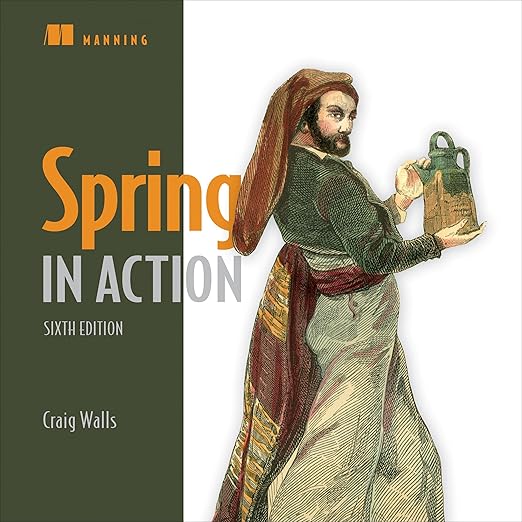
I came to this one with some prior familiarity with the Spring ecosystem, enough to have strong opinions about dependency injection and enough experience to appreciate what the framework actually saves you from having to write by hand. I finished it over the course of about two weeks, working through it in evening sessions after finishing whatever else I’d been listening to that day. The sixth edition covers Spring 5.3 and Spring Boot 2.4, and it remains, as it has across multiple editions, the clearest available introduction to a framework that is powerful precisely because of its accumulated complexity.
What Craig Walls has always done better than competing Spring texts is explain the “why” alongside the “how.” It is easy to write a Spring tutorial that shows you the annotations to apply and the XML (or, more recently, the Java configuration classes) to write. It is considerably harder to explain the inversion-of-control principle at a conceptual level, connect it to the dependency injection pattern, and then show how Spring’s ApplicationContext instantiates and wires beans in a way that makes the annotation-driven approach feel like a natural consequence rather than an arbitrary convention. Walls does this consistently, and it is what earns the book its reputation.
The Reactive Programming Chapters and Why They Matter
The sections that are genuinely new in the sixth edition, and which represent the most important structural shift in how Spring applications are built, are the reactive programming chapters. Spring’s Project Reactor and the WebFlux framework have changed how high-throughput applications are designed, and Walls explains the functional reactive programming model with patience. The distinction between imperative and reactive execution, why blocking threads under load creates bottlenecks that reactive streams avoid, is handled clearly and without the hand-waving that plagues many introductions to the reactive paradigm.
The RSocket coverage, which enables bidirectional streaming communication between services, is the section most likely to feel forward-looking to listeners who are primarily familiar with REST. Walls is careful to position RSocket as appropriate for specific use cases rather than as a universal replacement for HTTP, which is the kind of considered framing that prevents the book from reading like a framework marketing document.
The PDF Companion and the Audiobook’s Honest Limits
Audible’s note that a companion PDF is included in the purchase is not a minor footnote for this audiobook, it is functionally essential. Spring in Action is structured around a continuous example application that listeners build across the chapters, and the code samples that run through that example cannot be fully understood through audio alone. Walls reads code samples aloud in the narrative, and Julie Brierley handles them competently, but no amount of narration skill makes it natural to hear a Java class structure spoken as prose. The PDF companion means this audiobook works as a hybrid format: you listen for the conceptual explanation, then reference the PDF for the actual code.
For listeners willing to engage with it that way, the experience works. Brierley’s pacing is well-calibrated, she reads quickly enough to move through the material without making it feel like a lecture, but not so quickly that complex sentences about Spring Security configuration or Kubernetes integration blur into each other. Her voice has a quality of focused intelligence that suits a book where the reader is genuinely trying to explain something rather than simply recite it.
What 99 Ratings and Three Years of Reviews Tell You
The 4.1 average rating across 99 listeners is instructive. Listeners who approach the book as beginners consistently rate it highly, one review calls it “a gem” and praises the seamless transition from introduction to practical application. Listeners with more Spring experience tend to rate it slightly lower, noting that the coverage is not comprehensive across all areas (particularly for more advanced deployment patterns). That distribution tells you the book is doing exactly what it should: it is the right entry point for the framework, and it is not trying to be the only book a developer will ever need.
The listeners who will get the least value are those who buy the audiobook without being prepared to reference the PDF. For developers who work primarily with audio and would prefer not to read supplementary material, there are better choices in the technical audiobook catalog. For those who treat it as a hybrid resource, this is one of the better technical audiobooks available in the Java ecosystem.
Frequently Asked Questions
Is Spring in Action, Sixth Edition current enough to be useful, given that newer Spring versions have been released since Spring 5.3?
The book covers Spring 5.3 and Spring Boot 2.4. Core concepts around dependency injection, Spring MVC, and Spring Security remain applicable to later versions. Spring Boot 3.x introduced some breaking changes (particularly around Jakarta EE namespace migrations), so developers working on greenfield projects with the latest Spring Boot should supplement with current release notes.
Does this audiobook work without the companion PDF, or is the PDF essentially required?
The companion PDF is strongly recommended. Spring in Action is built around continuous code examples, and the audio narration of Java code samples is functional but difficult to follow without the visual reference. Treat the PDF as the primary code reference and the audio as the conceptual explanation layer.
How does Julie Brierley handle the code-heavy sections compared to the narrative explanations?
She reads code samples clearly and at an appropriate pace, but the inherent awkwardness of spoken Java is unavoidable. Her performance is noticeably stronger in the conceptual narrative sections, the reactive programming explanation chapters in particular benefit from her steady, intelligent delivery.
Is this suitable for a developer who knows Java well but has never used the Spring framework before?
Yes, this is exactly the target audience. Walls’ explanations assume Java competence but assume no prior Spring knowledge, and the progression from basic bean wiring through reactive streams and microservices deployment is well-sequenced for that starting point.