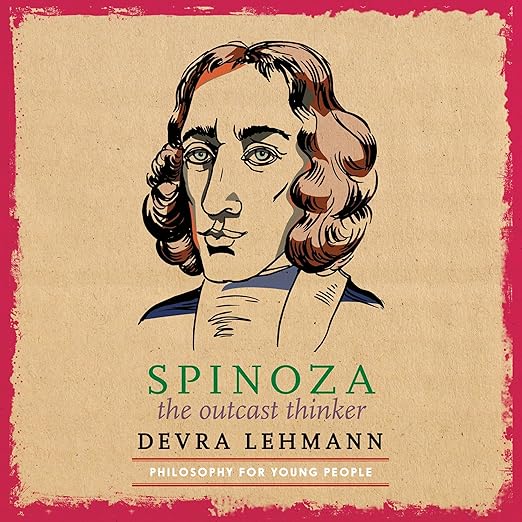
Bento Spinoza learned early to keep his ideas to himself, and the six hours of this audiobook are largely about what happened when he stopped. He was twenty-three when his own Jewish community in Amsterdam cast him out, cursed him, and erased him from its communal life, and the ideas that caused it went on spreading across Europe while he ground lenses for a living and refused to argue in public. Devra Lehmann tells that story for young readers, and the record files the result under teen listening. The written responses underneath it tell a different story about who is actually buying it.
The Review
Lehmann's framing is the reason this works at all. A philosopher whose positions arrive as propositions is close to unlistenable if a biographer simply recites them, so the book anchors each idea to the moment it cost him something: God as the sum total of nature rather than a father-figure watching over the world, the Bible as a book like any other rather than a text only religious authorities may interpret, religion as a commitment to basic moral behavior rather than a collection of rituals. Each of those sentences reads as a mild proposal now. In the Amsterdam he grew up in, each of them was an act with consequences, and the biography keeps those consequences attached to the sentence that caused them.
Amsterdam in the seventeenth century is the other thing the book gets right, and Nancy Smiler Levinson, writing in April 2019, puts a finger on why: the sweeping historical and philosophical background of Europe and its Jews in the period is doing as much work as the biography itself. That same response calls the book a crossover, marketed as young adult but written at a comfortable adult level, which is a compliment and also a warning about what the shelving tag will and will not tell you. A listener expecting a simplified life story will find something more demanding, and better, than that.
Why Spinoza Works as an Audiobook
Lens grinding is a detail the book returns to, and it is the sort of thing audio handles better than a page does. The simplest of lives, quietly devoted to optical work and to a search for truth carried on without an audience, is a rhythm rather than a plot, and a reading gives it duration in a way a chapter break cannot. Six hours is the right length for that: long enough to feel the years of deliberate quiet, short enough that the quiet never becomes the whole experience. The scandal keeps intruding, and the intrusions are what give the recording its shape.
Kirkus named this a Best Teen Book and starred its review of it, praising the clarity, the accessibility and what it called spot-on relevance to issues facing modern society. The book also took the National Jewish Book Award in the children's and young adult category. Those two credentials point at the same quality, which is that a book about freedom of thought, freedom of expression and freedom of religion has an obvious contemporary use and does not have to reach for it. Judi A. Felber, writing in November 2014 as a teacher, describes the book as a way to introduce students to a new way of thinking, which is exactly the classroom application those awards imply.
The Caveats
Subtitle trouble starts on the record itself. The title displays as one word, while the description twice calls the book Spinoza: The Outcast Thinker, so a buyer searching for the full title will not find this page and a buyer landing on it cannot tell which of the several available books called Spinoza this is. The series field is stocked with Philosophy for Young People but the series number is blank, even though the copy states twice that this is the second title in the run. Both problems are small and both are the sort that make an audio catalog hard to navigate.
Bennett carries the recording alone, and the material asks something specific of a single voice. A biography of this kind moves constantly between three registers: the historian's narration, Spinoza's own positions restated in his terms, and the language of the community that condemned him. On a page, quotation marks and indentation mark those handoffs. In audio the reader has to mark them with pace and pitch alone, and the whole argument of the book depends on a listener never confusing what Spinoza said with what his accusers said he said. That is the thing to test in the sample.
Categories are worth a second look before you buy this for a teenager. The record files it under teen and young adult with a biography tag, while four of the five entries beneath it come from adults describing their own reading rather than a young person's. Cyd G. Shaw, writing in January 2015, puts the position plainly: the book is geared to young adults, was still worth the time at fifty-two, and would make a good book club pick. Only the shortest response, headed Clearly written and filed in March 2025, says nothing at all about audience, noting instead that the ideas come through easily, which is difficult to manage with this particular philosopher.
Should You Listen to Spinoza?
Tolerance and benevolence are what the book says Spinoza spent his life trying to embody, and the audience it fits best is anyone who wants the origin story of ideas they already hold. Adults who want a first book on him will get a genuine one here rather than a children's summary; Paulo A. Reimann, writing in August 2018 after reading a number of other treatments, rates this the best of them. Teenagers reading for school will find the prose within reach. Anyone teaching the period gets a text that supplies the Amsterdam context without a separate assignment.
Outcast is the operative word for the skip list. Listeners who want Spinoza's arguments worked through in full, rather than his life with the arguments attached, should go to a philosophical commentary instead, because this book explains what he claimed and why it enraged people rather than how the reasoning holds up. Anyone allergic to the biographical mode will find the same limit. Taken as the story of a man who kept working through the curse, kept grinding lenses, and never once saw an idea of his win, it is hard to beat at this length.
Key Details
- Narration: Erin Bennett takes a text that constantly switches between a historian, a philosopher and his accusers, with nothing but pace to mark the handoffs.
- Themes: Freedom of thought and expression, excommunication, seventeenth-century Amsterdam, religious authority
- Mood: Calm and quietly furious
- Verdict: A genuinely good short life of Spinoza that adults should buy for themselves rather than only for a teenager.
Good to Know
Does the Spinoza audiobook explain his philosophy or only tell his life story?
Both, with the life carrying the ideas. The description names three positions outright: that God is the sum total of nature, that the Bible is a book like any other, and that religion means basic moral behavior. What you will not get is the reasoning worked through proposition by proposition.
Is the Spinoza audiobook marked as abridged anywhere?
No abridgment note appears anywhere on the record. The page gives a six-hour runtime, a Listening Library credit and an August 2023 release, and leaves the question unanswered. If a complete text matters to you, that is worth confirming with the publisher before buying rather than assuming from the runtime.
What awards did this biography win?
It won the National Jewish Book Award for Children's and Young Adult Literature and was named a Kirkus Reviews Best Teen Book. Kirkus also starred its review, praising the clarity and accessibility of the writing. Both citations come from the print edition rather than from this recording.