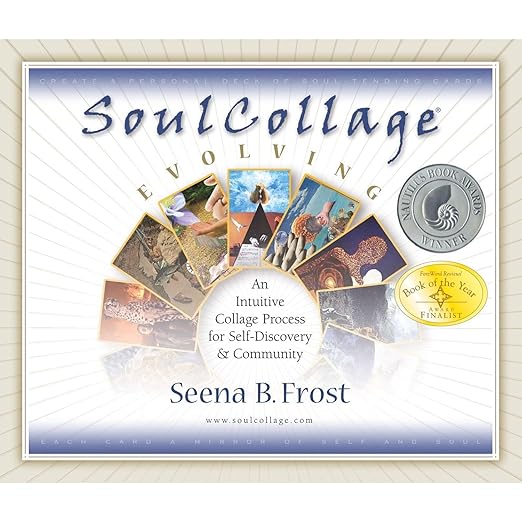
What question would you ask a homemade card built from a magazine clipping and a bit of glue? That is the exact practice at the center of this audiobook, Seena B. Frost's SoulCollage Evolving, a guide to a collage-based self-discovery method that asks almost nothing of its practitioners beyond scissors, pre-cut mat board, found images, and glue. Frost's original SoulCollage book, published in 2002 and now out of print, was a finalist for the Nautilus Book Award, and this newer volume expands the practice into group facilitation and a wider range of cultural and religious contexts.
Written by Seena B. Frost and narrated by Virtual Voice, this 6-hour-and-55-minute audiobook holds a 4.7 rating from 242 ratings. The narration is AI-generated rather than performed by a human reader, a fact worth knowing upfront for a book this dependent on tone and pacing.
Four Suits Structure the Whole SoulCollage Deck
The method itself is genuinely simple to describe: gather images, arrange and glue them onto pre-cut cards, then consult the finished cards later by asking them direct questions and listening for what intuitive answer surfaces. Reviewer lovetodream specifically praises how thoroughly the book explains the four suits that organize the card system, walking through each one in enough depth that a listener could realistically start building a deck without any other reference material.
What separates SoulCollage Evolving from a typical arts-and-crafts guide is how seriously it treats the practice as a tool for genuine self-inquiry rather than a decorative hobby. Reviewer Kathleen Schwab described it as an exploration of the inner world brought forward into consciousness, language that signals this sits closer to journaling or contemplative practice than to scrapbooking, even though the physical materials involved are nearly identical to either.
The synopsis is specific about how widely this method has been applied, across a genuinely broad range of socioeconomic, cultural, and religious contexts, and that breadth is part of what distinguishes SoulCollage from a narrower art-therapy technique tied to one particular tradition or demographic. Frost frames the process as adaptable by design rather than as a fixed system requiring a specific background to access.
Listeners new to the method are not missing anything essential by starting with this volume rather than hunting down Frost's earlier, harder-to-find original. Evolving stands on its own as a complete instructional text, walking through the practice from first principles rather than assuming a reader already owns the out-of-print predecessor.
Required Reading Before a Facilitators Course
Reviewer Stormdancer used this book as required preparation before attending a SoulCollage Facilitators course, which is a strong real-world signal of how directly practical the instructional content is. Listeners who want to actually run groups or teach the method, not just try it alone, get genuine grounding here rather than a surface-level introduction that leaves the harder facilitation questions unanswered.
The book's instructional structure means listeners can realistically act on what they hear rather than simply absorbing theory. Frost walks through the physical process step by step, and Kathleen Schwab's review specifically recommends both the book and the facilitator training that follows it, suggesting the content holds up as a genuine entry point into an ongoing practice rather than a one-time read with no lasting use.
The barrier to entry is genuinely low, which matters for anyone hesitant about committing to an expensive or specialized creative practice: nothing here requires a purchase beyond what most households already have in a junk drawer, closer in spirit to a structured journaling habit than to a fine-arts undertaking requiring skill or equipment most listeners do not already own.
Frost's standing as the method's actual founder matters here in a way it might not for a book merely explaining someone else's technique secondhand. She is describing decisions she made herself while developing SoulCollage over years of practice, and that originator's perspective gives even the more procedural instructional passages a lived-in authority a summarized or borrowed explanation would lack.
Synthetic Narration Strains the Meditative Passages
The Virtual Voice narration is worth weighing seriously before buying. A craft-instruction book like this depends on warmth and careful pacing, especially during the more meditative passages that guide listeners through asking their finished cards a question, and synthetic narration inherently strips some of the interpretive nuance a skilled human reader would bring to that kind of guided reflection.
This is also an inherently hands-on, visual, and tactile process, and audio alone cannot show a listener what a finished card actually looks like or demonstrate the physical technique of cutting and arranging images. Pairing this audiobook with Frost's original volume or another visual reference is close to necessary for anyone serious about actually building a deck rather than just understanding the concept.
Solo practitioners and group facilitators are likely to get different value from the same material, since a fair amount of the content anticipates group use and facilitator training specifically. Listeners who only want a personal, private practice should expect to filter some of the group-oriented instruction as not directly relevant to their own use case.
Because the book's core exercise involves consulting a finished card by asking it a direct question and listening for an intuitive answer, this works best for listeners already comfortable with open-ended, non-linear reflection rather than a step-by-step, single-right-answer framework. Those who prefer more structured, clinical self-help methods may find the intuitive language here takes some adjustment.
Made for Active Reflection During Life Transitions
Journaling and self-discovery practitioners, art-therapy-adjacent audiences, group leaders and facilitators-in-training, and anyone drawn to intuitive rather than purely analytical self-reflection tools will find real substance here. The four-suit card system in particular gives structure to what could otherwise feel like an unfocused creative exercise.
People navigating a specific life transition, a career change, a loss, or a major decision, are a particularly strong fit given how directly the synopsis frames the practice around asking important life questions of the cards themselves, a use case the book leans into far more than generic craft instruction typically would.
It is worth being clear about what this is not: SoulCollage Evolving is not a substitute for licensed art therapy or clinical mental health treatment, and the book itself frames the practice as an accessible, self-directed tool rather than a professional intervention. Listeners dealing with serious mental health concerns should treat this as a complement to, not a replacement for, professional support.
Anyone hoping for a passive, background-friendly listen should reconsider, since getting real value out of this means pausing to actually gather scissors and glue, and anyone who finds synthetic narration distracting in a book this intimate in subject matter would be wise to sample a clip before committing to the full purchase.
Is the SoulCollage Evolving audiobook narrated by a real person?
No, this audiobook uses Virtual Voice AI narration rather than a human reader, worth knowing given how much the practice depends on guided, reflective pacing.
Do I need art skills to follow this audiobook's SoulCollage method?
No. The process only requires scissors, pre-cut mat board, found images, and glue, and no prior artistic skill is assumed.
Does the SoulCollage Evolving audiobook replace the original out-of-print SoulCollage book?
It expands on it. Frost's original 2002 book is out of print, and this volume carries the practice forward into broader group and cultural contexts.