The Short Version
- Narrator: Henrietta Weekes brings a composed, sincere quality that suits the book's blend of holistic healing and emotional depth, she reads without irony, which the material requires.
- Subjects: The energetic bond between humans and animals, mirrored emotional wounds, co-healing through bioenergetic awareness
- Tone: Contemplative and spiritually oriented, gently challenging in how it asks readers to reconsider their pets' behavior
- Bottom line: A thoughtful, well-constructed guide for readers already open to energy healing and holistic frameworks, not a book that will convince skeptics, but a genuine resource for its intended audience.
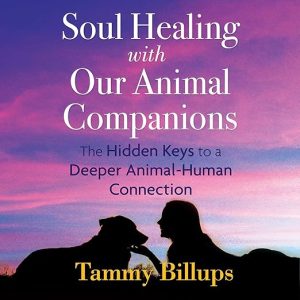
I have a cat who has had, for as long as I've known him, a specific anxiety around being left alone that we've managed but never fully resolved. I mention this because Soul Healing with Our Animal Companions by Tammy Billups arrived in my review queue at a moment when I was genuinely thinking about the question it addresses: what does my animal's behavior reflect about our shared environment, our shared patterns? I'm not a practitioner of energy healing, but I came to this book with genuine curiosity rather than reflexive skepticism.
Billups is a certified integrative bioenergetics counselor who has worked with animals and their caregivers for years, and this book, a 2020 COVR Gold Award winner, draws on that practice. Henrietta Weekes narrates just under five and a half hours of content that covers the theory of animal-human energetic bonding, a framework of five core emotional wounds in animals, and practical guidance for healing that operates on both sides of the relationship.
Five Emotional Wounds Shared by Pets and People
The central premise, that the animals we attract mirror our emotional patterns, and that healing one side of the relationship helps heal the other, is not new in the holistic wellness space, but Billups gives it systematic structure that other books in the genre often lack. The five core emotional wounds framework is her original contribution: abandonment, trust, self-worth, survival, and powerlessness. She maps specific behavioral manifestations of each wound in animals, then draws the parallel to how the same wound appears in human emotional life.
That parallel structure is what makes the book practically useful rather than purely theoretical. If your dog has separation anxiety, Billups invites you to consider what that anxiety might be reflecting, not as a mechanism of blame but as a diagnostic lens. Whether or not you accept the metaphysical underpinning, the behavioral observation layer is often genuinely useful.
Henrietta Weekes Narrates With Composed Sincerity
Henrietta Weekes reads this material with a quality I'd describe as composed sincerity, she doesn't aestheticize the content or perform spirituality, she simply delivers it clearly and with appropriate care. For a book that asks the listener to be receptive to ideas they may not have encountered before, that undemonstrative approach is exactly right. She doesn't push; she presents.
The short runtime, just over five hours, makes this an accessible listen. Billups writes in a way that's accessible to readers without a holistic health background, and Weekes's narration amplifies that accessibility. Multiple reviewers describe reading this more than once, which suggests the material rewards return listening as circumstances with their animals change.
Outside the Scientific Consensus, Strong on End-of-Life Care
Honesty requires noting that the framework Billups uses, bioenergetics, the idea that animals and humans share energetic patterns, the role of energy therapy in healing, is not within the conventional scientific consensus. Readers who need empirical validation for therapeutic claims will find the evidentiary basis thin. The book is written for readers who are already open to or practicing within holistic modalities, and it assumes that foundational openness.
It's also worth noting that Billups's three-step process for making difficult decisions on your pets' behalf, including end-of-life decisions, is handled with genuine tenderness. Several reviewers specifically mentioned this as one of the most valuable sections. For people navigating those decisions, it offers a compassionate framework that conventional veterinary guidance doesn't always provide.
Made for Holistic Caregivers, Not Empiricists
Well-suited for people who practice energy healing or are drawn to holistic frameworks and want to extend those practices to their animal relationships. Also genuinely useful for caregivers dealing with specific behavioral challenges in their animals who are curious whether an emotional or energetic lens might offer insight conventional approaches haven't. The end-of-life decision section makes it valuable for anyone supporting a seriously ill or aging pet. Skip it if you require empirical evidence for therapeutic claims, or if the language of energy work and soul-level healing is not a register you can engage with meaningfully. This is a book that rewards meeting it where it lives.
Questions Listeners Ask
How does Henrietta Weekes's narration handle the more spiritually oriented passages, does it feel performative?
Weekes is notably restrained, which is the right approach. She reads the more explicitly spiritual and energy-work passages with the same tone as the practical behavioral guidance, neither elevating nor distancing. That consistency makes the transition between conceptual and practical sections feel natural.
The book won a 2020 COVR Gold Award, what is that, and does it indicate quality?
COVR stands for Coalition of Visionary Resources, an organization that supports the body-mind-spirit publishing industry. Their awards recognize books that excel within the holistic and New Age publishing space. The award reflects recognition within that community specifically, and is a useful signal for readers already within or curious about that space.