Quick Take
- Narration: Teri Schnaubelt delivers a clear, measured read that suits the instructional register, steady pacing keeps complex Python concepts from blurring together.
- Themes: Software craft meets data science, production-readiness, best practices for working engineers
- Mood: Practical and methodical, like a skilled colleague walking you through what school never taught you
- Verdict: An essential bridge for data scientists who can build models but struggle when their code needs to survive contact with a real codebase.
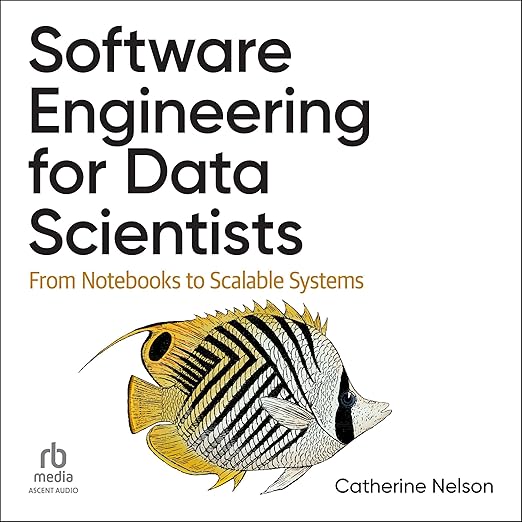
I picked this one up after a conversation with a friend who manages a data science team at a fintech firm. She had just spent a week untangling a production incident caused by a poorly structured pipeline that no one could maintain, not even the person who wrote it. She kept saying the same thing: “They know the math. They don’t know how to write code.” Catherine Nelson’s Software Engineering for Data Scientists is, in a very real sense, the book that answers that complaint.
I listened across a few long runs and one overnight train journey, and what struck me most was how deliberately Nelson resists the temptation to make this a Python tutorial. There are plenty of those. What this is, instead, is a curriculum for the skills that sit between a functioning Jupyter notebook and a production-grade system, and the gap between those two things is enormous.
The Gap Nobody Else Fills
One of the early reviewer quotes that surfaces around this book describes it as “the missing manual for early-career data scientists,” and that framing is accurate. Nelson covers object-oriented programming not as a theoretical concept but as a tool for writing code that other people, or your future self six months from now, can actually understand. She addresses documentation, packaging, APIs, error handling, testing, and logging: exactly the infrastructure topics that introductory data science courses skip because they’re not glamorous, and that most coding bootcamps skip because they’re not immediately visible.
What Nelson does well is anchor every topic in the kinds of real problems a working data scientist actually faces. This is a book written by someone who has lived inside data science teams, not outside them describing what she imagines happens there. The examples draw on NumPy and pandas, which means you are not learning alien tools just to follow the prose, you are learning better habits around tools you already use.
Who This Book Is Actually Written For
The minority review in the available set comes from a four-year practitioner who found the depth insufficient. That is a fair and honest note, and worth taking seriously. This is not a book for senior engineers who already know what a linter is, have written unit tests under CI/CD constraints, and have deployed models to production APIs. Those readers will find the first third familiar and the second two-thirds moderately useful as a checklist.
The book lands most forcefully for data scientists who are strong analytically but know, somewhere in the back of their minds, that their code does not belong in production. Nelson never condescends about this. She writes with the tone of someone who understands how you got here, you were hired to do statistical analysis and machine learning, not to be a software engineer, and who wants to fix the problem, not shame you for it.
The Audiobook Format and the PDF Companion
A note on the listening experience specifically: this book comes with an accompanying PDF available in the Audible library, which is not optional if you want the full value of the material. Code examples do not translate cleanly to audio. Teri Schnaubelt reads with real precision, she does not stumble over technical terminology, and her pacing through conceptual sections is measured enough that the ideas stick, but you will want the PDF open when Nelson walks through anything involving actual Python syntax. This is not a flaw in the production so much as an honest limitation of the format for a coding book. The audiobook is best understood as the lecture; the PDF is the lab.
Who Should Listen, Who Should Skip
Listen to this if you are a data scientist who has mostly worked in notebooks, if you have been passed over for a promotion because your code lacks “engineering rigor,” or if you are starting a new role on a team that includes software engineers and want to close the cultural gap fast. Listen to this if you teach data science and want to understand what your students are missing.
Skip this if you already write production Python regularly, have a background in software engineering, or are looking for advanced material on distributed systems, MLOps at scale, or system architecture. You will not find cutting-edge coverage of containerization or ML platform tooling here. For that territory, you will need something more specialized.
Frequently Asked Questions
Does this book cover testing and CI/CD workflows, or just basic Python practices?
Nelson covers testing as one of several best-practice chapters, including approaches to error handling, logging, and writing testable code, but she does not go deep on CI/CD pipelines or specific testing frameworks at a production-engineering level. The coverage is substantive for someone new to these concepts.
Is the PDF companion truly necessary, or can you get full value from the audio alone?
The PDF is strongly recommended. Code examples and anything involving Python syntax will be difficult to follow in audio only. Schnaubelt reads the material clearly, but the audio works best when you treat it as a conceptual walkthrough and use the PDF for the technical details.
How does this compare to more advanced software engineering books aimed at developers rather than data scientists?
This book is explicitly targeted at data scientists moving toward engineering fluency, not software engineers deepening their craft. Experienced engineers will find the fundamentals familiar. Its value is in the framing, everything is contextualized to the data science workflow rather than general application development.
Does Nelson address working with software engineers on a mixed team, or is the focus purely on individual coding habits?
There is a chapter specifically on working more effectively with software engineers as collaborators, which reviewers have called one of the most practically useful sections. Nelson addresses the cultural and communication friction between data science and engineering roles, not just the technical differences.