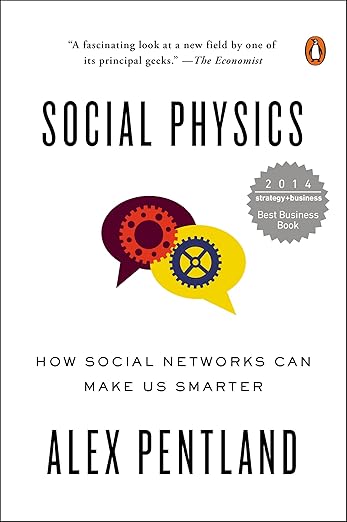
Quick Take
- Narration: Robert Petkoff brings characteristic steadiness to Pentland’s data-rich prose, navigating technical passages with the clarity that makes this kind of science writing accessible on audio.
- Themes: Big data and social behavior, idea flow in human networks, collective intelligence
- Mood: Intellectually excited, occasionally self-congratulatory, consistently thought-provoking
- Verdict: Pentland’s research is genuinely landmark, and Petkoff’s narration makes the technical content accessible, but readers should know they’re getting an MIT insider’s account with limited critical self-examination.
I was halfway through my morning walk when the concept of idea flow clicked for me in a way it hadn’t from the book’s introduction. Sandy Pentland had been building toward it for several chapters, laying out the sociometer research and the MIT experiments with digital bread crumbs, and then suddenly the claim made sense not as an abstract proposition but as a description of something I was actually doing, moving through a neighborhood, absorbing signals from faces and posture and environmental cues, in a process that predates language and operates largely below conscious awareness. That’s the kind of insight Social Physics delivers when it’s working.
Alex Pentland is one of the most cited researchers in computer science, a founder of the MIT Media Lab’s Human Dynamics group, and a figure whose work with wearable sensors and mobile data has genuinely reshaped how social scientists think about group behavior. The book is, in part, a report on that research, and the findings are remarkable: Pentland’s team has demonstrated that you can predict a group’s productivity, creativity, and effectiveness by analyzing patterns of information exchange without knowing anything about the content of the communications. The medium, in other words, is doing more work than the message.
The Sociometer Revolution
The research tool at the center of Social Physics is the sociometer, a badge-sized sensor that records social interactions: who is talking to whom, for how long, with what energy and engagement. Pentland’s lab has deployed these devices in hospitals, call centers, investment banks, and urban neighborhoods, and the data they’ve produced overturns a lot of folk assumptions about how organizations work. In one study, the single most important predictor of a call center’s productivity wasn’t individual talent or training or management quality. It was whether employees had the opportunity for face-to-face contact during breaks.
Steve Gladis’s review calling Pentland the big daddy of big data captures the flavor of the book’s intellectual ambition. Pentland isn’t merely contributing to social science; he’s claiming to have founded a new field. Social physics, in his framing, is the first truly quantitative science of human social behavior. That’s a large claim, and the book makes it with confidence.
Where the Confidence Becomes a Problem
The more critical review from the anonymous Amazon customer is worth taking seriously. The book is self-congratulatory in a way that serious scientists sometimes allow themselves when writing for general audiences, and the limitations of the research methodology are handled lightly. The studies are mostly correlational. The claim that social incentives reliably predict behavior across contexts rests on data from particular institutional settings that may not generalize cleanly. Pentland acknowledges some of this in passing but doesn’t dwell on it in a way that would satisfy a methodologically careful reader.
Robert Petkoff’s narration manages this well. He’s a narrator whose technique doesn’t add drama where the text doesn’t call for it, which is right for science writing. The data-heavy passages land clearly without becoming tedious, and he handles the shift between research findings and narrative storytelling without jarring transitions. At just over six hours, the book is dense but not exhausting in audio form.
The Policy Turn in the Final Chapters
The book’s second half moves from research to application, and this is where it gets both most interesting and most contested. Pentland argues that social physics provides tools for designing more productive organizations, more innovative cities, and more equitable institutions. The examples, a bank that improved productivity by restructuring break schedules, a city that used mobility data to optimize transit, are compelling demonstrations. But they also raise questions the book doesn’t fully address: about privacy, about consent, about who controls the data that enables these optimizations and to what ends.
Pentland is aware of these questions and gestures at them, but Social Physics reads as a work of enthusiasm rather than a work of critical examination. Which is, in a sense, what it needed to be. The field was new when the book was written, and establishing its legitimacy required a book that made the case rather than complicated it.
Who Should Listen, Who Should Skip
Listen if you want to understand how big data is being used to study social behavior at scale, and if you’re willing to engage with the material critically rather than accepting all of Pentland’s conclusions at face value. Petkoff’s narration makes the technical content genuinely accessible.
Skip if you want a methodologically rigorous account that fully acknowledges the limitations of correlational data. This is a scientist’s excited presentation of a research program, not a balanced assessment of it.
Frequently Asked Questions
What is social physics, and is it a real academic field?
Pentland uses the term to describe the quantitative study of how ideas and behaviors spread through social networks using large-scale behavioral data. As a distinct field with that name, it is primarily Pentland’s coinage, though it draws on sociology, network science, and behavioral economics. Some researchers find the framing persuasive; others view it as a rebranding of existing approaches.
Does the book require a background in data science to follow?
No. Pentland writes for a general audience and explains technical concepts in accessible terms. Readers with data science backgrounds may find some sections underspecified, but the core ideas are conveyed clearly without equations or technical notation.
How does Robert Petkoff’s narration compare to listening to this as a print book?
Petkoff’s measured, clear delivery suits the material well. The technical passages benefit from being read at a controlled pace, and the narrative sections move fluently. This is one of those science books where audio is a legitimate format rather than a compromise.
Are the privacy implications of Pentland’s sociometer research addressed in the book?
Briefly and insufficiently, by most critical accounts. Pentland is aware of the concern and mentions it, but the book’s primary purpose is to demonstrate the research’s value rather than to wrestle seriously with the surveillance implications of continuous behavioral monitoring. Readers who want that engagement should supplement this with other sources.