The Operating Layer That Separates Brands Now
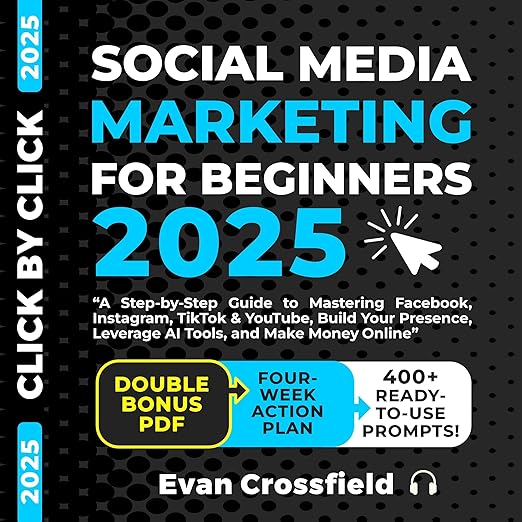
Maxwell Cyberstein's Social Media Marketing for Beginners 2025 enters a crowded field with a specific hook: artificial intelligence is no longer a future-facing novelty in digital marketing, it is the operating layer that separates brands with consistent reach from those perpetually scrambling to catch up. This audiobook, narrated by Jason Belvill, is the second entry in the Click by Click series, and it arrives with a clearly defined audience in mind: entrepreneurs, small business owners, and aspiring influencers who feel chronically behind the algorithmic curve and want a structured way forward. At five hours and twenty-five minutes, it is dense enough to cover its subject without overstaying its welcome, and Belvill's narration keeps the pacing tight throughout so the practical information remains accessible rather than overwhelming.
The framing throughout is resolutely practical. Cyberstein organizes the material around five core learning areas: AI-assisted content creation, smart automation for posting and analytics, SEO and hashtag strategy, growth hacking for viral reach, and the mechanics of social selling and monetization. That is a reasonable syllabus for a beginner-to-intermediate guide, and the audiobook format works reasonably well for this kind of material, provided listeners treat it as a framework-building exercise rather than a passive listen. The advice is concrete, the examples are relevant to today's platform landscape, and Belvill's delivery makes even the more technical passages feel navigable rather than intimidating for someone approaching this territory for the first time.
Follower Counts Versus Genuinely Engaged Communities
The book's greatest strength is its specificity about AI tools and their actual applications in content workflows. Rather than treating AI as an abstract concept, Cyberstein walks through concrete use cases: generating post copy in volume, automating response flows, analyzing performance data without a dedicated analytics team, and producing graphic content without design training. For listeners who have been vaguely aware that AI tools exist but uncertain how to integrate them into a real marketing workflow, this provides a useful mental model that can be acted on immediately rather than filed away as theory.
The automation chapter is particularly relevant for small business owners who are managing social media alongside other responsibilities. The argument that consistent posting schedules, smart batching of content creation, and analytics-informed publishing can replace the exhausting cycle of daily manual effort is persuasive and grounded in practical advice rather than vendor promises. Listeners who finish this audiobook and actually implement even half of the automation strategies described will spend measurably less time on social media while improving their output quality and consistency. That is a meaningful promise for an audience whose time is already stretched thin.
The social selling and monetization section rounds out the picture. Cyberstein does not promise overnight viral success, which is to his credit. The emphasis is on converting existing audiences rather than chasing algorithmic luck, and the distinction he draws between follower counts and genuinely engaged communities is made clearly and early. That orientation toward sustainable growth rather than vanity metrics separates this book from the more breathless entries in the digital marketing space. The hashtag and SEO chapter is also notably useful, covering how these tools function as discovery mechanisms that compound over time rather than as one-time boosts.
Volume Two Assumed Knowledge From Volume One
The 2025 in the title signals currency, but listeners should approach any marketing guide with the awareness that platform algorithms and AI tools evolve faster than any book's publication cycle. Some of the specific platform recommendations and tool suggestions will date more quickly than the underlying strategic principles. The audiobook's core lessons about consistency, audience alignment, and content quality are durable; the specific tactical advice about particular AI tools should be treated as a starting point for your own research rather than the final word on any given platform or application.
The Click by Click series context also matters here. This is volume two, and while Cyberstein presents the book as accessible to beginners, listeners who have not encountered the foundational concepts from volume one may occasionally find certain terms and frameworks assumed rather than introduced. The book does not require reading volume one first, but prior exposure to basic social media strategy concepts will make the material land more effectively and allow you to move from framework-building to immediate implementation without pausing to fill knowledge gaps.
Belvill's Narration Supports an Accessible Conversational Tone
This audiobook is best suited to small business owners, independent creators, and marketing generalists who understand that social media matters to their growth but have not yet built a systematic approach. If you are manually posting content without a clear strategy, ignoring analytics, or feeling overwhelmed by the pace of platform change, the structured framework here is genuinely useful. The AI integration angle also makes it relevant to marketers who are currently curious about AI tools but have not found a practical on-ramp into actual usage.
Experienced digital marketers or those with a background in paid media and audience analytics will find the coverage too introductory to be actionable. The material is designed for people starting from a relatively low baseline of knowledge, and Cyberstein's accessible language reflects that intentional targeting. Approach it as a foundation, not a ceiling, and you will get fair value from the five-plus hours of clearly narrated, well-organized guidance.
Cyberstein's conversational tone throughout the book makes even the more technical discussions feel accessible rather than intimidating, which matters for an audience that may associate AI tools with complexity and jargon. That accessibility without oversimplification is a harder balance to strike than it appears, and Belvill's narration supports it effectively.
Frequently Asked Questions
Does this audiobook cover specific AI tools by name, or does it focus on general strategy?
Both. Cyberstein names categories of AI tools for content creation, automation, and analytics, and discusses how to evaluate and implement them. Specific tool names should be verified for current availability, as the AI tools landscape changes rapidly.
Is this audiobook accessible if you have no background in digital marketing?
Largely yes. The book is titled for beginners and written accordingly, though some familiarity with social media platforms as a user is assumed. Complete novices may want to supplement with basic social media literacy first.
Do you need to listen to Volume 1 of Click by Click before this audiobook?
No, but it helps. Volume 2 builds on some frameworks introduced in the first installment. The book reads independently, but listeners with prior context will absorb the strategic material more quickly and with more immediate applicability.