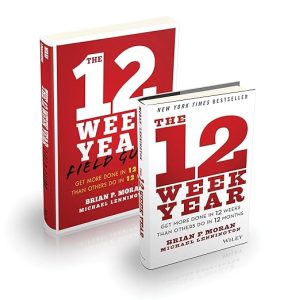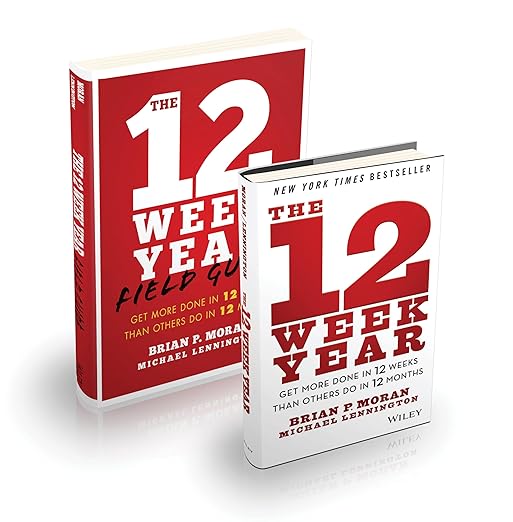
Productivity systems that run on paper are strange things to buy as audio, and this listing makes the tension impossible to miss. The 12 Week Year audiobook is sold as a bundle of two titles, the original book and its study guide, and the headline deliverable in the description is the Game Plan paper system, backed by tools, templates and exercises. The run time on the page reads one hour and eight minutes. Brian Moran and Michael Lennington's argument is simple enough to state in a sentence: stop planning in years, plan in twelve-week blocks, and treat every week as though the deadline were real.
The Listing Never Mentions a Second Author
Annual goals collapse early, because a year contains so much slack that any single day can be written off without consequence. Compress the horizon to twelve weeks and the arithmetic changes: each week is worth better than eight percent of the whole period, so nothing survives being deferred to a quarter that never arrives. Breaking free of annualized thinking is how the copy names the target, and the promised outputs are clarity, focus on what matters most, and a manufactured sense of urgency. Underneath sits a claim worth separating out: you already know what to do, and the system exists to make you execute rather than to teach you anything new. That is why the model travels so well, and why it survives being compressed this hard. Stop procrastinating and get more done in three months than most people manage in a year is a promise no book can keep on your behalf, but it does state plainly what the method is for.
Credits deserve a look before you buy. One name appears as author, Brian P. Moran, while the description credits the material to two people, Moran and Michael Lennington, described together as strategy and execution experts. That is a co-author who did not make it onto the listing. The title is similarly partial: the page says The 12 Week Year while the description says this is a bundle containing The 12 Week Year and The 12 Week Year Study Guide, which are two separate products being sold and displayed as one. The listing dates the release to January 2025, so this is a recent repackaging of established material rather than a new book.
Why a Solo Practitioner Is the Ideal Case
Brevity is the strongest argument for this particular edition. Execution books are usually padded, and the core of this one is a rule, a planning horizon and a weekly scoring habit. Getting all of that inside a single sitting is a genuine service. One of the three written responses runs to a single exclamation, which is about the right length of reaction for material this compact.
What the three responses describe is application rather than admiration. One reports getting more done than before and encountering concepts that were new to them. Another, a licensed professional counselor, frames the system as the approach that will take a private practice to the next level, in the future tense, meaning the plan was made before any results arrived. That is an accurate picture of what this material is: a commitment device, judged entirely by whether you keep the commitment.
Bundle logic is sound in principle too. A method book paired with its own workbook means the argument and the exercises arrive together, which is how execution material ought to be sold. The description promises templates, step-by-step tips for crafting a personal and business vision, and exercises it says have been tested in real use, and putting those next to the theory is the difference between a book you agree with and a book you use.
The audience the description names is worth checking against your own situation. Professionals and entrepreneurs, it says, people who want to take back their life, improve their thinking and advance a business or a career. The most substantial of the three responses fits that profile exactly, coming from a counselor planning to apply the system to a private practice, and a solo practitioner is arguably the ideal case: nobody else sets your deadlines, so a manufactured twelve-week clock has something real to replace. Inside an organization with its own quarters and reviews, the method has to compete with a calendar you do not control.
Pile's Credit Is the Only Thing Confirmed Here
Now the problems, and they stack up. First the format: a paper Game Plan, tools, templates and a study guide full of exercises, all delivered as sound, with no accompanying material mentioned anywhere on this page. You cannot fill in a template you are hearing described. Second the run time. One hour and eight minutes for a full book plus its study guide is a small fraction of what either would normally take, and the listing never says whether this is an abridgement, a summary or something else, so anyone expecting the complete text of both volumes should check before buying. Third the metadata, which is a mess: a print ISBN is attached to an audio listing, the product code itself is an ISBN rather than an audio identifier, and the publisher and language entries both carry stray invisible characters. Fourth the responses. Nine ratings, three written accounts totaling roughly forty-five words between them, one of which is a single word, and none mentions the recording, the reader or the length. Tom Pile is credited and the page says nothing further.
The One Thing This Format Cannot Deliver Is Paper
Get it if you already know you want the method and want the fastest available route into it, or if you read the book years ago and want a refresher you can finish over lunch. As a cheap test it does the job: if the twelve-week frame still appeals at the end, buy the full edition and the workbook in a form you can write on. Sixty-eight minutes is a low-risk way to find out whether you are the kind of person who scores their own week.
First-time encounters with the system should go elsewhere if you intend to actually run it, because running it requires the paper, and paper is the one thing this format cannot deliver. Buyers who need to know exactly what they are getting should also hesitate, since the listing describes a bundle, displays it as a single title, and gives a run time that does not obviously match either volume inside it. A method built on precision about the next twelve weeks deserves better bookkeeping than this page manages about itself.
Good to Know
Does this audiobook include the study guide exercises?
The description says the bundle contains both the book and the study guide, and promises templates and tested exercises. What audio can carry is a description of each exercise, not the exercise itself. No accompanying document is mentioned anywhere on the listing, so plan on sourcing the worksheets separately.
The description names two authors, so why does the listing credit one?
Good question, and the page never answers it. Brian P. Moran appears as the author while the description hands the thinking to Moran and Michael Lennington jointly. Uncredited co-authors are common on bundled editions, but it is worth knowing that two people stand behind this material.
Can you run the 12 Week Year system from the audiobook alone?
Partly. The frame is memorable enough to carry in your head: twelve weeks, weekly scoring, no annual slack. The scoring and the Game Plan both need a written surface, so treat the recording as the argument and build the paperwork yourself, or alongside it in a notebook.