Kevin Mitnick once said tricking someone into revealing a password beats the effort of hacking the system directly, and that single insight anchors this audiobook's entire case for why social engineering remains one of the most effective attack methods available to any patient, moderately charming liar. Would you notice if someone ran that exact play on you this week? Social Engineering promises a technical dissection of elicitation, pretexting, and influence, built from real-world cases rather than abstractions, and narrator A. T. Chandler treats the material with the same unhurried, precise register throughout its nearly fifteen-hour runtime.
Credited to Wilson, Actually Written by Hadnagy
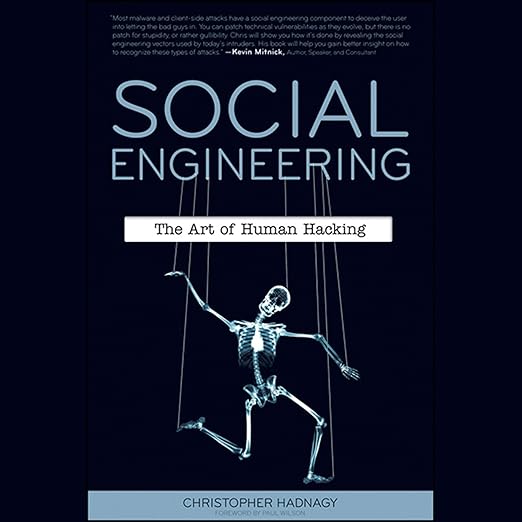
The catalog lists Paul Wilson as author, credited specifically for the foreword, and that detail matters because the actual author, based on the book's own content and the reviews attached to this edition, is Christopher Hadnagy, the security researcher whose earlier work on social engineering is quoted and referenced directly inside the text. One reviewer who says he served as the book's technical editor refers throughout to 'Chris, the author,' and another calls it plainly 'Chris Hadnagy's book on Social Engineering.' Whoever compiled this listing appears to have promoted the foreword writer to the byline by mistake.
Structurally, the book works both sides of the problem at once, walking through how manipulation tactics actually function and then pivoting to how to defend against them, which keeps it useful for readers who want to understand the offense as much as the defense. That dual structure, offense explained clearly enough to be genuinely instructive and defense grounded in the same specifics, is the book's real organizing strength.
The synopsis names three specific techniques as its analytical core: elicitation, the art of extracting information without the target realizing they're being questioned; pretexting, building a false but plausible scenario to justify a request; and influence, the broader psychological toolkit both techniques draw from. Naming these separately rather than treating social engineering as one undifferentiated skill is exactly the kind of technical precision the book's reputation rests on.
The book's dual structure, offense and defense addressed with equal seriousness, distinguishes it from titles that focus purely on organizational policy or purely on hacker technique. A listener walks away understanding both how a specific manipulation tactic is built and what a target could have done differently, which is a genuinely more complete education than either half alone would provide.
The fuller title referenced inside the synopsis, Social Engineering: The Art of Human Hacking, frames manipulation explicitly as a craft rather than a bag of dirty tricks, and that framing matters for how the book teaches it: as a skill built from careful observation and practiced technique, the same way an actual craft would be taught, rather than as a shortcut or a party trick.
Front-Desk Staff Are the Real Targets
The real-world grounding sets this apart from more abstract security theory. One reviewer, who says he helped run a well known social engineering community online, praised the book's detailed information and real-life examples despite acknowledging his own bias as a friend of the author. Another, more critical review calls it a solid 'stepping stone,' useful for both enthusiasts and people wanting to defend themselves, while honestly noting it won't turn anyone into an expert on its own.
That honesty about scope is actually reassuring. This isn't selling itself as the only book you'll ever need on the subject; it's positioning itself as a genuinely useful foundation, covering everything from the basics through more advanced technique, and Chandler's clean, patient delivery makes the more advanced sections land without ever feeling like a lecture.
Kevin Mitnick's own biography gives the book's central claim real weight beyond theory: a hacker who served federal prison time before rebuilding a career as a security consultant, Mitnick's public insistence that social engineering beat pure technical hacking as his most effective method came from someone with genuine firsthand authority on the subject, not a security vendor's marketing claim.
The people most often targeted by real social engineering attacks aren't executives or IT administrators; they're front-desk staff, customer service representatives, and new employees eager to be helpful, exactly the roles least likely to have received dedicated security training. Listeners in customer-facing or administrative roles, not just technical ones, will find the book's threat model applies directly to their own daily work.
Beyond workplace applications, the same underlying tactics increasingly target elderly relatives through phone and romance scams, and understanding the mechanics Chandler narrates here, the deliberate building of false trust before a request ever arrives, gives listeners a genuinely transferable framework for having a useful conversation with family members who may be vulnerable to exactly this kind of manipulation.
Nearly Fifteen Hours, Denser Than It Sounds
A companion PDF is included with your purchase, and for a book this dense with named tactics and technical process, it's worth downloading before you start rather than after. Security nonfiction in this vein tends to lean on reference material that's easier to scan visually than to hold in memory from audio alone, and this title is no exception.
Total beginners with zero security background may find some sections denser than the friendly framing suggests, even with Chandler's clarity working in their favor. This sits closer to a practitioner-facing text than a casual true-crime-adjacent read, so listeners going in expecting pure entertainment value should recalibrate their expectations toward something more like a working manual.
This sits closer to a practitioner's technical manual than the more narrative, true-crime-adjacent security books that have found wider mainstream audiences recently. Listeners coming from a podcast or documentary about a specific famous scam should know this book trades story for systematic technique, examining the mechanics behind many different cons rather than following one dramatic case from start to finish.
Nearly fifteen hours is a substantial runtime for a technical security title, longer than many comparable introductions to the field, and that length reflects genuine depth rather than padding: real-world case examples throughout give the theoretical framework concrete grounding rather than leaving each named tactic as an abstract definition.
The book's real-world case examples give it staying power that pure theory wouldn't have, since named tactics dating back years still map cleanly onto how phishing emails and pretext phone calls work today. The specific tools referenced may have aged, but the underlying psychological principles Chandler narrates clearly have proven durable.
Skip It If You Only Want Defense
Security professionals, IT staff, small business owners worried about phishing and fraud, and listeners genuinely curious about how real-world deception tactics function will get the most out of this one, especially anyone who wants the mechanics behind Mitnick's famous claim rather than just the anecdote.
Skip this one if you want a gentle, beginner-only introduction with no technical depth, or if you're looking exclusively for defensive advice without wanting to understand how the attacks themselves are actually constructed.
A Few Questions About Social Engineering
Who actually wrote this audiobook, Paul Wilson or Chris Hadnagy?
The evidence points strongly to Christopher Hadnagy. The catalog's author field credits Paul Wilson specifically for the foreword, and listener reviews attached to this edition repeatedly refer to 'Chris' or 'Chris Hadnagy' as the actual author.
Is the companion PDF necessary to follow this audiobook?
It isn't strictly necessary, but it helps. The material covers dense, named tactics and technical processes that are easier to scan visually than to hold in memory from audio alone, so downloading the included PDF before you start is worthwhile.
Is Social Engineering too advanced for a listener with no cybersecurity background?
Some sections run denser than the friendly framing suggests, but the book explicitly covers basics through more advanced technique, and narrator A. T. Chandler's clear, patient delivery helps beginners keep pace.
Does the book only cover attack tactics, or also defense?
Both. The structure walks through how manipulation tactics function and then pivots to how to defend against them, which is one of its real organizing strengths.