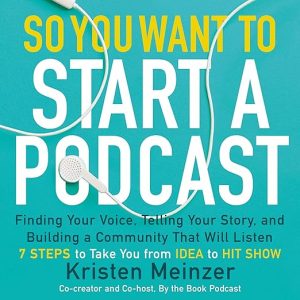
Kristen Meinzer has hosted three podcasts that reached more than ten million listeners combined, and she narrates this audiobook herself, which means the voice teaching you how to sound good on a podcast is demonstrating the skill in real time. So You Want to Start a Podcast walks through hosting, guest booking, editing, and marketing in just under five hours, built around four blunt questions Meinzer wants every aspiring podcaster to answer honestly before buying a microphone: why a podcast instead of a blog or a YouTube channel, what the show is actually about, who it's for, and how it's structured.
An Audie Award and Four Blunt Questions
This won a 2020 Audie Award in the Business and Personal Development category, and listening to it, the recognition makes sense: Meinzer treats podcasting as a craft with real technical and creative demands rather than a hobby anyone can pick up over a weekend. Her background as former director of nonfiction programming for Panoply, Slate's sister company, gives the advice an institutional weight beyond her own hosting experience, and the four-part structure never feels like padded filler despite how much ground it covers in under five hours.
The four-question framework structuring the book, why a podcast, what it's about, who it's for, how it's structured, sounds simple stated plainly, but Meinzer uses each question to push past the vague enthusiasm that sinks most first-time podcast attempts. Reviewer Joe Zahaitis calls the guidance genuinely 'apply-able' rather than theoretical, and that practical, checklist-adjacent quality is exactly what distinguishes a useful craft book from an inspirational one that leaves you excited but no more prepared than before you started.
Brisk Pacing Mirrors Good Podcast Editing
That Audie Award win matters more than a typical book-award blurb might, since the Audies are voted on by the audiobook industry itself rather than the broader publishing world. The recognition speaks directly to how well this particular production works as a listening experience, not just to the strength of the underlying text.
The book's brisk pacing mirrors good podcast editing itself, cutting material that doesn't earn its place rather than padding runtime for its own sake, a discipline Meinzer clearly applies to her own audiobook as rigorously as she recommends applying it to episode structure. That consistency between the advice and its own delivery is a small but genuine mark of craft.
Meinzer's Pacing Demonstrates Her Own Advice
The strongest argument for choosing audio here is almost meta: a book about making a good-sounding podcast, narrated by someone with a demonstrated ear for pacing and audio craft, functions as a working example of its own advice. Every choice Meinzer makes about pacing, emphasis, and tone models the exact skills the book is trying to teach, in a way a page of text never fully could.
Reviewer DIRTY, LAZY, KETO, a longtime listener of Meinzer's By the Book podcast who preordered specifically to prepare for launching a show, describes the timing as ideal, with Meinzer's suggestions for shaping episode content arriving right as the launch was underway. That kind of specific, timely usefulness is the book's real selling point: this isn't abstract podcasting theory, it's the accumulated, tested judgment of someone who has actually built shows that found real audiences.
Podcasting's growth from a niche hobby into a genuinely competitive media category makes the timing of a book like this matter more than it might have a decade earlier. Meinzer wrote this in a landscape crowded with established shows and increasingly sophisticated production values, which is precisely why her four foundational questions, rather than a more scattershot 'just start recording' approach some earlier podcasting guides favored, function as real triage for anyone trying to find genuine air in an increasingly saturated field.
Reviewer Joe Zahaitis specifically praises the 'apply-able' structure enough to plan ongoing reference use rather than a single listen-through, which points to a real strength of the audio format here: listeners can bookmark and revisit the specific four-question section relevant to whatever stage of planning they're currently stuck on, rather than needing to re-read an entire chapter to find one relevant passage.
Tagged as Tech, Really About Voice and Storytelling
Reviewer W. Allemon offers the most balanced take available: a great beginner overview with 'a few pearls of wisdom' for more experienced podcasters too, but ultimately 'a quick read' where each chapter runs roughly the length of a blog post. That's a fair characterization of the runtime itself; under five hours covering the entire podcast-creation process necessarily means breadth over exhaustive depth on any single topic.
Listeners hoping for deep technical instruction on audio engineering, specific software tutorials, or monetization mechanics in granular detail should adjust expectations accordingly. This functions best as a strategic and creative foundation, the questions to answer and the structural decisions to make before diving into equipment and platforms, rather than a hands-on technical manual for the production side of podcasting.
Genre tagging files this under Computers and Technology, which undersells how much of the actual content is creative and strategic rather than technical; listeners expecting a software-focused guide may be pleasantly surprised to find more emphasis on voice, audience, and storytelling instead.
A 4.6 rating from 494 ratings is a genuinely strong result for a craft-instruction title, and it tracks with the specific, actionable praise across the attached reviews rather than vague enthusiasm. Listeners should also note this predates several more recent shifts in the podcast landscape, including the push toward video-podcast hybrids on platforms built around watching as much as listening, so some marketing-specific guidance may need updating against current platform trends even as the foundational four-question framework holds up well.
Calibrated for People Who Haven't Started Yet
Complete beginners are the clear primary audience, and the book delivers exactly what that audience needs: a structured, judgment-driven starting point rather than an overwhelming technical dump. Reviewer Joe Zahaitis plans to keep referencing it throughout his own podcast's early development, which speaks to its usefulness as an ongoing resource rather than a one-time listen.
Meinzer's own three podcasts, spanning different formats and subjects, mean the advice here isn't calibrated to just one type of show; listeners planning anything from a narrative documentary series to a casual interview format will find the four-question framework flexible enough to apply regardless of the specific genre of podcast they're actually building.
Skip this one if you're already several seasons into an existing podcast and looking for advanced growth or monetization strategy; the four-question framework is specifically calibrated for people who haven't started yet, and experienced podcasters will find the material more validating than revelatory.
- Voice: Kristen Meinzer narrates her own guide with the pacing and clarity of the professional broadcaster she actually is.
- Big ideas: Podcast craft, audience definition, practical launch strategy
- Atmosphere: Encouraging and briskly practical
- Worth it?: A sharp, efficient starting point for anyone who hasn't launched a podcast yet, less useful once you're several seasons in.
A Few Questions About So You Want to Start a Podcast
Does Kristen Meinzer's own podcast experience actually show in this audiobook?
Yes, clearly. She's hosted three podcasts reaching over ten million listeners and previously directed nonfiction programming for Slate's sister company, Panoply.
How long is the So You Want to Start a Podcast audiobook?
Just under five hours, which reviewer W. Allemon notes plays out like chapters roughly the length of a blog post each.