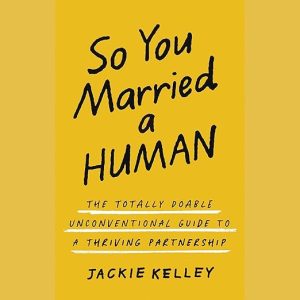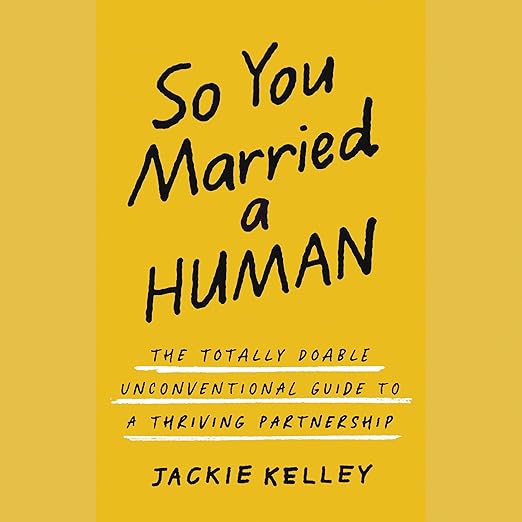
I have read more marriage books than most people would admit to, partly because my literary background means I am professionally obligated to take the genre seriously, and partly because the distance between what these books promise and what they deliver is one of the more instructive gaps in popular nonfiction. Most marriage advice books are one of two things: heavy on research and light on readability, or warm and accessible but thin on anything you could actually apply on a Tuesday evening when you are annoyed about something minor that is actually about something major. So You Married a Human, by content creator Jackie Kelley, appears to be going after the readability end of that spectrum with intention and self-awareness.
The title is both the joke and the thesis. The premise is that your spouse is a bewilderingly different creature from you, that this is not a problem to be solved but a condition to be navigated, and that navigation works better when you have some structure and a lot more playfulness than most couples manage to maintain after the initial years. Kelley writes from her own experience of marrying young and learning, as she puts it, the hard way. That positioning matters because it gives the advice the texture of hard-won understanding rather than theory applied from a distance.
Seven Hours Without the Book's Illustrations
The book is illustrated, which is unusual for the marriage advice genre and signals something about its intended register. This is not a clinical workbook or an academic treatment of relationship science. Kelley describes herself as a content creator, and the book reflects that background in the best way: it is designed to be visually engaging, tonally accessible, and structured around practical rules that actually sound like something a real person might remember and apply. Rules like 'voted off the island,' 'no smack talk,' and 'date your spouse' are designed to stick in the way that abstract principles from relationship research do not.
The audio edition converts this illustrated guide into a listening experience, which inevitably loses the visual dimension. How much this matters depends on how central the illustrations are to the book's emotional delivery. For listeners who prefer audio and are drawn to the relational content rather than the visual design, the core material translates. The seven-hour runtime is generous for this type of content and suggests there is substantial narrative and personal story alongside the framework sections.
Kelley's Self-Effacing Tone Translates Well to Audio
Kelley's authentic, self-effacing tone is one of the things reviews of her work consistently praise, and that quality tends to work particularly well in audio, where personality comes through in vocal texture and pacing in ways that text cannot always deliver. A content creator used to communicating through video and audio will likely have an ease with the medium that not all authors bring to self-narration or performance.
The book is aimed broadly: 'whether you're days or years into your marriage,' as the synopsis puts it. That wide aperture reflects the practical frameworks Kelley uses, which are designed to address problems that arise at any stage rather than being stage-specific. The 'weird math for marriage' decision-making approach and the emphasis on rediscovering playfulness are particularly relevant for couples who are years in and have let the routines of partnership crowd out the quality of it.
Faith-Adjacent Publisher, Mostly Secular in Practice
This is published by Zondervan, which signals a faith-adjacent context, though Kelley's approach appears to lean more toward practical humor and relational wisdom than explicit theology. Listeners who have found Zondervan titles in the past to be more directly devotional should be aware that this one reads more like a secular relationship guide with a faith-compatible worldview than a scripture-forward program.
The lack of any reviews available at time of writing means this assessment is based entirely on the synopsis, publisher context, and Kelley's public profile as a content creator. Listeners should weigh that context. This is a pre-release audiobook not yet available to the general public, and the full picture of how it lands will only emerge after release in October 2026.
Practical Humor for Couples Who Aren't in Crisis
This is well-suited for couples who want practical relational tools delivered with enough humor to actually make implementation feel possible rather than like homework. It is a good fit for partners who are not in crisis but are aware that things could be better, warmer, or more playful. Readers who need clinical frameworks or research-heavy relationship science should look to Gottman or other evidence-based sources. This is not that kind of book. Within its intentional register, combining honest personal storytelling with practical, memorable rules, it fills a space in the genre that more serious approaches tend to leave empty.
The book is illustrated : how does the audio version handle the visual content?
This is a genuine limitation of the audio format for an illustrated guide. The visual elements that contribute to Kelley's content creator sensibility do not translate to audio. Listeners who want the full illustrated experience may prefer the physical book. For those primarily interested in the relational content, personal storytelling, and practical frameworks, the audio version should carry the essential material.
At seven hours, how much of this audiobook is personal storytelling versus practical advice?
Based on the synopsis, Kelley weaves her own 'brutally honest stories of married life' throughout the practical framework sections rather than separating them into distinct chapters. The seven-hour runtime suggests this is not a brief tips-and-tricks book but a fuller narrative treatment where the personal material gives weight to the practical advice. That integration tends to work better in audio than a purely prescriptive format would.