Quick Take
- Narration: Virtual Voice handles the certification study content adequately, exam prep material benefits less from human warmth than most audiobook genres, though it is still not ideal.
- Themes: Snowflake architecture, SnowPro Core certification preparation, cloud data platform features
- Mood: Structured and exam-focused, systematic rather than exploratory
- Verdict: The most current and comprehensive SnowPro Core study resource available in audio, covering the 2026 C0F-C03 exam including Cortex AI and Iceberg Tables.
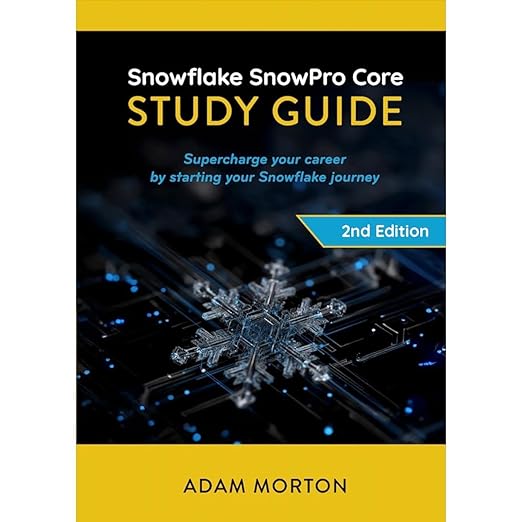
Certification study guides occupy an unusual position in the technical audiobook market. They are not meant to be read for pleasure or to develop a broad understanding of a domain, they are optimization tools for a specific outcome, and they should be evaluated on how well they serve that outcome. I came to the SnowPro Core Study Guide in its second edition knowing that Adam Morton had built a reputation in this space through Udemy courses that have apparently helped thousands of candidates pass the certification. The audiobook should be understood as an extension of that curriculum, not as a standalone literary contribution.
What distinguishes the second edition from the first is its coverage of the current exam version (C0F-C03, updated February 2026) and the Snowflake features that emerged after the first edition launched. Morton is direct about this: the addition of a dedicated Cortex chapter represents the most significant new content, covering Snowflake’s AI services layer that has expanded substantially in the past two years. Snowflake Intelligence, Cortex AI functions, Document AI, and Native Applications are all treated as first-class exam topics in ways they weren’t when the first edition was written.
The Architecture Foundation That Certification Requires
The book’s opening treatment of Snowflake’s three-tier architecture, the storage layer (columnar compressed data in cloud object storage), the query processing layer (virtual warehouses that scale independently), and the cloud services layer (the control plane that handles metadata, optimization, and access control), is the necessary foundation for everything that follows. Morton explains this architecture clearly and with enough depth that the exam questions about virtual warehouse sizing, credit consumption, and the difference between scaling out and scaling up make intuitive sense rather than feeling like arbitrary memorization targets.
The virtual warehouse configuration chapter is among the strongest in the book, covering auto-suspend and auto-resume settings, multi-cluster warehouses, and the resource monitor system for cost governance. These topics appear consistently in SnowPro Core exams, and Morton’s treatment gives you not just the correct answers but the reasoning that allows you to handle edge-case questions.
The New Features Coverage and Why It Matters for the Current Exam
The Iceberg Tables and Dynamic Tables chapters represent some of the more conceptually complex material in the guide. Iceberg Tables, which allow Snowflake to serve as a compute layer on top of open-format data stored in customer-controlled object storage, represent a meaningful architectural alternative to Snowflake’s native storage, and the exam tests whether candidates understand when this approach is appropriate versus when native Snowflake storage makes more sense. Morton’s explanation of the open table format landscape and Snowflake’s position within it is well-contextualized.
Snowpipe Streaming, which enables low-latency continuous data ingestion in contrast to traditional batch Snowpipe, is another area where the second edition adds genuine value. Morton explains the architectural difference between the two ingestion patterns clearly enough that distinguishing them under exam conditions should be straightforward.
Virtual Voice and Exam Prep Material
The Virtual Voice narration is a lesser impediment for certification study material than it would be for other audiobook genres, for a simple reason: exam prep content is typically consumed in shorter review sessions rather than long listening stretches, and the lack of narrative arc means the flat delivery is less disorienting. That said, the synthetic voice still affects the listening experience of the longer conceptual sections, particularly the Cortex AI chapter, which involves enough new terminology that a human narrator’s natural emphasis would help orient listeners to what is most important.
Multiple reviewers mention pairing this audiobook with Morton’s Udemy practice tests, which is sensible advice. The audiobook gives you conceptual understanding and structural coverage of the exam domains; the practice tests give you the pattern recognition needed to perform well under timed conditions. Neither resource fully substitutes for the other.
The Practical Bottom Line
If you are preparing for the SnowPro Core certification on the current C0F-C03 exam and want an audio-compatible study resource that covers the full exam domain including 2026 features, this is the most current option in the market. Morton’s 10 years of hands-on Snowflake experience and his track record with the certification community give the material credibility that generic cloud certification study guides often lack. The Virtual Voice narration is a compromise, but for structured study sessions rather than extended listening, it is manageable.
Frequently Asked Questions
Is this edition current enough for the February 2026 C0F-C03 exam version, or is there a risk the content is already behind?
Morton explicitly updated this edition for the C0F-C03 exam, including new chapters on Cortex AI, Iceberg Tables, Dynamic Tables, Snowpipe Streaming, and Snowflake Intelligence. Given it reflects the February 2026 exam update, it should remain aligned with the current exam structure for the near term.
Do I need to use this alongside practice tests, or is the audiobook sufficient as a standalone study tool?
Multiple reviewers recommend pairing it with practice tests, and Morton himself mentions Udemy practice tests as a complement. The audiobook provides conceptual understanding and exam domain coverage; practice tests build the pattern recognition for multiple-choice performance under timed conditions. Both are useful; neither fully substitutes for the other.
How does the Virtual Voice narration affect the learning experience compared to a human narrator?
For shorter study sessions, the flat delivery is manageable. For extended listening, the absence of natural emphasis makes it harder to identify the most exam-critical points. Listening at 1x speed and taking notes during the new feature chapters (Cortex, Iceberg Tables) helps compensate.
Does this book cover Snowflake Data Clean Rooms and Native Applications, which are relatively new features?
Yes, both are covered as part of the data sharing and collaboration section. Morton treats them as exam-relevant topics and explains their use cases in enough detail to handle related exam questions, though practitioners wanting production-implementation depth will need to supplement with Snowflake’s documentation.