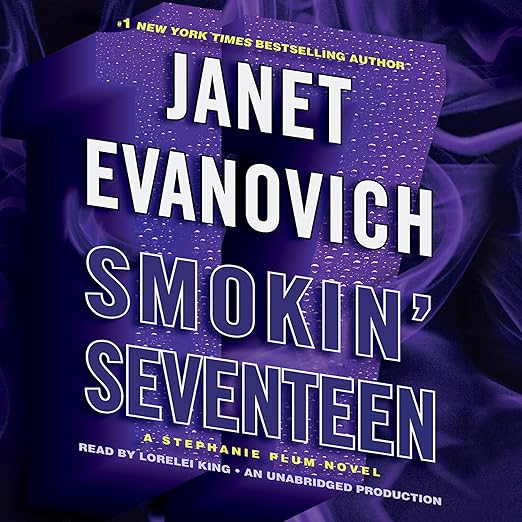
At what point does a series character become a comfortable habit rather than a story you need? By the time Smokin' Seventeen arrived, Stephanie Plum's audiobook had become a familiar ritual for millions of listeners, and the recurring Morelli-versus-Ranger love triangle had transformed from narrative tension into something more like a running joke that everyone in the room was already in on. This installment asks that question, then sidesteps it with the same cheerful chaos Janet Evanovich has always used as her primary defensive maneuver. The result is exactly what seventeen books' worth of momentum produces: a comedy that knows its own rhythms so well it can execute them without visible effort.
Lorelei King has been narrating the Stephanie Plum series since its early days, and at seventeen volumes she is no longer merely performing characters. She inhabits them. King's Lula is a comedic achievement at this point in the series. Her Grandma Bella, the old-world Italian grandmother who threatens Stephanie with supernatural retribution throughout this installment, is the funniest running bit in the book, and King squeezes every possible note out of her scenes. One reviewer quoted Bella directly: You think he believe you over his grandma? You think he believe you when you ugly with boils? That line lands as hard in audio as it does on the page, which is a credit to both Evanovich's timing and King's total commitment to the character.
The actual mystery in this installment involves dead bodies turning up in shallow graves on the empty construction lot where Vincent Plum Bail Bonds used to stand, and Stephanie's name appearing on the killer's list. This is standard-issue Plum danger, which means it functions less as a genuine thriller than as a scaffold for the comedy. Evanovich has never pretended otherwise, and Smokin' Seventeen is honest about its priorities from the first scene. The murder plot moves toward resolution without ever generating real dread, and the tone signals continuously that you are inside a comedy with crime elements rather than crime fiction with comic relief grafted on top.
The new character introduced this time around is a former high school football star who has returned to Trenton, pushed by Stephanie's mother as the obvious solution to the Morelli-Ranger situation. Stephanie's mother's role in these books has always been to embody a particular kind of suburban New Jersey aspiration that Stephanie resists, and this new character functions as another variation on that theme. King handles the family dynamics with a light touch that keeps the domestic scenes from clogging the forward momentum.
Why It Works in Audio
The case for audio over text in this series is straightforward and has been true since the early volumes: King's Lula is irreplaceable in audio form. Lula's voice, her comic indignation, her elaborate justifications for every questionable decision she makes, loses something significant on the page. King has inhabited this character for so long that there is genuine warmth in the performance that you can hear alongside the comedy. The boudoir bake-off scene, which involves Lula's proposed solution to Stephanie's romantic situation, is the kind of set piece that rewards audio specifically, because the timing is inseparable from the delivery.
The six-hour runtime is right for the material. Evanovich's prose is punchy and scene-focused, and King keeps the pace alive throughout. There is no sense of padding even at a point in the series when the format could have grown formulaic. The capture-list subplot, featuring a dancing bear and a senior citizen who believes himself to be a vampire, delivers the kind of purely absurdist humor the series does best, and King plays it completely straight, which is exactly the right choice for this kind of material.
Before You Commit to Smokin' Seventeen
Series fatigue is a real consideration here. Smokin' Seventeen does not resolve the Morelli-versus-Ranger question, and it does not try to. Readers who have been waiting seventeen books for that particular plotline to settle will not find their patience rewarded. If you are coming to this installment hoping for a narrative reset or a significant shift in Stephanie's personal situation, the book will disappoint. The formula is the formula, and Evanovich is not interested in breaking it at this stage of the series.
New listeners should understand that this is very much a mid-series entry. The dead bodies have context that accumulates across seventeen volumes. Characters like Grandma Mazur and Connie have years of established personality behind them, and while the book does not require you to have read all sixteen predecessors, much of the comedy depends on knowing the rhythms of this world and the history of the relationships in it. Start with book one if you have not already made that investment.
Who Will Get the Most From It
For established Stephanie Plum fans, this audiobook is exactly what they want from the series, no more and no less. King's narration remains one of the best comedy performances in the genre, and the Grandma Bella sequences alone are worth the six hours. For new listeners, start at the beginning of the series before arriving here. For readers who tired of the series somewhere around the mid-teens and want to know if Seventeen offers a reason to re-engage, the honest answer is that it does not change the fundamental formula. Whether that is a selling point or a warning depends entirely on your current relationship with Stephanie Plum and how much Trenton you have left in you.
The Short Version
- Voice: Lorelei King is the definitive Stephanie Plum voice, and by book seventeen her command of the full Trenton ensemble is total.
- Big ideas: Serial romantic indecision, comedic violence, the Jersey absurdist universe
- Atmosphere: Raucous, fast, and cheerfully chaotic
- Worth it?: If you have made it to book seventeen, Lorelei King and Grandma Bella alone justify the runtime.