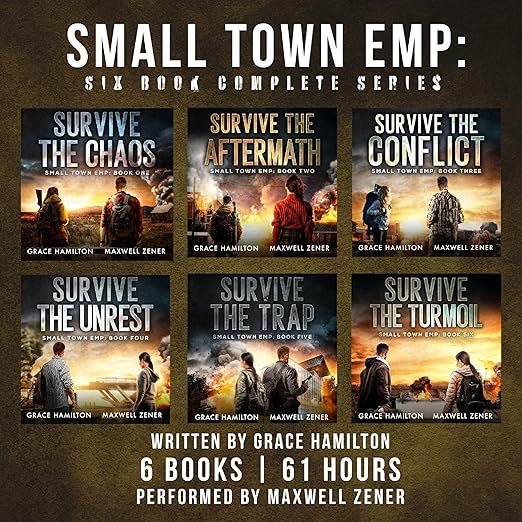
Austin Merryman is separated from his fourteen-year-old daughter the moment the lights go out across America, and the audiobook version of this six-book box set drops you straight into that disorientation with enough propulsion to carry sixty-one hours of listening. I came to this collection during a stretch when I was drawn to long-form survival fiction, the kind that asks not just how people survive, but who they become in the process. Grace Hamilton's Small Town EMP delivered on both counts, and Maxwell Zener's performance sealed it as one of the more satisfying post-apocalyptic audio experiences I've encountered in this crowded genre.
Austin's Transformation Powers the First Trilogy
Hamilton's premise is familiar enough: an EMP attack cuts power across the country and a father sets out across lawless terrain to find his child. What the synopsis undersells is the structural intelligence behind how the series unfolds. One reviewer noted that the set divides neatly into two trilogies, Survive the Chaos, Survive the Aftermath, and Survive the Conflict in the first arc; Survive the Unrest, Survive the Trap, and Survive the Turmoil in the second. That architecture matters for audio listeners. Each trilogy builds to its own emotional climax, and knowing that rhythm helps you pace your investment rather than wondering when a sixty-hour audio commitment will feel earned.
Austin's journey from ordinary father to something harder and more capable is the engine of the first trilogy. Hamilton does not cheat the transformation. He makes genuinely poor choices, occasionally cruel ones, and the narrative refuses to treat survival-mode decision-making as automatically heroic. Reviewer anastasia ber put it well: the main characters 'make what they sometimes think are the best choices... or the only choice.' That ambiguity is the series's real subject. Reviewer Dan C. noted he 'couldn't put it down' despite the length, a testament to how Hamilton keeps that moral tension alive across books rather than resolving it neatly in the first arc.
Amanda Is a Mirror, Never a Trophy
Amanda's arrival changes the dynamic of the first book in ways the synopsis doesn't telegraph. She arrives with her own survival history and her own scar tissue, and her partnership with Austin is one of the series's best elements. Hamilton avoids making Amanda a trophy or a burden; she functions as a mirror for Austin's blind spots and, in the second trilogy, as a character with her own crisis arc. The relationship between them, built on shared violence and dependency rather than convenience, has more texture than most post-apocalyptic pairings I've encountered in this subgenre.
The conspiracy thread running beneath the blackout is introduced cautiously and paid out across the full six books rather than being dumped in exposition. Hamilton's instinct is to show first and explain later, which is correct for audio. Listeners who stick through the quieter mid-sections of books three and four are rewarded in the second trilogy with a wider canvas and higher stakes. Reviewer Marjorie Gibson's detailed breakdown of the structure is accurate and useful, this is genuinely a story told in two distinct phases, and treating it that way helps you manage expectations at the midpoint.
Zener Gives Amanda a Dry Pragmatism
Maxwell Zener narrates the full set with a performance calibrated for the long haul. He anchors Austin with an everyman quality, not a trained soldier's register, not a protagonist's confidence, but the voice of someone learning what they're capable of under pressure. His characterization of Austin's daughter, when she finally appears, avoids the trap of making her a plot reward; she has her own fear and her own judgment, and Zener renders that with care. Amanda gets a dry pragmatism in Zener's delivery that suits Hamilton's writing for the character.
The chief risk for listeners considering a sixty-one-hour commitment is the pacing of the middle books. Books three and four are the most structurally dense, Hamilton is building toward the second-arc reveals while resolving the first-arc threats, and the pace slows perceptibly. Listeners who want constant external conflict may find the quiet rebuilding sequences of Survive the Conflict and Survive the Unrest harder going. But Hamilton earns those slower stretches: the community-building chapters are where the series's real argument about human behavior lives. One reviewer's comment about characters being 'flawed humans who make what they think are the best choices' applies most directly to those quieter sections.
Skip This for a Fifteen-Hour Standalone Instead
Listeners who thrive in character-driven post-apocalyptic fiction and who can commit to a series-length audio investment will find this a satisfying and substantial collection. The box set format makes the price-per-hour calculation favorable compared to individual book purchases, and the narrative continuity means the story actually benefits from listening straight through rather than waiting between releases. If you've burned through Patriots, One Second After, or the Going Home series and want something with more moral complexity and better-developed female characters, Hamilton's set is the logical next listen.
Skip this one if you want a single standalone narrative that resolves in under fifteen hours, or if you need your post-apocalyptic protagonist to be competent and decisive from page one. Austin's early book mistakes are realistic but occasionally frustrating, and listeners who resent that kind of organic character struggle will find the first third of the series a slog before the writing hits its stride.
Do I need to listen to all six books in the Small Town EMP audiobook series to get a satisfying ending?
The first three books form a complete arc that resolves Austin's original mission. The second trilogy expands the stakes and the cast. You can stop at book three with a reasonable sense of completion, but the full payoff requires the second arc.
Does the conspiracy element in the audiobook pay off, or does it stay vague through all six books?
The payoff is real and lands in the second trilogy. Hamilton holds back information strategically rather than vaguely. Listeners who track the early hints will find the reveals in books five and six satisfying rather than arbitrary.