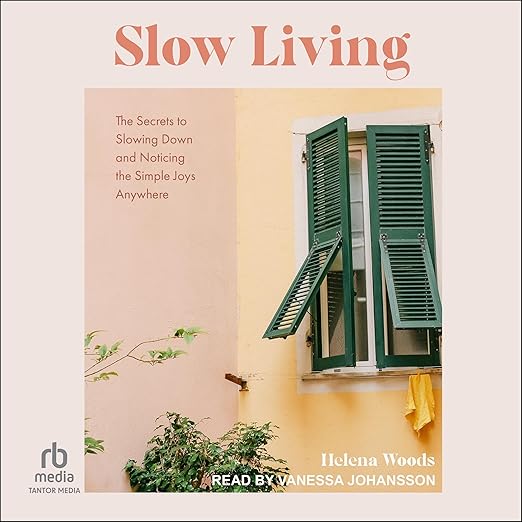
Helena Woods's Slow Living, narrated by Vanessa Johansson, arrives with a specific credential that distinguishes it from the broader slow-living genre: Woods actually moved from the United States to France and built the life she describes. Her YouTube channel Simple Joys has documented that transition for a substantial audience, and the book is the extended, more intimate record of what she learned. This audiobook is not a manifesto about the philosophy of slowness, it is a practical and personal account of how to build it, wherever you are.
Four Practical Areas, Grounded in Life in France
The slow living genre has a crowding problem. Dozens of books promise European simplicity to American readers while staying resolutely abstract about what that simplicity actually requires. Woods avoids that trap by staying specific and personal. She is not arguing for slow living as an abstract ideal; she is describing what happened when she reorganized her actual life around its principles, and she is translating those observations into guidance that does not require moving to France as a prerequisite. The book explicitly frames slow living as achievable "wherever you are," and that framing is genuine rather than hedged.
The four practical areas the book addresses, valuing quiet moments, letting less become more in the home environment, simplifying everyday routines for mental clarity, and building enriching rituals, are familiar to readers of the genre but grounded here in personal observation rather than borrowed wisdom. Woods draws on the rhythms of French daily life she encountered after her move: slower mornings, meals as genuine pauses, the cultural comfort with unscheduled time that can feel foreign to Americans trained toward productivity. The book neither romanticizes France nor dismisses the practical difficulties of cultural transition.
Reviewers who know Woods's YouTube work describe the book as deepening rather than repeating the video content, offering more development of the ideas she explores in shorter formats. That observation captures something accurate: the written medium allows sustained argument that a visual channel naturally fragments into episodes. The audio version of that written content extends the depth further, because Johansson's narration gives the reflective passages room to breathe in a way that silent reading does not always provide. The combination of a reflective writer and an appropriately paced narrator produces something that feels more like a long conversation than a listening task.
Vanessa Johansson's Pacing Embodies the Book's Argument
Vanessa Johansson's narration makes a specific argument for the audio format. Woods's prose is reflective and descriptive rather than argumentative, she is describing sensory experiences, quiet moments, the feeling of a slower morning, and audio captures that quality differently than reading does. Johansson's unhurried pacing does not feel slow because the narrator is instructed to slow down; it feels slow because the material warrants it, and that distinction is audible. For a book whose core claim is that unhurried attention is its own reward, a narration that embodies that quality is a genuine asset.
At 6 hours and 37 minutes, the runtime positions Slow Living as a weekend listen or a week's worth of commute segments. Either approach works, though the book's own argument would suggest that unhurried listening, a chapter at a time, with pauses, is closer to the spirit of the subject than rushing through it. Woods's writing has the quality of good travel writing: it places you in a specific sensory context and lets that context do intellectual work without forcing a conclusion on you.
Closer to an Essay Than to a Workbook
The book is not a systems manual and should not be approached as one. Readers looking for specific step-by-step protocols for decluttering, schedule redesign, or productivity optimization will find the content too experiential and not prescriptive enough. Woods's approach is closer to essay than to workbook, and the guidance it offers is attitudinal rather than procedural. That is not a weakness, it is a genre choice, and a coherent one, but it matters for managing expectations before you begin.
The book's intentional inclusivity, Woods explicitly designed it for men, women, families, and children rather than the female-primary audience that personal growth books often default to, is a meaningful design decision that shows up in how she frames household practices, relationship rhythms, and shared routines. The slow living she describes is not a solitary practice but a relational one, and that distinction gives the guidance more practical texture than it would have if addressed to a single reader in isolation. Her discussion of building slow rituals within a household rather than despite one is particularly useful for readers who have felt that simplicity literature assumes you live alone.
Written for Slower Living, Grounded in Real Experience
This audiobook is for listeners who feel that the pace of their current life is extracting more than it is returning, who are drawn to the European slow-life ethos but want something grounded in actual experience rather than lifestyle aspiration, and who appreciate a listening experience that reflects its subject matter. It pairs naturally with other lifestyle simplicity titles, Woods herself names Essentialism and Simple Pleasures as companions, but offers something those books do not: the specific texture of living the transition rather than theorizing about it. Listeners who need concrete frameworks and step-by-step systems should look elsewhere. For everyone else, Vanessa Johansson's narration of Woods's reflective, specific, and honest account of how to slow down is the audiobook equivalent of a long, unhurried walk, one you will want to take again.
In Brief
- Voice: Vanessa Johansson's narration suits Helena Woods's reflective, experiential prose, her pacing is unhurried in a way that mirrors the book's subject matter, which is a genuine alignment rather than a coincidence.
- Big ideas: intentional simplicity, the European slow-life ethos translated for any geography, quiet moments as genuine value
- Atmosphere: Contemplative and gently aspirational, like an afternoon with nowhere specific to be
- Worth it?: Helena Woods's audiobook offers a sincere and livable version of slow living philosophy, grounded in her actual experience moving from the US to France rather than in abstract idealism.