Quick Take
- Narration: Maria Marquis delivers Nestle’s memoir with measured warmth, letting the personal passages breathe without over-dramatizing the academic and political sections.
- Themes: Late-career reinvention, women in science, food industry influence
- Mood: Candid and quietly inspiring
- Verdict: An honest account of how one woman built an entire field from scratch after starting over in her forties, best suited to listeners who care about food politics as much as the human story behind it.
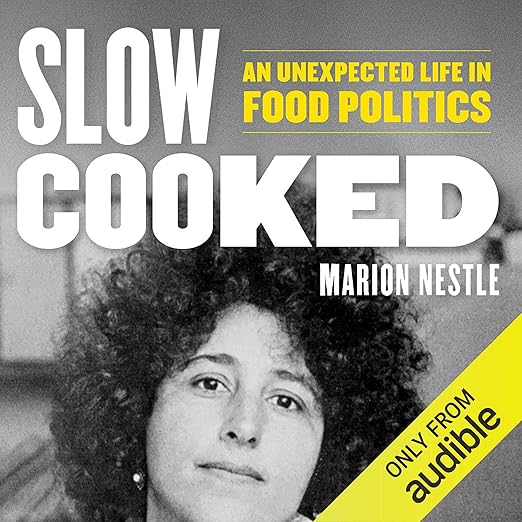
I had the audiobook queued up for a Saturday morning walk and ended up standing still on a park bench for twenty minutes listening to Marion Nestle describe what it was like to be the only woman in a science lab while her male classmates dropped dead rats into her drawer. That detail is not in the synopsis, but it surfaces early in Slow Cooked, and it sets the tone for everything that follows: a memoir that does not flinch from the specific, granular reality of being a woman building a career in a world that assumed she would not bother.
Nestle was married at nineteen, dropped out of college, worked as a lab technician, divorced, and raised two children before she returned to earn her doctorate in molecular biology. By the time she began the work that would define her professionally, she was past forty. The book takes its title from that arc, and it earns the metaphor: this is a life that needed time, low heat, and patience before anything meaningful emerged.
Our Take on Slow Cooked
What distinguishes this memoir from the standard late-career triumph narrative is Nestle’s refusal to smooth things over. She is candid about the moments she doubted herself, about the institutional resistance she encountered at NYU while building what would become the first food studies program in the country, and about the ongoing tension between academic caution and her public advocacy work. Reviewers have called it a story told in a clear and distinctively candid voice, and that is accurate. She does not perform humility, and she does not perform triumph. She simply tells you what happened, in the order it happened, with the eye of someone who has spent decades thinking carefully about systems, incentives, and the gap between what we are told and what is actually true.
Maria Marquis handles the narration with intelligence. She does not impose dramatic readings on material that does not need them. The passages covering Nestle’s Washington stint advising on dietary guidelines, or the long slow effort to make food politics a legitimate academic subject, land as what they are: important and somewhat unglamorous institutional work. Marquis keeps the register even throughout, which is exactly the right call for a book whose author is famously suspicious of oversimplification.
Why Listen to Slow Cooked
The book works on two levels that reinforce each other. As career memoir, it is a genuinely useful account of how someone navigates a field that does not yet fully exist, building authority through persistence and specificity rather than pedigree. As food politics history, it offers a first-person account of how the food industry’s influence over dietary guidance was gradually exposed and documented. Nestle does not separate these threads, which is one of the book’s strengths. Her personal story and her professional arguments grew together, and the memoir reflects that.
For listeners who have read Food Politics or What to Eat, this provides useful biographical context. For those coming in new, it works as an accessible entry point, though it rewards rather than requires prior familiarity with her arguments. One reviewer described it as relevant to anyone who thinks it is too late to follow a passion, and while that sounds like jacket copy, it is actually born out by the specifics Nestle provides.
What to Watch For in Slow Cooked
The pacing is deliberate. This is not a propulsive listen. The early chapters covering Nestle’s childhood and first marriage are more personal and intimate; the middle sections shift toward professional history and institutional politics; the later chapters move into reflection on legacy and influence. Listeners who prefer a single driving narrative thread may find the tonal shifts between personal memoir and food policy history a little uneven. The material on the food industry’s lobbying activities, while important, covers ground that Nestle has covered more extensively in her other books, and those passages can feel slightly compressed by comparison.
The book’s honesty about the limits of individual advocacy is one of its more sobering qualities. Nestle has spent decades fighting against the food industry’s influence on public health guidance. She does not claim to have won. That restraint makes the memoir more credible, not less inspiring.
Who Should Listen to Slow Cooked
This is the right listen for anyone navigating a career change in midlife or later, for those interested in how academic disciplines get built from scratch, and for anyone who has ever read Nestle’s policy work and wondered what drove her. It is less suited to listeners looking for a conventional food or nutrition guide, or those who want a faster-moving narrative. At seven and a half hours, it asks for sustained attention, but it rewards it.
Frequently Asked Questions
Do I need to have read Marion Nestle’s other books, like Food Politics, before listening to this memoir?
No prior reading is required. Slow Cooked works as a standalone, though familiarity with her arguments about the food industry will add depth to the personal backstory sections.
Is this audiobook primarily a career memoir or does it cover food science and policy in depth?
It is primarily memoir, but Nestle weaves her professional advocacy work throughout. Readers looking for a comprehensive food policy argument should look at her nonfiction titles; this is the personal story behind them.
How does narrator Maria Marquis handle the shift between personal storytelling and academic subject matter?
Marquis maintains a consistent, measured register throughout, which suits both the intimate early chapters and the more institutional mid-section. She does not overdramatize either mode.
The synopsis mentions Nestle achieved success after age 50. Does the book dwell on the late-bloomer angle, or does it avoid that framing?
Nestle acknowledges the late timing without making it the book’s dominant theme. She presents it as a fact of her particular life rather than a universal inspiration formula, which keeps the memoir grounded.