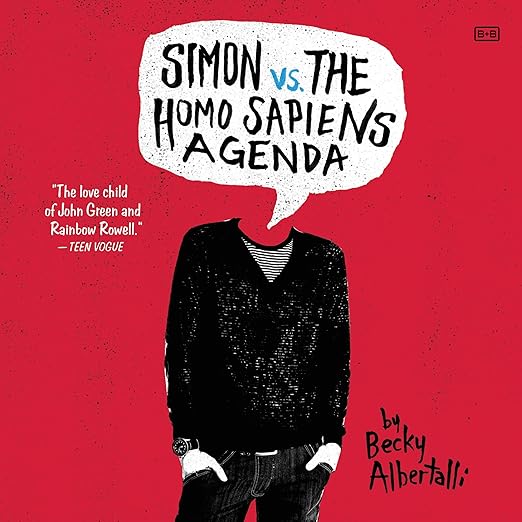
There is a line in Simon vs. the Homo Sapiens Agenda that I keep returning to: why is straight the default? Simon asks this question not in a speech but in a passing observation, and it is the line that explains why this book became a phenomenon beyond the LGBTQ readership it was written for. Becky Albertalli is making an argument about what we take for granted, and she is making it through a sixteen-year-old boy who is charming, funny, and completely believable, which is a harder combination to achieve than it looks.
Simon Spier is not-so-openly gay. He corresponds anonymously with a classmate he knows only as Blue, the two of them having connected through their school's anonymous gossip blog. The emails between Simon and Blue are the best writing in the book, specific and tentative in exactly the way that correspondence between people who are falling for each other while terrified of exposure tends to be. When the emails end up in the wrong hands and another student threatens to out Simon unless he cooperates with something unrelated, the book becomes about more than romance. It becomes about the right to tell your own story, in your own time, in your own words.
Michael Crouch's narration is the right choice for this material. He reads Simon as a specific teenager rather than a type, finding the rhythm of Albertalli's first-person voice without ironing out the slightly awkward moments that make Simon feel real. The humor works because Crouch trusts it. He does not punch it up. He delivers Albertalli's jokes at the pace they are written and lets the comedy land on its own.
What the book gets right, and what sets it apart from a lot of YA LGBTQ fiction of a similar era, is how ordinary Simon is in every way except the one. He loves Oreos and his friends and his school musical. His family is intact and loving. He is not navigating poverty or violence or parental rejection. That relative normalcy is a deliberate choice on Albertalli's part, and one reviewer who read the book in Australia in 2017 notes that if they had found it in high school they would have felt a lot better about themselves. The representation of a gay teenager whose life is fundamentally fine, who just needs to work up the courage to be honest, matters precisely because it had not been done with this much warmth and specificity before.
Why Simon vs. the Homo Sapiens Agenda Works as an Audiobook
This is a William C. Morris Award winner for best young adult debut, and the prize is deserved. Albertalli writes Simon's voice with consistency and care over the whole novel, which is technically harder than it sounds. First-person YA narration can become grating when the protagonist is too self-aware or too oblivious. Simon is neither. He notices things about himself and his world with the particular slightly-off accuracy of a smart teenager who has not yet had enough experience to calibrate perfectly.
The supporting cast earns genuine affection over six and a half hours. Simon's friend group, his family, and even the peripheral characters who complicate his life have enough dimension to feel inhabited. Albertalli does not use them purely as plot mechanisms.
Weak Spots in Simon vs. the Homo Sapiens Agenda
The mystery of Blue's identity is central to the novel's appeal, and Albertalli structures the clues carefully enough that the revelation is both surprising and in retrospect inevitable. Listeners who enjoy puzzle-solving will have a good time with this element of the book. Listeners who find the guessing game frustrating should know it resolves satisfyingly.
The book is also, in places, very funny, which is worth noting because YA coming-out narratives sometimes forgo humor in favor of seriousness. Albertalli does not. The comedy does not undercut the emotional material. It makes it more bearable, which is truer to how teenagers actually navigate hard things than a uniformly serious treatment would be.
Should You Listen to Simon vs. the Homo Sapiens Agenda?
This is frequently assigned in high schools and recommended for middle school, and the age range works. Adult listeners who enjoy YA fiction will find nothing condescending here. LGBTQ listeners of any age who missed this when it came out in 2015 should correct that gap. Parents who want to understand what a coming-out experience looks like when the family is supportive will find this a generous and specific portrait. And listeners who simply want a well-crafted, emotionally honest, genuinely funny novel delivered by a narrator who clearly enjoys the material have found their next listen.
Frequently Asked Questions
Is Simon vs. the Homo Sapiens Agenda suitable for middle-grade readers or is it strictly YA?
It is written for young adult readers, typically defined as ages 12 and up. The content is age-appropriate for middle school, though parents who screen content should know the novel deals with identity, coercion, and coming out. There is no explicit sexual content.
Does Michael Crouch's narration work for a first-person story written in a teenage girl author's voice?
Yes. Crouch does not attempt to feminize the performance but finds Simon's voice as a specific character rather than as a male or female archetype. The narration reads as Simon-specific rather than gender-marked, which is the right approach.
Does the movie Love Simon follow the plot of the audiobook closely?
The film adaptation preserves the core plot but makes changes typical of adaptation, including alterations to secondary characters and some tonal shifts. The audiobook provides a more interior experience of Simon's voice, which the film cannot fully replicate.