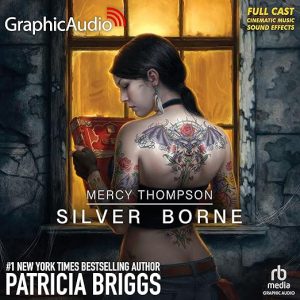
- Narration: A full cast of over thirty actors brings Patricia Briggs's world to life with immersive sound design and cinematic music that elevates the material beyond standard single-narrator production.
- Themes: Fae politics and dangerous knowledge, the cost of keeping secrets, pack loyalty and found family
- Mood: Tense and atmospheric, with warm character moments holding the supernatural stakes together
- Verdict: A full-cast audiobook adaptation of Briggs's fifth Mercy Thompson novel that uses its production resources to deepen rather than distract from one of urban fantasy's most dependable series.
Patricia Briggs's Mercy Thompson series sits in a particular corner of urban fantasy where the world-building is dense enough to reward longtime readers but the emotional core is always personal rather than encyclopedic. Silver Borne, the fifth novel in the series, arrives at a point in the sequence where Briggs can afford to let the mechanics of the Fae world do some of the narrative work while keeping the human cost of Mercy's choices visible throughout. This audiobook production takes a strikingly different approach from the typical single-narrator format, deploying a full cast of over thirty actors alongside immersive sound design and scored music that turns the listening experience into something closer to a radio drama than a standard recorded book.
The casting alone signals the ambition of the production. Khaya Fraites leads as Mercy, supported by Gregory Linington, Christopher McLinden, Nora Achrati, Helen Day, and over thirty additional actors covering the full breadth of the novel's character roster. Urban fantasy at the series level accumulates a large recurring cast, and having each character voiced distinctly rather than filtered through a single narrator's interpretation changes how the listener relates to the ensemble. Mercy's relationships with the wolves, the Fae, and the vampires who populate her world carry different emotional weight when each party sounds like themselves.
First, the Big Picture
The plot turns on a Fae book that Mercy had previously borrowed under circumstances of desperation and now needs to return. When she arrives at the bookstore to do so and finds it locked and shuttered, she becomes entangled in a situation where the book's contents, involving secret knowledge the Fae will do nearly anything to suppress, have made her a target. Simultaneously, her friend Samuel is struggling with his wolf nature in ways that could get him killed by his own father if Mercy cannot cover for him in time.
Briggs's skill with dual-threat structure has always been one of the series' formal strengths. She builds pressure from two directions and allows the reader to feel the compression without providing easy exits. Silver Borne is particularly effective because both threats are personal. The Fae politics carry weight because Mercy has specific relationships with specific Fae, and Samuel's crisis carries weight because their friendship has been a long-running emotional thread across the series. The novel also explores the dynamics within Mercy's pack in ways that add texture beyond the immediate plot, particularly around questions of loyalty, leadership, and what it costs to belong to a wolf pack when you are not a wolf.
Why Listen to Silver Borne
The full-cast production format is the central reason to choose the audiobook over print for this particular title. The production's immersive sound design and scored music lift action sequences and emotionally significant moments in ways that a single reader speaking alone cannot. Urban fantasy as a genre benefits from atmospheric audio production when it is done well, and this production has the resources and craft to do it well. Action scenes gain kinetic presence from sound design, and the quieter emotional moments between Mercy and the people she is trying to protect land differently when the voices surrounding her feel like a genuine ensemble rather than one person cycling through registers.
New listeners should note that Silver Borne is the fifth book in an ongoing series. The emotional weight of Samuel's crisis, the texture of Mercy's pack relationships, and several elements of the Fae threat depend on context established in Moon Called, Blood Bound, Iron Kissed, and Bone Crossed. The production quality makes this a compelling argument for listeners who want to experience the series in audio, but that experience should begin at the beginning.
A Few Reservations
Full-cast productions come with their own considerations. Listeners accustomed to the intimacy of a single narrator may find the transition requires adjustment, particularly if they have been following the series through single-narrator versions and have established personal interpretations of each character. The sound design is described as cinematic, which means it is active rather than restrained. Some listeners experience that as enhancement; others find it intrusive. Neither response is wrong, but knowing the format before committing to the runtime is useful.
The Fae politics at the center of the main threat are more layered than they initially appear. Briggs introduces elements of Fae law and custom that require attention to track, and the book's secret knowledge premise hinges on understanding why the Fae would go to such extreme lengths to suppress particular information. Listeners with series context will have the necessary background. Those encountering Mercy for the first time here may find certain motivations opaque without that groundwork.
It is also worth noting that the production adapts the novel rather than simply recording it. The synopsis describes it as adapted from the novel and produced with a full cast, suggesting that the audio version may have condensed or restructured certain elements for the format. Listeners familiar with the print version of Silver Borne may notice differences in pacing or scene arrangement. For listeners encountering the story for the first time through audio, the adapted version provides a complete and satisfying experience. The distinction matters primarily for the subset of listeners who would compare audio to print directly.
The Right Listener for Silver Borne
Existing fans of the Mercy Thompson series are the primary audience, and for them this full-cast production is a genuine event. The format applied to a beloved urban fantasy world offers something new even in familiar territory. Listeners new to the series should begin with Moon Called and work forward. Urban fantasy listeners who enjoy productions with strong sound design and ensemble casts will also find Silver Borne worth their time, though some of the emotional resonance will be reduced without prior series context.
Is Silver Borne a good entry point into the Mercy Thompson series for this audiobook?
Not recommended as a starting point. Silver Borne is the fifth novel, and the emotional stakes around Samuel and Mercy's pack relationships depend on context from earlier books. Begin with Moon Called, the first book in the series.
How does the full-cast audiobook format affect the listening experience?
Significantly and positively for most listeners. Over thirty actors voice distinct characters alongside immersive sound effects and scored music, differentiating Mercy's large recurring cast more clearly than a single narrator could.
What are the two main threats driving the audiobook?
First, a dangerous Fae book Mercy needs to return has disappeared and the Fae willing to kill to keep its contents secret are now aware of her. Second, her friend Samuel is struggling with his wolf side in ways that risk his father sentencing him to death.
Does the audiobook use original scoring or standard sound design assets?
The production is described as using cinematic music and immersive sound effects, suggesting original scoring rather than generic audio assets. The scale of the cast and production investment indicates a high-budget approach to the audio experience.