Quick Take
- Narration: Pembroke reads his own history with the measured authority of a legal scholar, clear and composed, though occasionally academic in register.
- Themes: Imperial trade and its violent consequences, China-West relations from the Ming to the Qing collapse, the long shadow of opium
- Mood: Dense and absorbing, with the elegiac tone of history told by someone who understands its modern implications
- Verdict: One of the better accessible histories of China’s trade relationship with the West, and a necessary read for anyone trying to understand contemporary geopolitics through its historical roots.
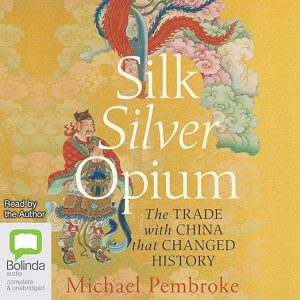
I listened to most of this during a stretch of long train journeys, which turned out to be the right context, there is something fitting about covering centuries of trade history while in transit. Michael Pembroke’s Silk Silver Opium covers a period that Western popular history has treated unevenly: the centuries of China’s engagement with European mercantile powers that ultimately produced the Opium Wars and the profound humiliation that shaped Chinese national consciousness in ways still visible in Beijing’s foreign policy today.
Pembroke is an Australian jurist and author whose previous work on Asia-Pacific history has earned him a reputation for accessible scholarship. He narrates his own audiobook, which is a choice that works here, he has the calm authority of someone who has thought carefully about this material, and his delivery suits the seriousness of the subject without descending into academic flatness.
Our Take on Silk Silver Opium
The book’s organizing logic is the commodity trade, silk, silver, porcelain, tea, and eventually opium, as both economic reality and geopolitical instrument. Pembroke’s argument is that the commodities themselves determined the shape of China’s interactions with European powers, and that the ultimate imbalance (a trade surplus that European merchants could only address through silver and then through opium) was not simply moral failure but structural inevitability. The opium chapters are hard to process without a kind of helpless anger, which Pembroke does not suppress but frames within systemic analysis.
One reviewer noted that the book starts with the first unification of China in the BCE, and that the early history is brief but functions as necessary context before the European arrival. That arc is well-constructed. By the time the trading ships arrive in the South China Sea, the reader understands enough of what they are disrupting to grasp the full scale of what follows. The connection Pembroke draws to contemporary geopolitics, the South China Sea disputes, Taiwan’s historical role as a Qing-era anti-rebel stronghold, the Ryukyu chain’s strategic significance, is the book’s most current value.
Why Listen to Pembroke Read His Own History
At 11 hours and 36 minutes, this is a substantial listen that rewards patient attention. Pembroke’s self-narration is one of the better examples of scholar-reads-own-book execution, he does not perform the text, but he also does not read it as if delivering a lecture to an empty room. There is real investment in the material. One reviewer described his narration as pleasant and easy listening while still being full of interesting information, which is accurate. He achieves the rare balance of making complex material followable without simplifying it into distortion.
The trade-focused structure, commodity by commodity, era by era, provides natural pacing breaks. You can pause after the silk chapters and resume at the silver chapters without losing narrative continuity. This is useful for listeners managing a longer history audiobook across multiple sessions.
What to Watch For in the Historical Argument
Pembroke’s perspective is broadly sympathetic to the Chinese position in these interactions, which is historically defensible but worth naming as an interpretive frame. Western readers who come to the book expecting a neutral treatment of competing national interests may find his framing tilted. That said, the tilt is grounded in documented history rather than advocacy, the Opium Wars were, by most historical consensus, an exercise in commercial coercion backed by military force, and Pembroke does not need to editorialize heavily to make that case.
One reviewer noted that the early history is too brief, and that is a fair observation. Pre-European China gets compressed treatment, and readers without some prior knowledge of the Ming and early Qing dynasties may find the pacing through that section slightly disorienting before the book settles into its primary subject.
Who Should Listen to Silk Silver Opium
Anyone following contemporary China-US relations who wants to understand the historical foundations of Chinese foreign policy behavior will find this genuinely illuminating. History readers interested in colonial trade systems and their long consequences are well served. The book bridges academic rigor and general readability effectively, not a specialist text, but also not a popular history that avoids complexity. Readers who found books like Empire of Cotton or The Silk Roads intellectually satisfying will find Silk Silver Opium in similar company.
Frequently Asked Questions
Does the book require background knowledge of Chinese history to follow?
Basic familiarity helps, but Pembroke opens with an overview of China’s historical foundations. Readers with no prior knowledge of Chinese history will need to move slowly through the early sections; those with general knowledge of the Ming and Qing dynasties will find the framing immediately accessible.
How much of the book addresses the Opium Wars specifically versus the broader trade history?
The Opium Wars are the climactic focus, but they represent roughly the final third of the narrative. The earlier sections on silk, silver, porcelain, and tea trade are substantial and necessary context rather than preamble.
Does Pembroke connect the historical trade conflicts to contemporary China-West relations?
Yes, explicitly. He addresses the South China Sea, Taiwan’s historical role, and the Ryukyu chain as places where past conflicts directly inform present geopolitics. One reviewer specifically noted these contemporary connections as the book’s most current value.
How does Silk Silver Opium compare to other accessible histories of China’s relationship with the West?
It sits between the comprehensive sweep of books like The Silk Roads and the more narrowly focused opium histories. Its commodity-by-commodity structure is distinctive and useful for listeners who want both economic and political framing rather than pure narrative history.