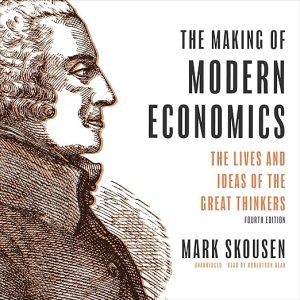
Quick Take
- Narration: Robertson Dean brings authority and warmth to Skousen’s biographical portraits, making the history of ideas feel like a story worth following.
- Themes: History of economic thought, biography and intellectual influence, free-market versus interventionist traditions
- Mood: Engaging and occasionally opinionated, intellectual history with genuine narrative momentum
- Verdict: The best available audiobook introduction to the history of economic thought, elevated by Robertson Dean’s narration and Skousen’s willingness to take sides.
Economics has a reputation as a subject that makes interesting things boring. I say this as someone who spent a significant portion of a literature degree reading cultural theory that suffered from the same tendency. The Making of Modern Economics is a sustained argument against that reputation, and Mark Skousen has now made that argument across four editions and several decades. I came to this audiobook after a conversation with a friend who teaches economics at a university and had been assigning it to undergraduates specifically because, in his words, it is the book that makes students understand that economists were people before they were ideas.
The fourth edition adds material on modern monetary theory, COVID-19’s economic implications, climate change as an economic problem, and updated treatments of Schumpeter on socialism and Malthus on immigration. These additions are topical rather than comprehensive, but they signal that Skousen is treating this as a living document rather than a frozen survey, which is the right approach for a field that continues to evolve rapidly.
Our Take on The Making of Modern Economics
Skousen’s approach is biographical before it is theoretical, which is both the book’s most distinctive quality and the source of its occasional controversy. He is interested in how economists’ personal lives, their financial circumstances, their marriages, their religious beliefs, their political commitments, shaped the ideas they developed. Reviewer Richard described the balance between biography, intellectual contribution, and storytelling as the book’s great strength, and that characterization captures something essential. This is not a neutral survey. Skousen has intellectual commitments of his own, leaning toward neoclassical free-market frameworks and centering Adam Smith, Alfred Marshall, and Milton Friedman as the book’s primary heroes, and those commitments shape both what he includes and how he frames it.
Reviewer FED, who self-identifies as supporting Austrian economics, notes finding the book valuable precisely because Skousen is willing to identify weaknesses in the Austrian school as well as its strengths. That kind of honest engagement across traditions is more unusual in popular economics writing than it should be, and it makes the book genuinely useful for readers across the ideological spectrum of economic thought, even as its ultimate sympathies are clear.
Why Listen to The Making of Modern Economics
Robertson Dean is one of the most reliable narrators in nonfiction audio, and he brings exactly the right qualities to this material: authority that makes you trust the content, warmth that keeps the biographical portraits human, and the pacing intelligence to give complex theoretical passages room to register. At 21-plus hours, a narrator who cannot sustain energy across the long form would be a serious liability. Dean has no such problem. His portrait of Marx, for instance, draws the same quality of attention from Dean as his portrait of Keynes or Friedman, regardless of where Skousen’s sympathies lie.
What to Watch For in The Making of Modern Economics
The book’s sympathies are visible enough that readers who disagree with neoclassical free-market frameworks will occasionally find Skousen’s framing frustrating. His treatment of Keynes, for example, is critical in ways that some economists would consider reductive, and his celebration of the Chicago School reflects a particular tradition within economics rather than a consensus view of the field’s history. Reviewer Frank G., a university economics instructor, recommends the book precisely for the theoretical and historical context it provides, which suggests that even readers who disagree with Skousen’s conclusions find the historical scaffolding valuable.
The book covers a very long period, from Adam Smith in the eighteenth century to contemporary debates, and the treatment of earlier figures is necessarily more compressed than the treatment of twentieth-century economists who have generated more scholarship. The material on pre-Smith economics, mercantilism, physiocracy, and the scholastics, is present but brief. Listeners who want deep coverage of medieval or early modern economic thought will need to look elsewhere.
Who Should Listen to The Making of Modern Economics
This is the audiobook to reach for if you want to understand why contemporary economics debates look the way they do, who the foundational thinkers were, what their personal circumstances contributed to their ideas, and how the field developed from Adam Smith to the present. It is accessible to listeners without formal economics training and genuinely useful to those with it. Anyone who has ever wanted a single comprehensive tour through the history of economic thought, delivered with narrative skill and genuine intellectual commitment, will find this exactly that.
Frequently Asked Questions
Is this book fair to economists whose views differ from Skousen’s free-market orientation?
Skousen is honest about his own sympathies, which lean toward neoclassical and Austrian traditions, but the book engages with Keynesian, Marxist, and institutionalist economics substantively rather than dismissing them. Reviewer FED noted finding weaknesses in his own Austrian school perspective through Skousen’s treatment, which suggests the author’s evenhandedness extends even to traditions he ultimately criticizes.
What new material does the fourth edition add compared to earlier versions?
The fourth edition adds coverage of modern monetary theory, COVID-19’s economic implications, climate change as an economic policy question, debates around minimum wage policy, Schumpeter’s analysis of socialism, and Malthus’s arguments as applied to contemporary immigration debates. These additions update the book to engage with active policy conversations rather than treating economics history as settled.
Does Robertson Dean’s narration maintain energy and differentiation across 21 hours of dense intellectual history?
Yes. Dean is experienced enough with long-form nonfiction to sustain the material across a 21-hour runtime without pacing problems. His biographical portraits of individual economists are particularly strong, bringing enough vocal distinction to each figure to help listeners track who is being discussed without requiring the author to over-explain.
Is this suitable for someone with no prior economics background, or does it assume familiarity with economic theory?
Skousen designs the book for educated general readers without assuming prior economics training. He explains theoretical concepts as they arise in the biographical narratives rather than assuming listeners already know what marginal utility or the multiplier effect means. Multiple reviewers with non-economics backgrounds found it fully accessible.