- Voice: C.S Cyan reads dense financial terminology with clean, unhurried precision built for review sessions, not dramatic flair.
- Big ideas: FINRA licensing prep, practice-question drilling, exam-day readiness
- Atmosphere: Practical and focused
- Worth it?: A solid review supplement for a candidate who has already studied the material once, not a first-pass teaching tool.
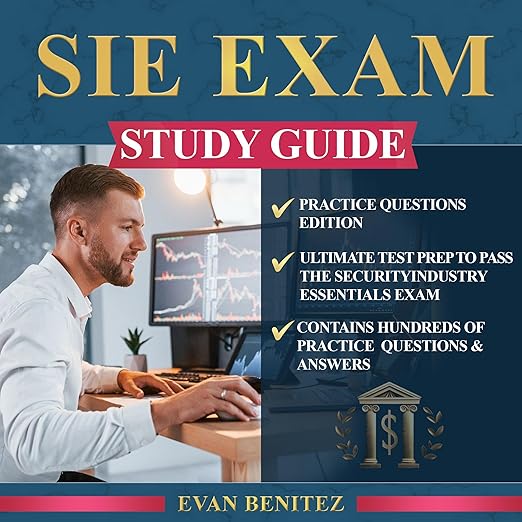
Fourteen chapters of securities law, options theory, and retirement-plan minutiae stand between a would-be financial professional and the SIE exam, and this audiobook is built entirely around getting a busy candidate through them without wasting a single commute. Evan Benitez, a working securities professional, structured the guide as a practice-questions edition rather than a straight lecture, which means most of the runtime is spent drilling scenarios instead of reading definitions aloud. That choice makes sense for an exam candidate with limited study windows, but it also sets expectations that matter before pressing play.
Miscategorized as a Cybersecurity Certification Guide
The fourteen chapters move from an introduction to the SIE framework through basic securities, primary and secondary markets, investment companies and mutual funds, regulatory structure, financial statements, customer accounts, fixed income, options and derivatives, economic factors, ethics, retirement plans, insurance products, and margin. Each chapter splits into further subsections, so the guide functions less like a single narrative and more like a modular reference a listener can dip into by weak area. Benitez keeps the tone practical throughout, favoring worked scenarios over abstract theory, which suits a licensing exam built on applied recall rather than conceptual debate.
One detail worth flagging plainly: this title is commonly filed under Security and Encryption in tech categories, a shelving quirk that has nothing to do with what is actually inside. The SIE is FINRA's entry-level securities licensing exam, the gateway credential for a career in stocks, bonds, and financial advising, not a cybersecurity certification. A listener browsing tech audiobooks who stumbles onto this by category alone will be confused within the first chapter, so it is worth clearing up before anyone presses play expecting firewalls or encryption protocols.
FINRA Introduced This Exam Just in 2018
The SIE itself is a relatively recent addition to the licensing landscape, introduced by FINRA in 2018 as a co-requisite exam that, unlike the specialized licenses that follow it, does not require sponsorship from a member firm. That accessibility is part of why this guide's audience skews broader than a typical finance-industry study aid, pulling in college students and career-changers testing the waters before committing to a securities career, not just professionals already working at a brokerage.
The synopsis specifies this as 'a practice questions edition', phrasing that implies a companion, more explanatory edition may exist for listeners who want concepts taught from scratch rather than drilled through questions alone, a distinction worth checking before buying if a listener isn't sure which format matches where they are in their own preparation.
Cyan Paces Ethics and Derivatives Differently
Narrator C.S Cyan reads financial terminology with the kind of precision that dense exam material actually needs, giving each subsection clean separation so a listener can find their place again after pausing mid-commute. That structural clarity matters more here than vocal warmth or dramatic range, since the entire value proposition is retention under time pressure, and Cyan's steady, unhurried pacing through terms like fixed income and margin never blurs one concept into the next.
The audio format earns its keep specifically for review rather than first exposure. A candidate who has already worked through the primary study material once can use this edition on a drive or a treadmill session to reinforce categories that are still shaky, letting the practice-question structure double as a spaced-repetition tool rather than a first-pass textbook substitute.
The chapters themselves demand different kinds of thinking, and Cyan's pacing adjusts accordingly without the listener necessarily noticing the shift. Ethics and Professional Responsibilities leans on judgment calls and scenario recognition, while Options and Derivatives leans on near-formulaic recall, and a narrator who reads both at the same clipped tempo would flatten that distinction. Cyan instead lets the more conceptual chapters breathe slightly longer than the mechanical ones, a small choice that pays off over six-plus hours.
Fifty Ratings Is a Thin Sample to Trust
No listener reviews are attached to this edition yet, which makes it harder to gauge how well the practice-question format actually lands for people who have used it to sit the real exam. The rating itself sits comfortably at 4.7 from fifty ratings, a reasonably strong signal for a niche exam-prep title, but the absence of written detail means a buyer is relying on that number alone rather than firsthand accounts of pass rates or specific weak chapters.
The bigger structural tension is one every audio exam guide runs into: practice questions are designed to be answered, not just heard. A listener cannot glance back at a multiple-choice stem while considering four answer options the way a print or PDF edition allows, with no built-in way to mark a missed question for later review short of pausing to write it down separately. Treat this as a genuine review supplement, best paired with the physical study material, rather than the sole vehicle for absorbing fourteen chapters of regulatory detail.
Fifty ratings is a modest sample for a licensing-exam guide competing in a crowded category of forgettable, barely-differentiated study aids, so a prospective buyer comparing this against competing SIE guides has little written detail to go on beyond the number itself and the chapter list. Cross-checking the specific chapter breakdown against personal weak areas before buying is a reasonable extra step given how little qualitative feedback exists.
The hundreds of practice questions promised in the synopsis translate to audio as a question read aloud, a pause for the listener to commit to an answer mentally, and then a worked explanation, a format that functions reasonably well for reinforcement but relies entirely on the listener's own discipline to actually pause and think rather than let the explanation roll in automatically. Author Evan Benitez's background as a working securities professional lends the explanations real practical grounding rather than textbook abstraction.
Letting Repetition Soften Exam-Day Anxiety
Working professionals already registered for the SIE and squeezing study time into commutes or gym sessions get real value here, especially anyone who has already been through the material once in print and wants a portable way to reinforce weak categories.
The synopsis itself acknowledges the exam's reputation for provoking real anxiety, calling it 'normal to have some anxiety about taking this test', and a genuine case exists for audio review specifically as a low-stakes way to build familiarity with the material before test day, letting a candidate hear the same concepts repeated across multiple commutes until the anxiety softens into recognition rather than dread.
Anyone starting from zero on securities terminology should pick up a primary print or video course first and treat this audiobook as the reinforcement layer rather than the foundation, since the practice-question format assumes a listener already has some footing in the subject before the questions start flying.
A Few Questions About SIE Exam Study Guide
Is this audiobook enough to pass the SIE exam on its own?
Treat it as a review supplement rather than a first-pass study tool. The practice-question format works best for reinforcing material a candidate has already studied once in print, since audio makes it hard to pause and consider multiple-choice options the way a page does.
Does this audiobook actually cover cybersecurity content given its Security & Encryption listing?
No. Despite how it's commonly categorized, this is FINRA's entry-level securities licensing exam guide, covering stocks, bonds, and financial regulation, not encryption or cybersecurity topics.
How is the SIE Exam Study Guide audiobook organized?
Fourteen chapters move from an SIE overview through securities basics, markets, regulatory structure, financial statements, options, retirement plans, insurance products, and margin, each split into further subsections.
Who is the ideal listener for this audiobook?
A busy working professional already registered for the SIE exam who wants a portable way to drill practice questions during commutes or workouts, ideally after a first pass through the primary study material.