Before You Press Play
- Narrator: Cynthia Bickford reads with the steadiness and warmth this material demands, she avoids both clinical detachment and overwrought emotionality, landing in the register of a trusted voice.
- Subjects: Relationship anxiety and anxious attachment, overthinking and emotional regulation, self-trust in intimate relationships
- Tone: Intimate and practical, gently confrontational
- Bottom line: A workbook-style audiobook with real specificity about the mechanics of relationship anxiety, best absorbed in dedicated sessions at home rather than during a commute, and directed specifically at women navigating anxious attachment patterns.
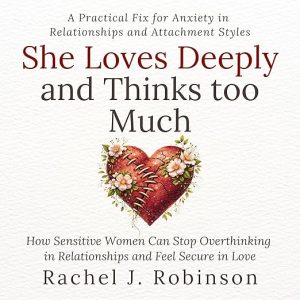
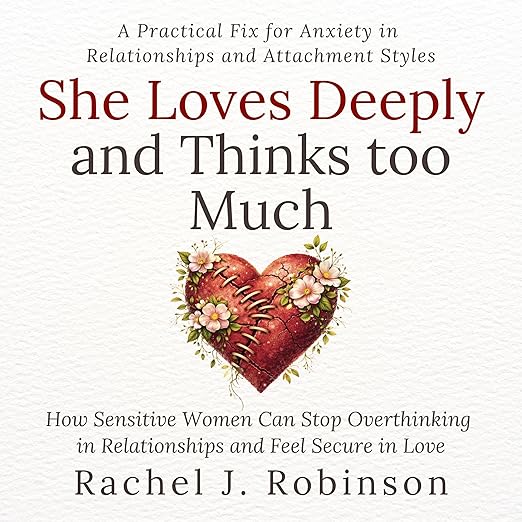
Rachel J. Robinson's audiobook She Loves Deeply-And Thinks Too Much, narrated by Cynthia Bickford, announces its subject on the first page and never pretends to be something else: this is a practical companion for women who experience love as something they have to actively manage rather than something they can simply inhabit. Robinson frames the central problem with precision, the woman who loves fully and completely but whose mind turns love into a surveillance operation, scanning every silence, every shift in tone, every unanswered message for evidence of what might go wrong. At ten hours and ten minutes, the audiobook is substantial, which is appropriate: the tools it offers are layered enough that they need room to develop, and the emotional territory they address is too specific to be resolved in a two-hour summary.
Bridge Phrases for Naming Difficult Feelings
Robinson's framing is one of the book's genuine strengths. She does not pathologize sensitivity or frame overthinking as a character flaw to be eliminated. Instead, she makes a distinction that shapes everything that follows: there is a difference between being fragile and being sensitive, between being broken and being deep. The woman this audiobook addresses is not someone who needs to become someone else; she is someone who needs tools to stay herself when anxiety floods in. That positioning changes the therapeutic register entirely. This is not a book about fixing a defect; it is a book about learning to carry a particular kind of emotional intensity without being controlled by it.
The practical tools Robinson offers are organized around several specific mechanics: techniques to interrupt overthinking spirals before they gain momentum, short body-based rituals to return to calm, what she calls "bridge phrases" for communicating difficult feelings without attacking or collapsing into pleading, and methods for distinguishing genuine warning signs in a relationship from anxiety-generated false alarms. The last of those is particularly valuable, because one of the defining features of relationship anxiety is that it makes real and imagined threats feel identical in the moment. Having a framework for that distinction is genuinely useful, and Robinson develops it with real care and specificity rather than offering generic reassurances.
Cynthia Bickford's Warmth Avoids Clinical Detachment
Cynthia Bickford's narration matches the material well. She reads with warmth and steadiness, which is exactly the register this content needs. A narrator who sounded clinical or detached would create an immediate disconnect with the emotional intimacy Robinson is trying to establish; a narrator who pushed into overwrought emotionality would undermine the practical credibility of the tools. Bickford finds a middle register that feels like a trusted voice, someone who takes the subject seriously without turning it into performance. At ten hours, the narration needs to sustain that quality across substantial repetition of core concepts, and it largely does.
The audiobook format works particularly well for this kind of material because the practices Robinson teaches benefit from hearing them spoken rather than read from a page. When she guides listeners through a body-based ritual or a breathing exercise, the audio delivery adds a dimension that text simply cannot replicate. The length also allows Robinson to return to key concepts from different angles, which is how the concepts actually consolidate in practice. This is not a book you listen to once and implement completely; it is one you return to across weeks or months as different sections become relevant to different moments in your life.
Only Two Reviews Behind a Perfect Rating
With a perfect rating from just two reviews, the listener feedback pool is extremely thin. This is not a title with a broad track record yet, and the existing reviews, while enthusiastic, do not provide the depth of perspective that comes from a larger audience. One reviewer noted this was the first book on relationship anxiety that made them feel genuinely seen rather than diagnosed, which is meaningful testimony, but represents a single listener's experience. Prospective listeners should set their expectations accordingly and treat this as a promising emerging title rather than an established standard.
The workbook nature of the audiobook also means that some sections, particularly the rituals and exercises, are harder to integrate while listening on the move. Taking notes, pausing to practice techniques, and returning to earlier sections is more feasible in a home listening context than during a commute. The title is also addressed specifically to women, and while the underlying mechanics of attachment anxiety and overthinking apply broadly, the specific framing and examples are built around a female experience of romantic relationships. Men or non-binary listeners dealing with similar patterns may find it useful but will need to translate some of the framing.
Women Managing Love as Constant Surveillance
This audiobook is written for women who recognize the pattern Robinson describes: loving deeply and with full presence while also living in a state of low-grade relational surveillance that exhausts them. Those dealing with anxious attachment patterns, a tendency to ruminate after disagreements, or difficulty trusting their own read on a relationship's health will find the most specific resonance here. The audiobook is best absorbed during dedicated listening sessions rather than background play, since many of the techniques require active participation to take root. Those looking for a research-heavy academic treatment of attachment theory rather than a practical companion guide should look elsewhere; Robinson's approach is applied and experiential, built for use rather than for understanding from a scholarly distance.
Before You Listen
Is this audiobook based on clinical attachment theory or is it more of a self-help workbook?
It is a practical workbook rather than an academic treatment. Robinson works with attachment concepts, specifically anxious attachment patterns, but her approach is applied and experiential. She provides techniques, rituals, and communication frameworks rather than theoretical analysis. Listeners wanting a research-grounded academic text on attachment should look to authors like Stan Tatkin or Sue Johnson instead.
Is this audiobook specifically written for women, or will it be useful for anyone dealing with relationship anxiety?
Robinson wrote this explicitly for women, and the framing, language, and examples reflect a female experience of romantic relationships. The underlying mechanisms of anxious attachment and overthinking apply broadly, but men or non-binary listeners may need to translate some of the framing. The audiobook does not claim universal applicability.
Can you listen to this audiobook passively, or does it require active engagement?
Active engagement is important for getting real value from the techniques Robinson teaches. Several sections include body-based rituals, breathing practices, and communication exercises that require you to pause and participate rather than simply absorb. The audiobook works best during dedicated home listening sessions rather than as background audio during a commute or other activities.
With only two reviews, how confident can you be about the quality of this audiobook?
The limited review pool is a genuine caveat. Both reviews are five stars and one is substantive, praising the book as the first on relationship anxiety that felt genuinely practical rather than diagnostic. But two reviews is not enough to establish a reliable track record. Treat this as a promising emerging title and monitor the review count before committing if that uncertainty bothers you.