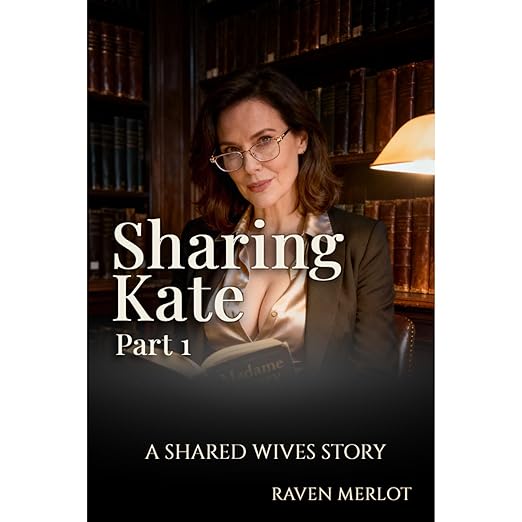
Sharing Kate - Part 1 opens in Bath, England, in a household that looks, on paper, like the settled, organized life most people spend years constructing. Kate Morrison is a university lecturer, a mother of two teenagers, a wife of twenty years. This audiobook belongs to the Shared Wives series by Raven Merlot, but what separates it from the bulk of erotic fiction with similar premises is that Merlot is genuinely interested in the psychology of the woman at its center. Kate is not a passive figure reacting to events around her. She is someone who discovers a specific desire and, critically, chooses to name it to the person she has built her life with.
The premise, once laid out, is deceptively simple. Kate tells her husband Daniel what she wants. His response surprises them both: he wants to watch. What unfolds from that conversation is less about the explicit content than about the texture of trust inside a long marriage, the way people can coexist for decades while still holding chambers of themselves they have never opened, and what happens when one of those chambers finally gets a key. Merlot is clear in the synopsis that this is a character-driven novella about trust, consent, and the exhilarating terror of discovering who you really are. That framing holds up across the actual narrative.
Surrendering Reveals the Woman Kate Always Was
Merlot writes Kate with a specificity that matters. She is not vague or interchangeable as erotica protagonists sometimes are. She is intelligent, composed, professionally anchored. The desire she discovers does not fit any obvious narrative of the bored housewife seeking escape. It is more complicated than that: it surfaces not from dissatisfaction with Daniel but from something untested within herself, something she has simply never had the occasion or permission to examine. That distinction is what gives the novella its particular charge. The vulnerability is real because Kate is particular.
One reviewer described the story as following an interesting couple, Kate and Daniel, who are absolutely normal until something knocks Kate for a loop. That reading is fair in outline but undersells Merlot's ambition. The story is not about disruption for its own sake. It is about how identity hardens over twenty years of routine and what it costs to chip at that surface and see what is underneath. The final lines of the synopsis, where Merlot states that the woman Kate becomes when she surrenders is not a stranger but the woman she has been all along, are the emotional thesis of the book rather than a marketing line.
AI Narration Leaves an Emotional Gap Here
The Virtual Voice narration is worth addressing directly. AI-generated narration on character-driven intimate fiction is a real limitation. The nuance of Kate's internal voice, the particular tension in scenes where she and Daniel are navigating new emotional territory, the shifts in register between Kate's professional composure and her private candor, all of this benefits enormously from a skilled human reader. What the narration does adequately is carry the prose through its more straightforward expository sections. It is not disorienting in the way that poorly processed AI narration can be. But listeners hoping for an immersive performance that matches the emotional precision of the writing will feel a gap.
At just over three hours, the pacing is lean. Merlot does not linger in set dressing or period detail beyond what grounds the scene. Bath is present as atmosphere without becoming a travelogue. The university milieu establishes Kate's intellectual life without making it an academic novel. The domestic setting, the teenage children, the long-established rhythms of the marriage, these function as weight rather than backdrop, the accumulated life that makes Kate's discovery feel consequential rather than trivial.
Daniel Is Surprised Uncertain and Then Honest
Readers of character-driven erotica in the tradition of Anaïs Nin or the more psychologically serious end of contemporary literary erotic fiction will recognize what Merlot is doing: using explicit content as a vehicle for genuine character revelation rather than as the point in itself. That is not to oversell the literary ambitions here. This is part one of a series, and it ends at a point of escalation rather than resolution. Some readers will find that frustrating. Others will appreciate that Merlot takes time to establish the emotional architecture before moving into the territory later installments presumably occupy.
The consent framework is explicit and earnest throughout. Every escalation is negotiated. Daniel's response to Kate's disclosure is one of the most interesting character moments in the book: he is surprised, he is uncertain, and then he is honest about his own reaction. The dynamic that emerges between them is collaborative in a way that distinguishes this from standard cuckolding or voyeurism narratives where one partner is a passive instrument of the other's desire. Both Kate and Daniel are active participants in deciding what this means for them.
Psychologically Grounded Fiction With a Clear Arc
Listeners who want psychologically grounded erotic fiction with well-drawn characters and a clear emotional arc will find this series entry worth the runtime. It is explicitly adult in content and rated accordingly. Listeners looking for quick-paced action or plot-heavy erotica may find Merlot's pace too contemplative. Anyone bothered by AI narration on intimate material should be aware of the Virtual Voice limitation before purchasing. Those who connect with Kate in part one will likely want to continue through subsequent installments, as the story is structured as a serial rather than a standalone.
- Narrator: Virtual Voice handles the narration, which works tolerably for dialogue-light introspective passages but lacks the emotional register this character-driven story ultimately needs.
- Subjects: Marital desire and reinvention, consent and trust, identity beneath social performance
- Tone: Intimate and psychologically observant
- Bottom line: A surprisingly character-driven erotic novella that earns its emotional weight, though the AI narration limits what could have been a genuinely immersive listening experience.
Frequently Asked Questions
Is the Sharing Kate - Part 1 audiobook explicit in its content?
Yes. This is adult erotica with explicit sexual content. It also has substantial character and relationship development, but listeners should know going in that the explicit content is present and central to the story Raven Merlot is telling.
What is the narration quality like for this audiobook given that it uses Virtual Voice?
Virtual Voice narration is AI-generated, which means you get consistent, clear delivery but lose the emotional nuance a human narrator would bring to intimate and psychologically layered scenes. It is functional for following the prose but does not fully serve the character-driven depth of Merlot's writing.
How much of this audiobook is focused on the erotic content versus the relationship and character development?
A meaningful portion of the runtime is devoted to character development, Kate's interiority, and the negotiation dynamic between Kate and Daniel. Merlot explicitly frames this as a story about trust, consent, and identity discovery. The explicit scenes are present but embedded in that larger psychological architecture.