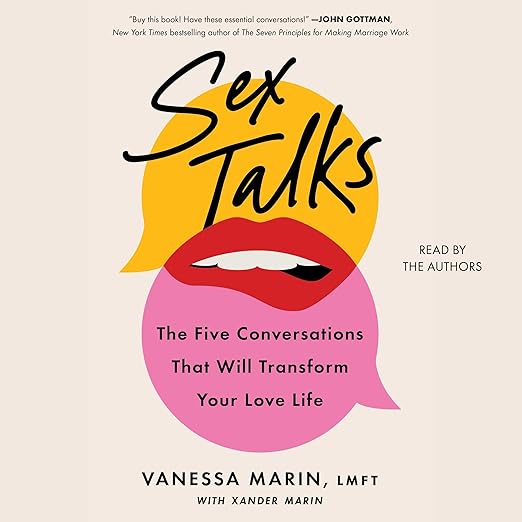
Quick Take
- Narration: Vanessa Marin self-narrates with the warmth and directness of a skilled therapist in session, her delivery makes the conversational framework feel genuinely lived-in rather than performed.
- Themes: Communication and vulnerability in long-term relationships, desire and its conditions, bridging the gap between fantasy and honest conversation
- Mood: Supportive and disarmingly practical, with occasional flashes of humor
- Verdict: If communication about sex has felt impossible in your relationship, too awkward, too loaded, or simply never started, this audiobook gives you the actual language to begin.
I started listening to Sex Talks on a Tuesday evening when I had maybe forty minutes before my partner was due home, and I kept going well past that point. There’s something about the way Vanessa Marin structures this book that creates a kind of momentum, not the propulsive urgency of a thriller, but the satisfying pull of a conversation that keeps getting more honest and useful. By the time I reached the chapter on the “Exploration” conversation, I had mentally drafted three things I’d never managed to say out loud.
That’s not a small thing for a guide in this territory. Most books about sex and relationships either stay at such a high level of abstraction that they never help you find words, or they get so specific with scripts and prescribed language that they feel hollow. Marin, a sex therapist who runs this content alongside her husband Xander, threads that needle with consistent skill. The five-conversation framework, Acknowledgment, Connection, Desire, Pleasure, Exploration, is simple enough to hold in your head and specific enough to actually use.
The Five Conversations and Why the Structure Works
What makes the framework genuinely functional rather than just neat-looking is the sequencing. Marin doesn’t expect couples to jump straight into discussing their deepest fantasies. The first conversation, Acknowledgment, essentially “sex is a thing we have and it matters”, sounds almost too basic, but she makes a convincing case that it’s exactly where most couples get stuck. You can’t have a productive conversation about desire if neither of you has fully owned the fact that your sexual connection is a topic worth tending.
Each subsequent conversation builds logically. The Connection chapter addresses what makes people feel emotionally close enough to be sexually open, which means it overlaps with and enriches the relationship frameworks of writers like John Gottman, who is quoted in endorsement here. The Desire chapter gets into the mechanics of what actually turns people on, and how radically different those conditions can be between partners who otherwise love each other very much. Marin’s willingness to name specific, sometimes unexpected desire patterns without judgment is one of the book’s more quietly radical qualities.
The Couples Marin Lets In
One thing Marin does that distinguishes this from purely instructional sex guides is the storytelling. She and Xander share their own history throughout, including the early years of their relationship when communication about sex was difficult or absent. That transparency defuses the implicit pressure that can come from reading a sex therapist’s advice, the sense that you’re being measured against an expert’s standard. Instead, the book establishes that even people who spend their professional lives helping others with this subject had to learn the same skills.
The client stories woven through each chapter serve a similar function. Marin has clearly worked with a genuinely wide range of couples, and the case examples normalize experiences that listeners may have assumed were unusual to them specifically: the long-term partner who has never directly named what they want in bed, the couple whose desire discrepancy has been silently damaging their relationship for years, the person who doesn’t know what they want and feels paralyzed by that uncertainty. One reviewer described it as “eye-opening” even for someone with what they considered a healthy sex life, that sense of surprise is exactly what well-chosen case material produces.
What Marin’s Voice Brings to This
Self-narration is a mixed proposition for nonfiction guides. Some authors read their own work with visible discomfort, or in a register that works on the page but becomes flat in audio. Marin is the exception. Her background as a practicing therapist means she’s accustomed to delivering direct, sometimes charged content in a way that feels calm and safe. She doesn’t shy away from explicit language where it serves the material, but she never sensationalizes. The effect is of someone who has said these words many times and means them without performance.
At eight hours and forty-three minutes, this is a substantial listen. The New York Times Bestseller designation reflects genuine crossover appeal, this isn’t a book only for couples in crisis. Several reviewers noted approaching it from a position of reasonable satisfaction with their relationship and finding it unexpectedly transformative anyway. That reach, from couples rebuilding connection to couples simply wanting to go deeper, is what separates the more enduring guides in this space from books that only speak to distress.
Who Should Listen, Who Should Skip
This works best for couples who are willing to engage with it together, or for individuals who want to bring what they learn back into a relationship. It can also be useful for people who are single and working on understanding their own patterns before their next relationship. It is not erotic content and has no explicit scenes, it is a therapeutic, relational guide delivered with empathy and clarity. Listeners looking for titillation will find the wrong book here. Listeners looking to actually change something will find the right one.
Frequently Asked Questions
Is Sex Talks applicable for couples who have been together for decades and feel like they’ve already had most of these conversations?
Multiple reviewers who described themselves as having strong, communicative relationships said they found new value in the book regardless. Marin’s framework goes deeper than most couples’ casual conversations, the Desire and Exploration chapters in particular tend to surface things that long-term couples assume they already know about each other.
Does Vanessa Marin address same-sex couples or non-binary readers, or is the framework heteronormative?
Marin writes for all couples regardless of gender or orientation. She and her husband Xander are a heterosexual couple and their examples reflect that, but the framework and principles are written to apply broadly. Reviewers across different relationship configurations have found it applicable.
Is there a companion workbook or exercises in print form that are referenced in the audio?
The five conversations are structured with specific prompts and discussion questions throughout the text. The audiobook appears to be a complete experience, though some listeners may want to note prompts as they listen for later use with a partner.
How explicit is the content, is this appropriate to listen to in shared spaces or with earbuds on a commute?
The content is direct and frank about sex but is written in a clinical-therapeutic register rather than an erotic one. There are no explicit scenes. It’s appropriate for adult listening in most private settings; some chapters use specific anatomical and sexual vocabulary that you’d want earbuds for in public.