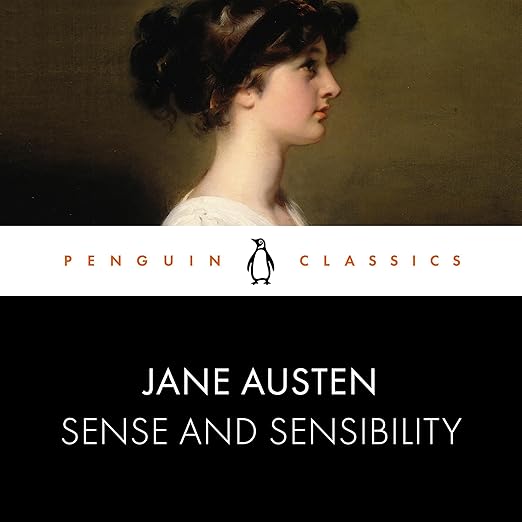
I had my doubts about this casting. Nicola Coughlan is a celebrity narrator, and the recent trend of attaching recognizable names from adjacent entertainment properties to classic audiobooks has produced uneven results. But Coughlan is not simply a name attached to a product; she is someone who spent years performing in a period drama built on Austen's own conventions, and she understands the social stakes of the drawing room in ways that academic preparation alone cannot produce. I listened to this edition over the course of a week, usually in the evenings, and came away thinking it may be the best way to encounter Sense and Sensibility for the first time and a genuinely useful way to return to it.
The novel itself is Austen at her most structurally severe. The Dashwood sisters, Elinor and Marianne, represent contrasting modes of navigating a world that has very limited use for women of diminished fortune. Elinor conceals. Marianne expresses. The novel does not, as it is sometimes misread, endorse one approach over the other. It is a study in how both approaches fail their adherents in different ways, how full emotional disclosure can be dangerous, and how complete suppression carries its own costs. The romantic plots involving Colonel Brandon, Willoughby, and the men who circle around the sisters are the vehicle for this argument rather than the argument itself.
What Jane Austen Delivers
What Coughlan understands, and what The Guardian noted in calling her performance a way of bringing new life and nuance to the story, is that Austen's prose is not genteel. It is sharp. The free indirect discourse that Austen uses to render Elinor's inner voice contains considerable irony, moments where the character's rational self-presentation is being gently undermined by the narrator's awareness of what the character cannot quite admit. Coughlan catches those moments. She does not play Elinor as cold or Marianne as merely foolish. She plays them as two people doing their best with the emotional and social toolkits they have, which is what the novel actually asks for.
Penguin's production values are high, and the accompanying introduction by Ros Ballaster, a scholar of eighteenth-century literature, provides useful context before the novel begins. At thirteen and three-quarter hours, the recording is unabridged. The novel's longer middle sections, the social visits, the letter writing, the drawing room maneuvering that can feel slow in print, benefit from the audio format in ways similar to other Austen novels: the dialogue becomes sharper when spoken, and the timing of revelations, the moment when Elinor finally learns what Edward Ferrars has been concealing, lands with more force heard than read. Coughlan's timing in that scene is exact.
Where Jane Austen Loses Some Ground
The dissenting opinion in reviews is represented by listeners who find the novel itself dated, its characters unconvincing and its romance thin. That is a legitimate response to Austen, and no narration resolves it. Coughlan is not going to make Marianne's illness convincing to those who find Victorian narrative conventions frustrating, or make Willoughby's villainy feel modern. What she can do is render the text clearly and with intelligence, which she does. There is also the question of Austen listeners who specifically prefer a traditional, classically trained British narrator and find the Bridgerton association distracting. That preference is worth acknowledging, though in practice, Coughlan's accent is entirely appropriate and her comic instincts serve the material well.
Who Should Pick Up Sense & Sensibility
First-time Austen listeners who want a contemporary, accessible entry point without sacrificing the wit of the original, fans of Bridgerton or Derry Girls who have been curious about Austen but intimidated by the distance, and experienced Austen readers who want to hear a fresh interpretation of a novel that is often read as a prelude to the greater achievements will all find something valuable in this edition. Those who prefer their Austen read by voices with no contemporary associations should look at other available recordings.
- Narration: Nicola Coughlan brings Bridgerton's comic timing and Derry Girls' warmth to Austen's most emotionally disciplined novel, and the combination is more successful than skeptics might expect.
- Themes: Emotional restraint versus expressiveness, social precarity and female survival, the cost of romantic idealism
- Mood: Wry and quietly charged, with more irony than the surface gentleness suggests
- Verdict: The Coughlan narration makes this Penguin Classics edition the strongest current audio version of Sense and Sensibility, recommended even for listeners who have encountered the novel before.
Frequently Asked Questions
Is Nicola Coughlan's narration appropriate for Austen, given her association with contemporary comedy?
Yes, more than adequately so. Coughlan's period drama experience through Bridgerton has given her the register Austen requires, and The Guardian specifically praised her performance as bringing new life and nuance to the text. Her comic timing, if anything, helps with the novel's irony.
Does the introductory material by Ros Ballaster add value or should it be skipped?
The introduction provides scholarly context on Austen's life, the novel's composition, and its place in the literary tradition. For first-time readers, it is worth hearing. For experienced Austen readers, it is optional background rather than essential framing.
How does this edition compare to other current audio versions of Sense and Sensibility?
The Coughlan Penguin Classics edition is the highest-profile recent production and benefits from strong production quality and a narrator who clearly prepared carefully. Other recordings, including some by traditionally trained British narrators, are also available. For most listeners, the Coughlan version represents the strongest current option.