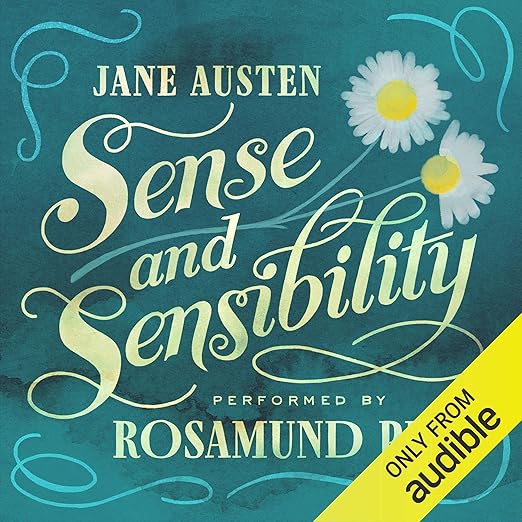
Rosamund Pike reading Jane Austen is the whole proposition here, and the audiobook is sold on exactly that basis: an Audible Exclusive, the description says, with an Academy Award nominee delivering Austen's first published novel across eleven hours and twenty-five minutes. Then you scroll down to the five posted reviews and find people discussing ribbon markers, gilt edges and a ninety-nine-cent digital copy. Not one of them mentions a voice. On a production built around a performer, that is a strange silence.
That gap is the most interesting thing on this record. When a publisher commissions a production around a specific performer, opinions about that performer normally arrive attached to the stars. Here the entire column grades editions instead. A hardbound Chiltern Classics printing with raised art on the cover. A digital file with working chapter links. A gift copy bought in Mexico for a sixteen-year-old who was curious about the English of the period. Five responses, and every one that names a format names a printed or downloaded object rather than a reading. Whatever else the column is doing, it is not reviewing what the publisher spent money on.
The likeliest explanation is dull: feedback pooled across formats, so the audio edition inherits comments left on printings that have nothing to do with it. It remains the practical situation a buyer faces. The 4.4 badge across thirteen ratings reports what people think of Sense and Sensibility, which was never seriously in doubt, and reports nothing whatsoever about whether Pike's Marianne repays eleven hours of your attention.
Pike gets a full biography in the description, and it runs longer than Austen's. She is presented as an English actress known for a Bond film and for Gone Girl, a graduate in English literature from Wadham College at Oxford, a stage and television performer before film, and a longtime admirer of Austen who played Jane Bennett in a 2005 adaptation of Pride and Prejudice. The copy also states that she recorded this novel in 2015. The record puts the release in August 2018.
Pike's Oxford Degree Doing Double Duty
Audible Studios holds the publisher line and Audible Exclusive is the format claim, a combination that normally means a production commissioned rather than licensed in. The description does at least say what it believes it is selling, calling the delivery passionate and grounding it in Pike's stated admiration for the work. That is a publisher's adjective rather than evidence, but it does tell you the reading was pitched as an interpretation and not as a straight recitation. For a novel carried almost entirely by dialogue and free indirect speech, the difference between those two approaches is not cosmetic; it decides whether the irony survives the trip from page to ear.
Jane Austen's biography on this page contains one sentence worth stopping over. It says that after graduating from Oxford, Austen survived typhus and began a literary career publishing anonymously throughout her life. Two paragraphs further down, the same page graduates Rosamund Pike from Oxford as well. One of those degrees is doing double duty. A listener who cares whether a publisher's author note can be trusted now has grounds to check the rest of it independently.
Sophia Rose wrote the longest response on the page and split it in half. The first half is pure edition review: hardbound, raised art print cover, gild-edged pages, ribbon marker, heavy paper stock, an easy-read font, giftable and collectible. The second half announces itself with a heading that stops mid-word at Book Thoug, and everything after it is gone. The portion that would have discussed the novel never made it onto the page at all.
One Empire Award, Two Different Spellings
Elinor and Marianne appear in the copy as two teenage heroines navigating a world where status and money set the terms of love, which is true as far as it goes and flattens what the book is arguing. What Austen wrote is a study of two temperaments, not of two ages. One reviewer gets nearer the mark, calling the dynamic between the sisters the most intriguing and endearing thing in it, and noting that the mother and youngest sister function largely as ornament. That reader is describing a structure the copy misses entirely, and doing it in a review that never once mentions how any of it sounds.
Empire turns up twice in Pike's biography with two different awards attached and two different spellings: an Empire Aware for Best Newcomer, then an Empire Award for Best Actress. One of those is a typing error and the other is presumably right, but a description that cannot spell the same award twice inside three lines was not proofread by anybody. On its own it is a triviality. Sitting beside the Oxford problem, it starts to look like a pattern.
Chiltern Classics in hardback, a C. E. Brock digital copy bought for ninety-nine cents with working chapter links and no typos, and a decorated hardcover given as a gift in Mexico: those are the three editions this column actually assesses. A fourth reviewer, writing from Japan, calls the author Jane Austin twice and recommends the book as a textbook on human nature since people have not changed. All five are honest responses to something. All five sit under the same badge as the recording.
Buy It for Pike, Sample It First
Newcomers to Austen have a genuine case for starting here rather than with Pride and Prejudice, which is where everyone starts. This one is shorter on famous lines and longer on the mechanics of money, and the sentence the description chooses to quote, about never expecting to meet a man one could really love, is the exact register the whole novel works in. Eleven hours and twenty-five minutes is an unintimidating length for a first attempt. Anyone who bounced off Austen at school will find the money talk considerably less dusty read aloud than it looked on a set text.
Owners of the novel in print who want a performance rather than a text will get the least out of this page, since every review they can see is about somebody else's binding. Owners who simply want Austen read aloud have one credit line and a publisher's adjective to work from. Buy it for Pike if you already know what Pike sounds like, and sample it first if you do not, because this record will never tell you.
The Short Version
- Read by: An Audible Exclusive built around Rosamund Pike, whose biography here runs longer than Austen's and says nothing about the reading itself.
- At its heart: Two sisters and two temperaments, courtship governed by money, ruinous feeling against guarded restraint, Georgian society setting the rules.
- Vibe: Wry and clear-eyed, with real heartbreak under the manners.
- Short version: The performance is the reason to buy, and it is the single thing this page offers no evidence about.
Frequently Asked Questions
Is this Sense and Sensibility audiobook complete, or abridged?
The listing never uses either word. Eleven hours and twenty-five minutes is consistent with a full text of a novel this length, and a commissioned exclusive production has little reason to cut, but the record states nothing. Anyone who needs certainty on that point should check with the publisher before buying.
Why does the description say 2015 when this audiobook shows a 2018 release?
The page contradicts itself and does not explain it. Pike's biography states that she provided narration of this novel in 2015, while the record dates the release to August 2018. A recording can sit unreleased for years, so both may be true, but the listing gives no way to confirm which date means what.
Is this a good Austen novel to start with?
It is a defensible starting point. The book runs shorter on quotable lines than Pride and Prejudice and longer on inheritance, income and the arithmetic of a proposal, which is what Austen is actually sharpest about. The length here is manageable, and the sisters give a first-time reader two clear positions to take sides between.