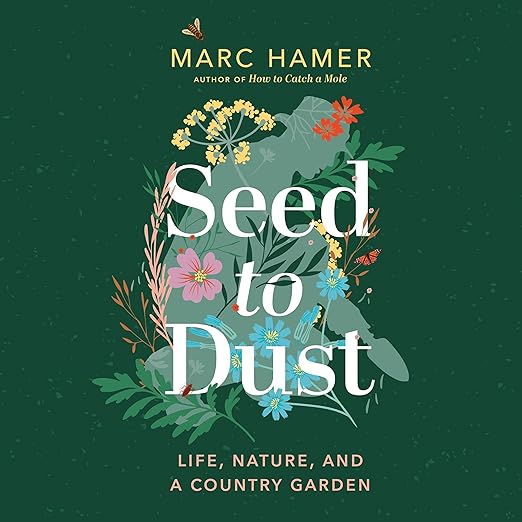
Quick Take
- Narration: Owen Teale brings a Welsh gravel and quietness to the prose that perfectly matches Hamer’s meditative rhythms; the voice earns every slow passage
- Themes: labor and impermanence, the ethics of tending something you do not own, aging and the body’s limits
- Mood: Still, ruminative, and unexpectedly emotional
- Verdict: A rare audiobook that asks the listener to slow down and rewards that patience with something genuinely affecting.
I finished Seed to Dust on a Saturday when the light was already going by four in the afternoon. I was doing nothing in particular, just listening, and I noticed at some point that I had stopped looking at my phone entirely. That does not happen often. Marc Hamer’s prose has a quality that resists distraction, not because it demands attention but because it rewards the kind of attention you forget you were giving.
The setup sounds austere: a gardener in his sixties describes a year working the same twelve-acre Welsh garden he has tended for two decades. The garden belongs to an aging woman called Miss Cashmere. It does not really belong to her either, as Hamer writes with a quiet precision that the book keeps returning to. The garden, like a book, belongs to everyone who sees it. That line arrives early and it sets up everything that follows, which is an extended meditation on labor performed without ownership, on care given without claim.
A Year in the Welsh Countryside, Chapter by Chapter
The structure is month-by-month, each chapter named for where Hamer finds himself in the garden’s cycle, and this form does exactly what it should: it lets the book breathe at the pace of the growing season rather than the pace of plot. The folklores attached to specific plants are folded into the prose without becoming a botany lesson. The observations of creatures, the creatures that hide from his blade or his rake, are specific and sometimes startling. What Hamer is doing throughout is building a portrait of attentiveness as a way of life, of what decades of close looking at a single place can accumulate into.
The biographical threads are handled with restraint. His time living homeless as a young man is not dramatized or made to carry more symbolic weight than it can bear. His marriage is present in the book as a quiet warmth rather than a narrative event. Reviewers have noted the emotional power of late passages about his wife, and one described crying at those sections, which I understand completely. But the tears are earned by a long accumulation of quiet trust rather than by any single scene. Hamer is a writer who understands that emotion arrives most forcefully when it has been kept waiting, and he manages the timing of these moments with the same patience he brings to a garden’s seasonal rhythms.
Miss Cashmere at the Edge of the Frame
One of the structural choices that I found most interesting is what Hamer does with his employer. Miss Cashmere is present throughout the book but always at the margins of his perception, glimpsed crossing the garden, exchanging brief words at the greenhouse, observed from a distance as her circumstances change. The death of her husband, the departure of her children, the increasing solitude of the stately home: Hamer registers all of this from his position on the other side of a social boundary that the book never tries to dissolve.
The restrained observation of her life from the outside functions as a parallel to his tending of the garden itself, caring for something that is not his, knowing it more intimately than its owner does, and accepting the limit of that knowledge. The relationship shifts at the book’s end in ways I will not detail here, but the shift matters and it is handled with the same refusal to over-sentimentalize that governs the rest of the book. It is among the more satisfying endings I have encountered in this kind of memoir, precisely because it costs the author something to write it.
What Owen Teale Adds to This Experience
Hamer’s prose is already calibrated for the ear, shaped by a gardener who has spent decades in solitude and silence. Teale’s narration serves the material with an intelligence that shows in every pause. He does not embellish the reflective passages with unearned emotion. He trusts the sentences. His Welsh accent, understated rather than performed, roots the listener in the landscape without becoming a marker of picturesque rural authenticity. This is one of those audiobook pairings where narrator and material feel genuinely matched rather than merely competent.
Listeners who came to this book via How to Catch a Mole, Hamer’s previous memoir about mole-catching, will find Seed to Dust more interior and more reflective. The comparison to Helen Macdonald’s Late Migrations and Amy Leach’s Vesper Flights that the publisher draws is apt in terms of the philosophical attention to the natural world, though Hamer’s register is quieter and less stylistically extravagant than either of those books. The experience of listening over several evenings, letting the book exist alongside ordinary life, suits it better than any attempt at a single sitting.
Listeners This Will Reach and Listeners It May Not
Listeners who respond well to slow, observational prose, people who loved H is for Hawk or any of Robert Macfarlane’s landscape writing, will find this deeply satisfying. Gardeners specifically will get an additional layer of pleasure from the botanical specificity and Hamer’s feel for the relationship between a person and the soil they have worked for decades. This is not the audiobook for someone seeking narrative momentum. Very little happens in the conventional sense. If your patience with meditative nature writing runs thin past the hour mark, the format may frustrate you. But if you are willing to meet the book on its terms, it offers something that feels increasingly rare: a quiet that is full rather than empty, a listening experience that stays with you past the final chapter.
Frequently Asked Questions
Do you need to be a gardener to appreciate Seed to Dust, or does it work for non-gardeners?
Multiple reviewers confirm it works without any gardening background. The botanical details are enriching but not gatekeeping; the book’s real subject is philosophy, labor, and aging, which require no horticultural knowledge to feel.
How does Seed to Dust compare to Hamer’s earlier book How to Catch a Mole?
Seed to Dust is more interior and more explicitly reflective on mortality and aging. How to Catch a Mole has more narrative texture around a specific craft. Both are meditative, but Seed to Dust reaches further into personal history and sits more quietly in its observations.
Is the relationship between Hamer and Miss Cashmere a significant emotional thread, or is she a minor character?
She is a sustained presence throughout but always at the edges of Hamer’s perception. The relationship is significant precisely because it is never sentimental or overstated. By the book’s end, it carries real weight, and the restraint with which it has been handled makes that final weight matter.
Is the audiobook’s pacing genuinely slow, or is that an impression from the literary press around it?
It is genuinely slow. Month-by-month chapters, reflective digressions on plant folklore, long passages of observation. This is a feature, not a flaw, but listeners who find Robert Macfarlane’s prose too leisurely will likely feel the same about Hamer.