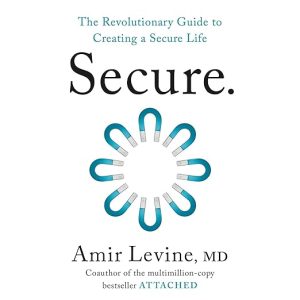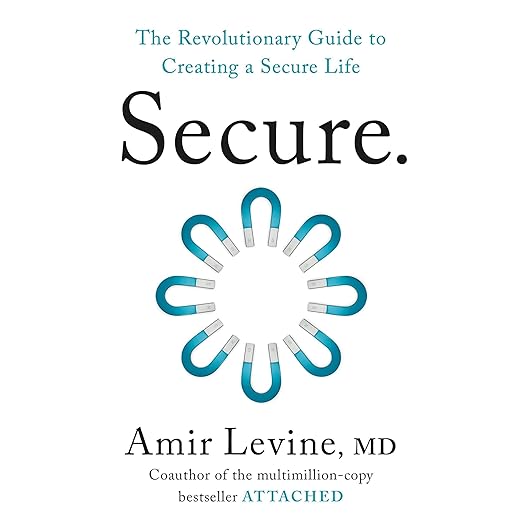
Secure arrives with a downloadable PDF of charts, visuals, and assessments. That footnote at the bottom of the description is the most practical sentence on the whole listing. Books organized around self-assessment usually lose something in audio, because nobody fills in a chart while walking the dog. Penguin Audio has handled it the ordinary way, by shipping the workbook material as a separate file, and anyone buying this audiobook should retrieve that file on day one rather than discovering it in month three.
One credit is missing here, and it deserves naming. The description introduces Amir Levine as coauthor of the multimillion-copy bestseller Attached, then never says who the other author was. The byline on this page carries a single name. Whoever wrote that earlier book alongside Levine appears in the sales pitch as a credential and vanishes from it as a person, which is a small thing on a product page and a larger one in a field where the previous book is doing most of the persuading.
The claim itself is bolder than the calm packaging suggests. Levine's earlier work introduced attachment styles to a general readership. This one argues that a secure attachment style is not something you either received in childhood or did not, but something anyone can learn to build in adulthood. He calls the destination secure mode, and the description promises that current research supports the transition regardless of how insecure a person feels today. That is a substantial claim about adult change, and it is the reason to listen or to hesitate. Nothing else in the description matters nearly as much as whether you accept that premise.
A long list of benefits follows, and it deserves scrutiny before purchase. People living in secure mode, the description says, tend to be healthier and to deal better with their health care providers; when seriously ill they report fewer symptoms and handle it better emotionally; job searches go more effectively and self-esteem suffers less; they are less susceptible to consumerism and navigate social media with fewer negative effects. Every item might be accurate. Not one carries a citation on this page, and a listener should notice the moment a benefit list stops reporting findings and starts selling.
Robert Petkoff Reads a Book Built to Be Worked
That said, the authority behind the argument is real and specific rather than borrowed. Levine is a psychiatrist and neuroscientist, and the framework offered here has a name and a practice attached, Secure Therapy and Coaching, instead of existing only between two covers. Trade psychology frequently rents its credibility from research the author never conducted. This one comes from someone whose earlier book became the common vocabulary through which a general audience discusses attachment at all, which is an unusual place to be writing from. The follow-up problem is real, though: a second book has to justify itself against the first one.
This material also suits nine hours better than most books in the category. Attachment theory asks a reader to hold several categories in mind simultaneously and then apply them to their own history, which is exactly the sort of thinking that benefits from a steady pace and a voice keeping the distinctions audible. Robert Petkoff reads it rather than the author, and that choice carries a consequence worth stating: the book will sound like a book, not like an hour with a clinician who has heard your story.
Nothing in the description promises a quick fix, which counts in its favor. The stated goal is cultivating security so that readers can thrive, with the tools described as practical and neuroscience-backed rather than transformative or life-changing. Taken together with the assessments in the companion file, that points to a book meant to be worked through instead of simply absorbed, and nine hours is a sensible size for something you will pause, replay, and come back to with a chart open beside you.
The Companion PDF Nobody Has Reviewed Yet
What this page cannot supply is any independent verdict whatsoever. No listener has weighed in yet, the rating field stands empty, and with an April 14, 2026 release date the listing offers no account of how the material actually lands. For a book making a claim about personal change, that absence is more than cosmetic. The interesting question about a title like this is never whether the science is explained well, but whether anyone finished it and then did anything differently afterward.
Two things about the companion file are worth checking early. Downloads of this kind are usually retrieved through a library page rather than the player itself, and they are genuinely easy to miss; more importantly, a book that ships charts and assessments separately is a book that expects you to stop and work. Anyone planning to run this at double speed between other tasks will collect the theory and skip the mechanism, which in a book about practice is most of what was being sold.
For readers who already know their own attachment style, a different caution applies. A framework announcing that anyone can become secure is easy to hear as an instruction, and the distance between learning to create a secure life and being told your insecurity is a solvable personal failing is narrower in practice than it looks on paper. Nothing in the description makes that mistake. A listener currently inside an anxious relationship should still keep it in mind, and treat the assessments as description rather than as a verdict.
Attached Readers Wanting a Next Step Forward
If Attached handed you the vocabulary and left you wanting the next step, this is explicitly built to be that step, and the audio edition ships with the workbook material intact. Anyone new to attachment theory can begin here, since the description restates the framework before extending it. Anyone who wants peer-reviewed sourcing rather than a trade summary should wait for a sample or go to the underlying literature, because a book with this many outcome claims and no visible citations will frustrate that reader within an hour.
Where this ultimately lands depends on whether the promise survives contact with practice, and nobody on this listing can tell you that yet. What can be said is that the proposition is coherent, the author has standing to make it, the length fits the material, and the format problem that usually ruins assessment-driven audio has been anticipated instead of ignored. Download the PDF first, then press play. On a listing this bare, the accompanying file is the only concrete thing a buyer can actually verify.
Before You Listen
Does the Secure audiobook include the charts and assessments?
Yes. The description states that this edition comes with a downloadable PDF containing charts, visuals, and assessments taken from the book. Retrieve it before starting, since the exercise material is what turns this theory into something usable, and files of this kind are easy to forget about entirely.
Do I need to read Attached before this audiobook?
Not required. The description restates the attachment framework before building on it, so a newcomer can follow the argument. Readers who already know the earlier book will get more, since this one positions itself as the practical sequel to a theory millions of people first encountered there.
Who narrates it, and does Amir Levine read his own work?
Robert Petkoff narrates the nine-hour edition, so the author does not read it himself. That keeps a professional reader between you and the clinical material, which some listeners prefer for dense psychology and others miss when the subject is personal. No reviewer has commented either way yet.