Before You Press Play
- Voice: Samantha Brentmoor balances banter and real danger solo, carrying the push-pull chemistry a two-hander romance usually splits across two narrators.
- Big ideas: Secret killer meets small-town doctor, found family within a touring circus, trust rebuilt after professional collapse
- Atmosphere: Dark and funny and spice-forward, brutal and tender in close alternation
- Worth it?: A satisfying, tonally confident close to the Ruinous Love Trilogy, best enjoyed after its two predecessors rather than as a cold open.
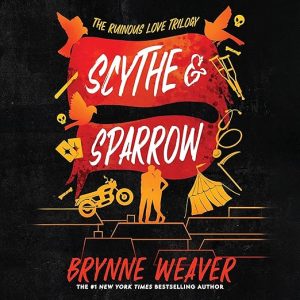
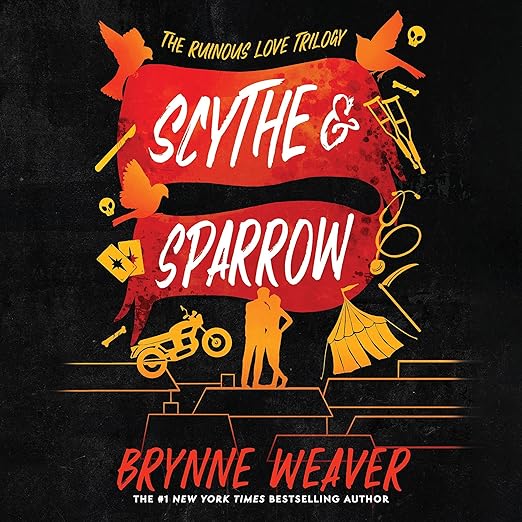
Scythe & Sparrow closes out Brynne Weaver's Ruinous Love Trilogy with its most domestic setup yet, a small-town doctor and a traveling circus performer, and this audiobook earns its place as a satisfying finale precisely because Weaver doesn't abandon the series' murder-and-mayhem premise just because the setting shrinks. Dr. Fionn Kane has fled Boston and a broken engagement for a quieter life in small-town Nebraska; Rose Evans has spent a decade touring with the Silveria Circus, moonlighting as a killer whenever the mood strikes, and a botched job leaves her injured and stuck recovering in the home of the very doctor she didn't expect to fall for.
As the third and final entry following Butcher & Blackbird and Leather & Lark, this book carries the weight of concluding a trilogy built on a genuinely odd but durable premise, ordinary-seeming professionals paired with secret killers, played simultaneously for dark comedy and real romantic stakes. Reviewer Cheyann's description gets at the tonal balancing act precisely: 'equal parts brutal and tender,' sharp humor and emotional depth woven into 'deliciously twisted romance' rather than any one tone dominating the others.
The friends-with-benefits structure gives Weaver a slower emotional build than a straight enemies-to-lovers or fated-mates setup might, and reviewer Rikki Lauzon singled this entry out as her favorite of the three specifically because the relationship 'felt relatable,' an interesting note for a book about a circus-performing serial killer and a surgeon rebuilding his life after a professional collapse. That relatability, grounded in small-town routine and slow-burn trust-building, is what keeps the book's darker premise from tipping into pure shock value.
Weaver's decision to give Fionn, not Rose, the fleeing-Boston backstory flips a common romantic-suspense convention, where the woman is more often the one running from a shattered old life into a small town's protection. Here it's the surgeon whose career and engagement collapsed, and Rose, despite her secret double life, is by comparison the more settled, established presence in Nebraska by the time the book opens, a decade into circus touring and comfortable in her own skin. That inversion gives their power dynamic a different shape than the genre's default, with Fionn arriving as the one needing to rebuild rather than the one already grounded.
Samantha Brentmoor Carries Fionn and Rose Solo
Narrator Samantha Brentmoor has an established track record in contemporary romance narration, including multi-narrator hockey romance productions requiring distinct chemistry between paired voices, and that comfort with romantic tension translates directly to carrying Fionn and Rose's push-pull dynamic across eleven-plus hours solo. The comedic register Weaver's prose depends on, banter that stays sharp even during genuinely tense chapters, asks for a narrator who won't oversell either the jokes or the danger, and Brentmoor's romance-genre experience suggests she understands that specific balance.
Reviewer Brandy Sisler's own review title captures the book's core appeal directly: Small Town Magic and Circus Shadows, the juxtaposition of a quiet Nebraska setting against Rose's circus background and secret double life. Hearing that contrast performed aloud, ordinary small-town scenes shifting suddenly into circus flashback or violence, gives the tonal whiplash Weaver is going for a clearer shape than silent reading might, since vocal pacing can signal the shift before the content itself makes it obvious.
The circus setting itself demands specific vocal texture Brentmoor has to sustain across a full trilogy-closing runtime, performance patter, ensemble camaraderie among Rose's fellow performers, and the sharp tonal pivot into her private, violent double life, all within scenes that sometimes shift between registers in a single chapter. Maintaining Rose as a coherent single character across that range, rather than letting the circus-performer and the killer read as two separate people the audience has to reconcile, is the narration's real technical achievement.
An Online Fanbase With Strong Trope Opinions
This is explicitly billed as spice-forward, and the synopsis itself doesn't hide the mature content; combined with the murder-and-mayhem premise, listeners sensitive to violence played for dark comedy, alongside explicit romantic content, should know both are structural to the book rather than incidental. The dark-romantic-comedy label in the synopsis is doing real work; this isn't a gentle small-town romance with a light thriller subplot, and listeners should expect that blend to hold steady across the entire eleven-plus-hour runtime rather than easing off once the central couple gets together.
As the third book in a trilogy, Scythe & Sparrow assumes at least passing familiarity with the Ruinous Love world's rules and recurring side characters from Butcher & Blackbird and Leather & Lark; jumping in cold is possible given each book's fresh central couple, but references to the earlier books' events land with more weight for readers who've followed the whole trilogy. The rating base here is also still building, twenty-one ratings at a strong 4.4 average, thinner than the earlier trilogy entries have likely accumulated by now.
Weaver's breakout with Butcher & Blackbird means this series carries an unusually online, engaged fanbase with strong opinions about pacing and trope delivery, worth knowing if you're coming to the trilogy from traditional romance recommendation channels rather than social media, since expectations set by that fandom, heavy banter, fast spice escalation, may run ahead of what a first-time Weaver reader expects walking in cold.
Competence That Masks Real Vulnerability Underneath
This fits existing Ruinous Love readers looking for a satisfying trilogy conclusion, and romance listeners generally drawn to Weaver's specific blend of dark comedy, murder-adjacent stakes, and genuine emotional depth, the combination that made Butcher & Blackbird a breakout hit in the first place. Fans of morally gray heroines and grounded, slow-burn small-town romance will find both elements well represented here.
Listeners who've heard Weaver's other trilogy entries will recognize her recurring interest in professionals whose competence masks real vulnerability, a pattern that runs through the whole trilogy and reaches maybe its most literal expression here, a surgeon whose steady hands off the page mask a genuinely broken sense of who he is after his career derailed. That thematic consistency is worth knowing if this is your introduction to Weaver specifically, since it signals what to expect from her other work too. Listeners drawn to romance with a strong comedic voice, banter-forward dialogue that never lets the darker plot elements curdle into pure grimness, will find that balance sustained reliably across all eleven-plus hours here, not just in the opening chapters before the plot gets moving.
Listeners who prefer their romance without violence, dark humor, or explicit content should steer toward a gentler corner of the genre entirely, since none of those elements are softened for a broader audience here. Anyone starting the trilogy with this book specifically, rather than Butcher & Blackbird first, will still follow the central romance but should expect occasional references to earlier events that land better with full trilogy context.
Do I need to listen to Butcher & Blackbird and Leather & Lark before the Scythe & Sparrow audiobook?
Not strictly, since each book follows a new central couple, but references to earlier events land with more weight if you've heard the full trilogy first.
How explicit is the Scythe & Sparrow audiobook?
Quite explicit. The synopsis bills it as spice-forward, and both the romantic content and the violence tied to Rose's secret life are played straightforwardly rather than softened.