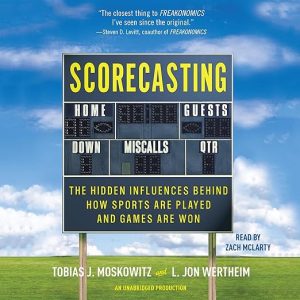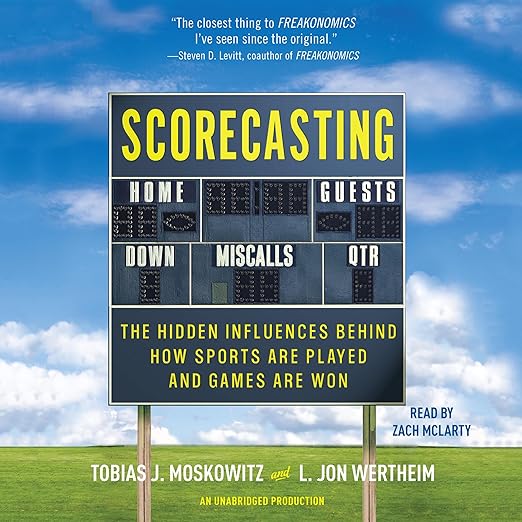
Tiger Woods missing crucial putts under pressure turns out to follow the exact same psychological pattern as an amateur golfer three-putting on a random weekend round, and that leveling instinct, elite athletes are still human, still measurably biased, still subject to the same behavioral quirks as the rest of us, is the engine driving this audiobook from start to finish. Scorecasting pairs University of Chicago behavioral economist Tobias Moskowitz with veteran Sports Illustrated writer L. Jon Wertheim, though the credited byline here lists Moskowitz alone, and the two spend nine and a half hours dismantling sports myths with actual data rather than sports-talk-radio intuition.
The Verdict, Briefly
The book's real craft achievement is structural: rather than building one sustained argument, Moskowitz and Wertheim assemble a series of self-contained myth-busting cases, home-field advantage, the defense-wins-championships axiom, umpire bias, the mythical hot hand, and let the accumulated weight of independently convincing chapters make the larger point that sports intuition is worth far less than sports data. One reviewer notes the non-sequential manner of chapters directly, and confirms it works in the book's favor rather than against it, keeping each argument tight and self-contained.
What keeps this from reading as a dry statistics text is the specificity of the examples chosen. A chapter on referees swallowing the whistle, declining to call fouls late in close games, and one on NFL coaches avoiding fourth-down conversions even when the math clearly favors going for it, both take a vague, commonly griped-about frustration and give it a precise behavioral explanation. That specificity is what one reviewer means calling the statistics not too overwhelming despite the book's genuinely rigorous research base.
The title itself is a portmanteau worth noting: scorecasting, part sports scorekeeping, part forecasting, and it signals the book's actual project more precisely than a generic sports-statistics title would. Moskowitz and Wertheim are not just recording what already happened in a given game; they are using accumulated data to predict and explain recurring patterns across the sport as a whole, a meaningfully more ambitious undertaking than a highlight-driven sports book, and the title earns its cleverness by describing that ambition accurately rather than just sounding catchy.
The chapter on draft-pick overvaluation is a good test case for the book's method generally: rather than simply asserting that teams misjudge draft value, Moskowitz and Wertheim's economics background lets them quantify exactly how and why decision-makers under pressure, with careers and reputations on the line, systematically overpay for perceived potential rather than proven production. That willingness to quantify a widely-suspected bias rather than just naming it anecdotally is what separates this from typical sports-talk commentary.
What Makes Scorecasting Worth Hearing
Zach McLarty narrates, and popular sports-economics writing like this depends on a narrator who can move fluidly between statistical explanation and genuine storytelling, sections range from Augusta's greens to a small parochial high school football program in Arkansas, without either register feeling like a jarring gear change. Based on the book's structure, a wide swing between data-driven argument and vivid on-the-ground sports writing, that range is exactly what the narration needs to deliver.
Reviewers reach for the same comparison repeatedly, one calls it Freakonomics but with sports, another goes further and calls it Freakonomics applied to sports directly, with a third invoking Malcolm Gladwell's Outliers and The Tipping Point in the same breath. That is a meaningful signal for audio specifically: Freakonomics itself became a genuine audio and podcast phenomenon partly because its narrative-driven approach to data translates unusually well to listening, and Scorecasting appears built from the same successful formula.
The book's intellectual lineage is worth naming directly. Moskowitz draws explicitly on research from fellow economists including Richard Thaler, a bestselling author in his own right and a foundational figure in behavioral economics, the broader field examining how real human decision-making departs from purely rational models. Positioning Scorecasting within that lineage rather than treating its sports insights as standalone trivia gives the book a sturdier intellectual spine than a typical surprising-sports-facts collection would have.
Points to Consider
The byline on this edition lists Tobias Moskowitz alone, but the synopsis is explicit that Scorecasting is a genuine collaboration with L. Jon Wertheim, a longtime Sports Illustrated writer whose narrative sensibility likely accounts for a meaningful share of the book's storytelling appeal. Worth knowing this is a true two-author work even where the credited byline suggests otherwise.
Despite carrying a science-engineering tag alongside sports-outdoors, this is behavioral economics and statistics applied to sports, not an engineering or hard-science book in any meaningful sense. Listeners drawn in expecting mechanical or technological content, stadium design, equipment innovation, will find instead a book about decision-making, bias, and incentive structures. The mislabeling is worth flagging directly so expectations land correctly before you commit nine and a half hours.
This book is now well over a decade past its original publication, and sports analytics as a field has moved considerably since Moskowitz and Wertheim first wrote it, some of the specific findings here helped kick off a wave of similar sports-data writing that followed. That does not diminish the book's core arguments, but listeners already steeped in more recent sports-analytics content may find a few of the individual data points feel foundational rather than cutting-edge at this point.
A 4.3 average across 426 ratings is respectable but sits a bit lower than the strongest performers in this same behavioral-economics-meets-pop-nonfiction category, worth naming honestly rather than glossing over. Nothing in the reviewer commentary here points to a specific complaint driving that gap, praise across all three cited reviews runs enthusiastic, which suggests the softer average may simply reflect a smaller, more specialized listener base rather than any real quality shortfall.
The specific comparison to Tiger Woods drawn in the opening also deserves a caveat: golf's individual, high-pressure putting scenario is a cleaner behavioral-economics case study than most team-sport situations discussed later in the book, where crowd effects, teammate dynamics, and coaching decisions complicate the data in ways a single golfer's psychology does not. Worth noting that the book's arguments vary somewhat in how cleanly they isolate a single behavioral cause.
Should You Listen to Scorecasting?
Fans of Freakonomics, Malcolm Gladwell, or narrative-driven data journalism generally will feel instantly at home here, and sports fans specifically get the added pleasure of having long-standing on-air debates, does defense really win championships, is the hot hand real, addressed with genuine rigor rather than opinion. You do not need a stats background to follow the arguments; the writing does the translation work for you.
Skip it if you came expecting genuine engineering or hard-science content based on the genre tag, that label does not match what is actually inside, or if you have already read extensively in the sports-analytics space that followed this book and want something covering newer research rather than a foundational, now-influential entry in the genre.
Frequently Asked Questions
Who actually wrote the Scorecasting audiobook?
The synopsis credits both Tobias Moskowitz and longtime Sports Illustrated writer L. Jon Wertheim as co-authors, even though this edition's byline lists Moskowitz alone.
Does this audiobook require a background in statistics?
No. One reviewer specifically notes the statistics are not too overwhelming, and the book translates its data-driven arguments through specific, accessible sports examples rather than technical jargon.
How long is the Scorecasting audiobook?
It runs 9 hours and 31 minutes, covering myths across basketball, baseball, football, and hockey in independently structured, non-sequential chapters.