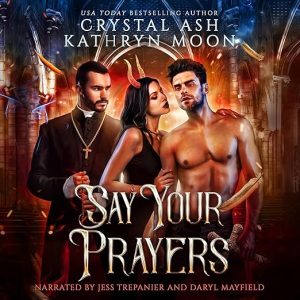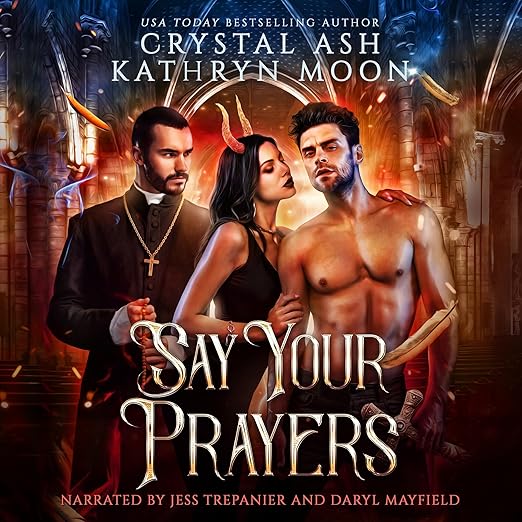
Deyva's horns catch the porch light first, then Father Stavros sees the rest of her: a succubus standing at his gate, begging for the one thing his order exists to offer strangers. Would a demon spat up from Hell's Rising really cross a church threshold just to hide, rather than to hunt? That question sits at the center of this audiobook adaptation of Crystal Ash and Kathryn Moon's Say Your Prayers, and Jess Trepanier's narration never lets it resolve too quickly. Bethel's three priests, jaded and battle worn after Hell has already swallowed most of Earth, are forced to choose between the faith that built them and the woman their faith tells them to fear. Twelve hours and forty-seven minutes later, that choice has reshaped every one of them, and the listener along with them.
Bethel's Gate Is the Last Real Wall
The premise reads like a dare: fold apocalyptic horror, reverse harem romance, and rectory politics into one standalone story and see if any of it holds together. It mostly does. Hell's Rising is not backstory here, it is an active, encroaching threat that keeps Bethel's gate feeling like the last real wall between order and collapse, which gives the romance plot an urgency a quieter setting could not manufacture. Stavros, Zach, and Kais each carry a distinct reason to distrust Deyva, and the book earns the slow thaw of that distrust instead of skipping straight to attraction. One reviewer, writing as Attempting to Amanda, joked that the setup makes Dan Brown's angels and demons look tame by comparison, three burly priests and a succubus included, and that comparison is not far off the mark.
Hell's Rising itself gets treated with more specificity than the setup might suggest; this is not a vague apocalypse hovering in the background. Bethel exists as one of the last named strongholds still standing, its gate a literal and symbolic line between whatever survived on the human side and whatever Hell's forces are still actively hunting. That concreteness gives Stavros, Zach, and Kais's decision to shelter Deyva real weight beyond a simple moral dilemma, sheltering her is framed as an active tactical risk to the very fortress keeping everyone else alive, not just a private crisis of conscience playing out in isolation from any larger stakes.
Jess Trepanier Sounds Like Second Nature Here
Jess Trepanier has narrated enough paranormal romance and reverse harem fiction that the genre's specific demands (multiple male love interests who each need a distinct voice, spice scenes that require tonal composure rather than embarrassment, sudden pivots between dread and desire) sound like second nature in her delivery. That composure matters more than usual here, since Say Your Prayers keeps swinging between confessional-booth intimacy and full battlefield stakes, sometimes within the same chapter. She also handles the faith-versus-temptation arc with real emotional range, letting Stavros sound genuinely torn rather than performing a conflict he has already resolved. A reviewer going by Murphy, who posts as JustAMomAndHerSmut, praised Devya as a strong female character even while wishing she had come across as a little more fierce before the rescue arrives, and Trepanier's reading gives that complaint room to breathe rather than flattening Deyva into a passive damsel.
The M/M content folded into the reverse harem structure gets the same steadiness, never treated as a side note to the main romance but as its own real thread between the priests themselves. Reviewer Callirhoe called the result 'delightful, loving, polyamorous porn,' meaning it as a compliment to how unashamed the book stays about its own premise, priests loving priests without narrative punishment, a succubus treated as a person rather than a monster to be redeemed. That confidence in tone is exactly what a reverse harem audiobook needs from its narrator, since any hesitation in the performance would undercut the story's whole argument that desire and faith are not automatically at war.
Three Detailed Reviews but Just One Rating
This is unapologetically explicit material, and the listing's own genre tags, erotica alongside literature and fiction and even science fiction and fantasy, undersell how central the spice is to the reading experience. Reviewer Attempting to Amanda opens her write-up with a full content warning covering biblical themes, graphic sex, murder, death, violence, religion, and religious taboo, and every item on that list shows up on the page in some form. Callirhoe's own framing is the fairest summary available: this is not written for readers 'who take their Christianity seriously,' since it stages sex scenes inside a church and treats angels, demons, and clergy with a playfulness some listeners will find liberating and others will find genuinely uncomfortable. Know which listener you are before pressing play, because the book has no interest in softening that mix.
The runtime also front-loads a lot of world building, Bethel's gate, the priests' distinct backstories, the shape of Hell's Rising itself, before the romance plot fully ignites, so listeners expecting the spice to start in chapter one should budget some patience for the first stretch. The standalone framing cuts both ways: everything resolves inside these twelve hours and forty-seven minutes, giving real closure, but also meaning the found-family dynamic between Deyva and all three priests has to be built and paid off without a sequel to lean on. Reviewer Murphy rated it four stars rather than five, in part because the ending, satisfying as it is, arrives fast.
The listing shows a single rating despite three detailed, enthusiastic reviews, worth noting honestly rather than treating the 4.4 average as a broad consensus. What the three reviews do agree on, independently, is the book's confidence in its own premise; none of the three reviewers express discomfort with the concept itself, even while disagreeing on smaller points like how physically assertive Deyva should have been. That consistency across genuinely different reviewers is a more useful signal than the numerical rating alone for a title this new and this specific in its niche.
Block Out Time for Twelve-Plus Hours
Fans of reverse harem romance who want their apocalypse dialed all the way up, readers who enjoy the collaborative energy of Crystal Ash and Kathryn Moon's joint projects, and anyone who wants clergy-adjacent forbidden romance without a hint of shame about the premise will find exactly what they came for. The M/M thread makes it a good fit for listeners who want a reverse harem where every relationship inside the group carries real weight, not just each man's bond with the heroine. Twelve hours and forty-seven minutes is a real commitment, so block out time rather than expecting a quick single-sitting listen.
Anyone allergic to religious iconography played for both eroticism and genuine spiritual stakes should give this one a pass entirely, since the church setting is not incidental set dressing, it is the whole engine of the conflict. Readers who prefer their romance kept separate from graphic violence will also want to look elsewhere, given how directly Hell's Rising intrudes on the love story. And if angels-and-demons apocalyptic fiction only appeals to you when it stays fully clean, Say Your Prayers was never going to be the audiobook that changes your mind, no matter how confidently Jess Trepanier delivers it.