Key Details
- Narration: Virtual Voice handles the conversational, direct prose adequately, though the synthetic delivery flattens the warmer anecdotal passages.
- Themes: People-pleasing patterns, conflict avoidance, assertive communication
- Mood: Practical and quietly encouraging
- Verdict: A compact, clear-headed guide for anyone who rehearses difficult conversations in their head but never quite manages to have them out loud.
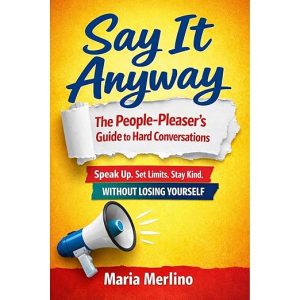
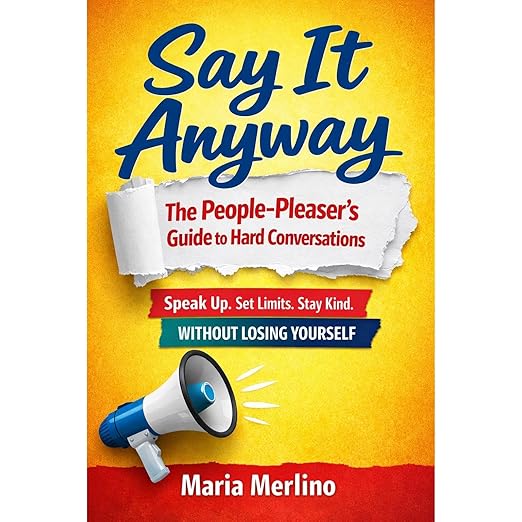
People-pleasers rarely lack the words. They know exactly what they want to say. The problem is that the words never make it out of the rehearsal stage, circling endlessly in the mind while the actual conversation goes safely unsaid. Say It Anyway The People-Pleaser's Guide to Hard Conversations, this audiobook by Maria Merlino, takes that specific inner experience seriously rather than dismissing it as mere timidity. The result is a guide that feels less like a lecture from someone who never struggled with conflict and more like advice from someone who has been there and mapped the exit route with care.
Naming the Body's Reflex to Avoid Conflict
Merlino structures the book around a pattern that will feel immediately familiar to anyone who defaults to keeping the peace: you swallow your words, smooth things over, and appear to everyone around you as kind and dependable, while internally you're accumulating resentment and fatigue. The book doesn't frame this as a character flaw but as a learned survival strategy, one that once served a purpose and can be unlearned without becoming someone harsh or confrontational. That framing alone sets a more useful tone than most books in this space, which tend to treat people-pleasing as a personality defect requiring aggressive correction.
The practical sections are where the book earns its runtime. At just under two hours and forty minutes, it doesn't have space for extended dives, but it uses that brevity well. Merlino covers how the body physically reacts to anticipated conflict, why guilt and anxiety specifically conspire to keep silence in place, and how the mind constructs elaborate justifications for not saying what needs to be said. Understanding the mechanism doesn't automatically dissolve it, but it does make it easier to recognize in the moment. There's value in being able to name the thing that's happening before you make the familiar choice to stay quiet again. That naming process, which Merlino walks through with patience and real examples, is one of the most practically useful things the book offers.
Synthetic Narration That Still Delivers Clear Guidance
The audio format suits the material well. Self-help writing of this kind benefits from being heard rather than read, partly because the listening experience itself mimics the conversational dynamic the book is teaching. You're receiving information directly, without the option to skim past the uncomfortable parts. The Virtual Voice narration is functional if not expressive; the synthetic quality mutes some of the warmer anecdotal moments, but it doesn't undermine the clarity of the guidance itself. The advice lands clearly even when the voice delivering it lacks the inflection that a human narrator might bring to the same sentences.
After You Speak, and What Silence Costs
What distinguishes this from similar titles is the attention paid to what happens after you speak. Merlino doesn't treat the difficult conversation as the endpoint. She addresses what to do when someone pushes back, when emotions rise and threaten to tip the exchange into something messier than you intended, and how to stay steady when the other person doesn't receive your honesty with immediate gratitude. That section alone is worth the listening time for anyone who has ever successfully said something difficult only to find the response made everything feel worse. Most guides stop at the moment of speaking. This one keeps going.
There's also a chapter on what Merlino calls the hidden cost of silence: the gradual confusion and growing distance that settles into relationships when honest communication is chronically withheld. Resentment, she argues, is not a sudden thing but a slow accumulation of unsaid truths. That reframing is useful because silence feels like safety, but Merlino makes the case that over time it produces exactly the relational damage that honest conversation was supposed to prevent. When you hold everything in, relationships become confusing. The people around you are responding to the version of you that appears, not the one that's actually present, and the gap between those two people widens every time you choose not to say the thing that matters.
Recognizable Scenarios Without Much Scaffolding
The book's compact format means it covers considerable ground without lingering long enough on any single technique to fully embed it. Listeners who prefer extended exercises, worksheets, or scripted practice dialogues will find the pace a little fast. There's guidance here, but implementation depends on the listener's willingness to take the principles and apply them in real contexts without much scaffolding beyond what the book provides. That's not a fatal limitation, but it's worth knowing before arriving expecting a step-by-step workbook with built-in accountability structures.
The examples Merlino draws on are recognizable workplace and domestic scenarios: the conversation you've been putting off with a colleague, the limit you've never quite managed to set with a family member, the request you've framed seventeen different ways in your head but never actually made. The familiarity is a strength, not a weakness. It makes the material immediately applicable rather than abstractly instructional. You won't struggle to find yourself in these pages, which is both the book's appeal and the quiet discomfort that makes it worthwhile. Recognizing yourself in a pattern is the precondition for changing it.
Chronic Conflict Avoiders Can Finish This Fast
This audiobook is well-matched to listeners who recognize themselves in the pattern Merlino describes: chronic conflict avoiders who are tired of replaying conversations in their heads and ready for a practical, non-aggressive path toward honesty. It works equally well for therapists, coaches, or managers looking for a clear, accessible framework to share with people navigating exactly this challenge. Those who prefer heavily research-driven texts with clinical citations may find it too conversational, and anyone looking for advanced negotiation strategy will need a longer, denser resource. But for its intended audience, the person who wants to stop losing themselves in the effort to keep everyone else comfortable, Say It Anyway lands with both clarity and genuine compassion. The brevity is a feature: this is a book you can finish in an afternoon and carry into the next difficult conversation the same day.
Before You Listen
Is the Say It Anyway audiobook appropriate for someone who has already read extensively on assertiveness?
It may feel familiar in places. The book covers core concepts in people-pleasing and assertive communication clearly, but it doesn't introduce advanced frameworks. Those with a background in therapy or extensive self-help reading will find it a useful refresher rather than new territory.
Does the Virtual Voice narration affect the listening experience significantly?
The synthetic narration is serviceable and easy to follow, but it reduces emotional warmth in the more anecdotal sections. Listeners sensitive to AI narration may prefer the print or ebook edition alongside the audio.
At under three hours, does this audiobook give enough depth to actually change behavior?
It provides a solid framework and practical techniques, but behavior change requires application beyond the listening session. Think of it as a clear map rather than a guided tour: you'll need to do the walking yourself. The book acknowledges this and focuses on giving you the tools to start.
Can this audiobook help with specific high-stakes conversations like asking for a raise or addressing a serious relationship issue?
Yes, though not with scripted dialogue specific to those situations. Merlino covers preparation, word choice, emotional regulation, and handling pushback in ways that apply across contexts. Listeners may want to supplement with scenario-specific practice after finishing.