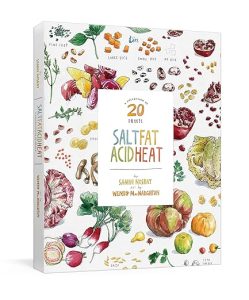
Salt, Fat, Acid, and Heat are the four words Samin Nosrat built an entire cooking philosophy around, and this audiobook is her explaining that philosophy directly, in her own voice, over roughly seven and a half hours. Worth knowing upfront: the retail listing attached to this title actually describes a separate boxed set of twenty art prints by Wendy MacNaughton, the illustrator who worked alongside Nosrat on the original book, rather than the audiobook's own content, which means every listener review attached here is really about framed kitchen art rather than the narration, structure, or usefulness of the spoken material itself.
Four Elements Build a Philosophy Beyond Recipes
Setting the listing mismatch aside, the real Salt, Fat, Acid, Heat is a James Beard Award-winning cooking guide organized around exactly those four elements as a mental framework for understanding food, rather than a straightforward recipe collection to follow step by step. Nosrat's pitch is that mastering the balance of salt, fat, acid, and heat teaches a cook to improvise confidently, which is a genuinely different, more foundational kind of instruction than most cookbooks attempt.
Nosrat's approach to the four elements also reflects a specific pedagogical philosophy: rather than dictating exact measurements, she teaches listeners to taste and adjust continuously, building intuition through repetition rather than rigid adherence to a recipe's stated quantities. That philosophy translates unusually well to audio specifically, since it is built around an ongoing internal conversation between cook and ingredient rather than a static, glance-at-the-page instruction.
Salt, Fat, Acid, Heat has become something of a modern culinary touchstone since its original publication, frequently recommended alongside classic technique-focused cooking references precisely because it teaches principles rather than a fixed repertoire of dishes. That reputation is independent of and considerably older than the confusion around this particular listing, which speaks to how firmly established the underlying book really is regardless of how any single retail listing happens to be organized.
The book's original print edition leans heavily on Wendy MacNaughton's illustrations, hand-drawn diagrams and visual explanations that are, by design, part of how the material teaches. An audio-only format necessarily strips that visual layer away entirely, which is a real structural limitation for this specific book, arguably more than for most cookbook adaptations, given how much of the original teaching happens through MacNaughton's art rather than prose alone.
The four-part structure, one section each for salt, fat, acid, and heat, gives the audiobook a clear, teachable shape even without the visual component: each section builds toward a genuine, transferable cooking principle rather than a list of dishes to memorize, which is part of why the book found an audience well beyond typical cookbook readers.
Nosrat's Chez Panisse Training Shows in Her Warmth
Nosrat trained as a cook at Chez Panisse before becoming a teacher and writer, and that background shows in her narration: warm, digressive, genuinely enthusiastic rather than clinical or recipe-card flat. Self-narration by an author with this much real teaching experience is close to essential for a book whose whole appeal rests on making technique feel approachable rather than intimidating.
The four words in the title function as a genuine teaching sequence, not just a catchy label: Nosrat orders her framework so listeners build an intuitive feel for seasoning, richness, brightness, and temperature control in that specific progression, each concept building on the last. Hearing that sequence explained aloud, in the voice of the person who developed the framework through her own years of professional kitchen experience, gives the audiobook a classroom quality that a silently read cookbook cannot quite replicate.
The book's cultural footprint extends well past the page: one reviewer attached to this listing mentioned watching the Netflix docuseries adaptation before buying these prints, confirming the book's reach into a much wider audience than cookbook readers alone. That adaptation and the book's James Beard Award are real, independently verifiable signals of its broader reputation even though none of the reviews attached to this specific audiobook listing address the audio content directly.
Because the small handful of reviews that do exist here barely touch at all on what the audiobook itself actually sounds like or how it holds together as a listening experience, this assessment leans more heavily than usual on the book's well-documented broader reputation, its award, its adaptation, its enduring popularity among home cooks, rather than on direct listener testimony about the audio itself.
These Reviews Rate Art Prints, Never the Audio
The single biggest thing to know before pressing play: the reviews attached to this listing describe a companion art print set, not the cooking guide itself. Anyone drawn in by the 4.8-star rating should understand that rating reflects satisfaction with framed illustrations for a kitchen wall, not confirmation of the audiobook's own quality, however good the underlying book actually is.
Even setting that mismatch aside, this remains a visually driven cookbook at heart, and audio strips away MacNaughton's diagrams entirely. Listeners who learn best from visual technique demonstrations should seriously consider pairing the audiobook with the print or ebook edition rather than relying on audio alone for a subject this hands-on.
At seven hours and thirty-eight minutes, the audiobook covers Nosrat's core framework thoroughly without dragging, but it is, by nature, a conceptual and philosophical cooking guide rather than a quick-reference recipe book, so listeners wanting fast, specific recipes to follow along with should adjust their expectations accordingly.
Shoppers specifically interested in the audiobook itself, rather than the MacNaughton print collection this listing's reviews actually describe, should confirm they are purchasing the roughly seven-and-a-half-hour audio edition narrated by Nosrat before completing any purchase, given how easily the two distinct products appear to have been conflated on this specific listing.
Home Cooks Wanting Philosophy Over Quick Recipes
This audiobook suits home cooks who want the underlying framework and confidence-building philosophy behind good cooking, rather than a straightforward recipe-by-recipe reference, along with fans of the Netflix adaptation curious about the source material in Nosrat's own voice.
It also works well for listeners who enjoy a warm, teacherly narrator and do not mind conceptual, technique-focused instruction over quick, actionable recipes, since that is genuinely the book's core mode throughout. It also rewards repeat listening, since the four-part framework is designed to be internalized gradually through practice in an actual kitchen rather than absorbed completely on a single pass.
It is less well suited to complete beginners who want their hand held through a first meal step by step, since the book's whole premise is building judgment and adaptability rather than walking through a single fixed recipe from start to finish.
Cooks who need to see illustrated technique diagrams to really absorb the material, and shoppers specifically looking for the art print set given the confusion baked into this specific listing, should look elsewhere or pair this audiobook directly with the print edition instead.
Does this audiobook include Wendy MacNaughton's illustrations?
No. The original book relies heavily on MacNaughton's hand-drawn diagrams, and audio cannot reproduce them, so pairing the audiobook with the print or ebook edition is worth considering.
Why do the reviews for this audiobook talk about art prints instead of cooking?
This listing's own product description actually points to a separate twenty-print art collection based on MacNaughton's illustrations, not the audiobook's own spoken content, which is why the attached reviews discuss framed kitchen art rather than narration or recipes.
Does Samin Nosrat narrate the audiobook herself?
Yes, Nosrat narrates her own material, bringing the same warm, teacherly enthusiasm she is known for from her writing and television work.