At a Glance
- Narrator: Angus King reads with a contemplative steadiness that suits the meditative quality of Newell's prose, never rushing the passages where slowness is the point.
- Subjects: Celtic Christianity and earth-based spirituality, the sacred feminine, reconnection with nature and creation
- Tone: Quiet and searching, devotional without being exclusive
- Bottom line: A serious and beautifully constructed entry into Celtic spirituality that works best as a slow, repeated listen rather than a single linear run-through.
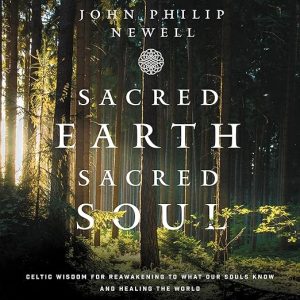
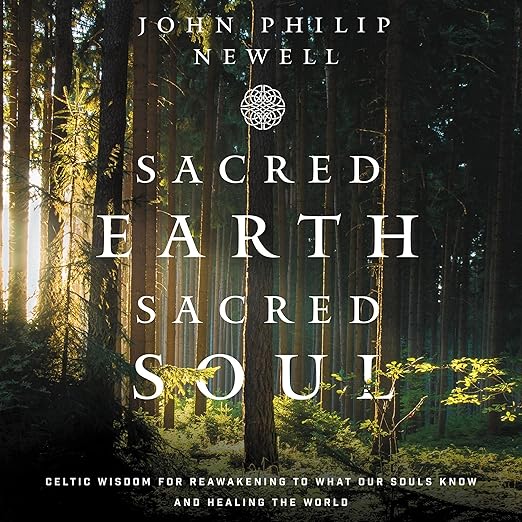
I listened to Sacred Earth, Sacred Soul across a series of early mornings, which felt appropriate in ways I could not have planned for. There is something about this particular book that resists evening listening, resists background listening, resists anything other than genuine attention. John Philip Newell writes with a cadence that rewards being met halfway, and Angus King's narration honors that quality from the first pages.
What Newell has assembled here is not an introduction to Celtic Christianity in the survey-course sense. It is something more intimate and more demanding: an argument that the Celtic tradition carries within it a set of spiritual postures, a way of attending to the world, that contemporary Western religion has largely abandoned, and that we are the worse for it. Whether you arrive at this book as a practicing Christian, a spiritual seeker outside formal religion, or simply someone troubled by the fractures between human civilization and the natural world, the argument lands with real force.
Pelagius, Condemned by Rome, Still an Open Wound
Newell structures the book around a series of figures: Pelagius, the British theologian condemned by Rome for insisting on the inherent sacredness of human beings; Brigid of Kildare, whose community life modeled an integration of the sacred and the everyday; John Muir, whose wilderness writings Newell reads as deeply Celtic in their reverence; and Teilhard de Chardin, the Jesuit paleontologist who spent his life articulating a vision of science and faith as part of the same story.
This structure is the book's greatest strength. By anchoring each chapter in a specific life rather than an abstract theological argument, Newell keeps the material grounded and personal. The chapter on Pelagius is particularly strong, presenting the historical condemnation of his theology not as a settled ecclesiastical matter but as an ongoing cultural wound: the suppression of an earth-affirming spirituality by a sin-centered orthodoxy that still shapes Western religious life today. That argument is made carefully and with historical specificity, not as polemic but as an invitation to examine inherited assumptions. Several reviewers noted being genuinely shaken by this chapter, which is a rare response to historical theology.
Angus King Reads the Meditations Like Pauses
One reviewer noted that this is a book to read slowly, to digest before moving on. That observation applies doubly to the audio version. Angus King reads at a pace that respects the weight of the material, but the material itself is dense with layered meaning. The suggested meditations at the end of each chapter, which King reads with particular care, are designed to extend the experience of each section rather than summarize it. In audio, those passages feel like genuine pauses in the flow of the book rather than appendices.
Newell's writing style is simultaneously poetic and logical, as one reviewer described it, which is an unusual combination to sustain over a seven-hour audiobook. He moves between biographical narrative, theological reflection, and lyrical description without the register shifts feeling jarring. King's narration matches that fluidity; he is equally at home in the more scholarly passages and in the moments that approach something closer to prayer. The result is an audiobook that functions differently from most in its genre: less like a lecture course, more like a sustained devotional practice.
Serious Scholarship, Resonant Across Celtic Traditions
Several reviews mention being pleasantly surprised by what this book refuses to be. It is not, as one listener noted, an airy fairy sentimental book about Celtic spirituality. Newell engages seriously with historical scholarship, theological controversy, and the practical implications of a tradition that insists on the sacredness of the physical world in an era of ecological crisis. The chapter connecting Celtic earth-reverence to contemporary environmental responsibility is neither naive nor preachy; it builds its case through the logic of the tradition itself rather than importing contemporary politics.
The book is also not exclusively for Christians. Reviewers from both Celtic Christian and Celtic Pagan backgrounds found it equally resonant, which says something about the tradition Newell is describing. The spirituality he illuminates does not require institutional affiliation; it requires a willingness to attend to what is already present in the world around you and within you. That universalism is, Newell argues, one of the tradition's defining characteristics and one of the reasons it was viewed with such suspicion by more hierarchical expressions of faith. Listeners who have felt caught between religious tradition and ecological awareness will find the synthesis Newell offers genuinely illuminating rather than forced.
Essential for Celtic Seekers, Demanding by Design
Sacred Earth, Sacred Soul is essential listening for anyone exploring Celtic spirituality with serious intent, regardless of their religious background. It is also rewarding for listeners drawn to the intersection of ecology, spirituality, and history, and for those who have found conventional religious frameworks unsatisfying without abandoning a spiritual orientation entirely.
Listeners looking for practical self-help or devotional content in a simpler register may find the intellectual and historical depth demanding. This is not a book that delivers easy comfort; it asks you to reconsider some foundational assumptions about humanity, sin, nature, and the divine. At seven hours, it is not a light undertaking, and the meditative pauses mean the effective listening time, if you take them seriously, is longer than the runtime suggests. Approach it as a practice rather than a product and it delivers more than almost anything comparable in its genre. The seven-hour runtime felt, by the end of my listening, less like a measure of duration and more like a measure of how much ground Newell needed in order to make his argument with proper care. Every chapter earns its place.