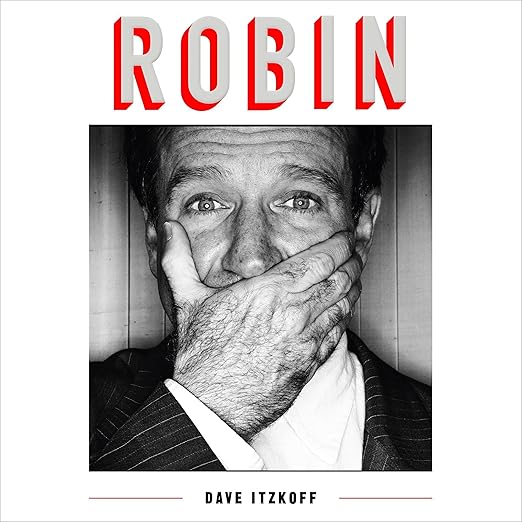
A definitive biography carries an unusual production note on this audiobook, and it sits right at the top of the description: the program includes a prologue and epilogue read by the author. Fred Berman handles everything in between, sixteen hours and fifteen minutes of it, for Macmillan Audio. That structure says something about how the book is built, with Dave Itzkoff stepping forward at the edges and vanishing into the reporting for the rest.
More Than a Hundred Original Interviews
Duane Schneider's August 2019 five-star names the effect this book aims for and largely achieves: finishing a biography with greater respect for its subject, which does not always happen. That response came from a fan of the films who had found Williams somewhat manic in interviews and not consistently funny, then left persuaded by the testimony inside, where fellow actors and comedians return again and again to the improvisation and to a photographic memory.
Reporting is the spine of the thing. More than a hundred original interviews with family, friends and colleagues, plus extensive archival work, and Itzkoff uses that volume to keep the book from collapsing into a highlight reel. Mork & Mindy, Good Morning, Vietnam, Dead Poets Society, The Fisher King, Aladdin and Mrs. Doubtfire all get their space, but the attention stays on what was happening around the making of them. The interviews carry the weight, and the effect is cumulative rather than revelatory: the same qualities described by twenty different people until the shape of a personality emerges from the overlap.
Good Will Hunting Is Where the Point Lands
An argument runs underneath all of it, stated plainly in the description: comic brilliance masking a deep well of conflicting emotions and self-doubt, with Williams drawing on both. The biography holds those two things together rather than choosing between them, which is the harder path to walk. Good Will Hunting is where the point lands, an intense and controlled performance from a man whose public identity was built on the opposite of control.
Explains the One You Already Watched
Bouncer's February 2026 five-star makes the case in three sentences: a great biography, and anyone who liked Robin Williams will find a deeper connection here. That is the honest promise on offer. This is not a book that reveals a different person underneath the one you watched. It explains the one you already watched, which for a performer observed this closely is the considerably harder achievement.
Half the Material Concerns a Voice
The format suits this subject better than it suits most biographies. Half the material concerns a voice: rapid-fire riffs, tongue-twisting intensity, one character inhabited and shed after another at lightning speed. A printed description of that is a poor substitute for a spoken account, and a spoken account starts with an advantage a printed one cannot match.
Those authorial bookends justify the whole structure. A biographer who has spent years with a subject and then reads the framing material personally is making a claim about who owns the interpretation, and it also draws a clean line for the listener between the reporter's voice and the narrated body of the book. Macmillan Audio made a good decision there, and the description leads with it for a reason.
Five Stars First Half, Three for the Second
Neil Roberts, at four stars in June 2018, offers the sharpest structural criticism available and it deserves attention: five stars for the first half, three for the second. That account praises the well-researched childhood material, the relationship with parents, the influential icons and the psychological seeds of the personality, along with the early club years, the big break and the television series that followed. The back half, in that reading, does not sustain the level.
At Least One Graded Response Missing
The numbers underneath are broken in a way worth noticing. The page shows 4.5 from four ratings, while five separate people have posted a graded response, so the counter sits behind the visible record by at least one. Add the five written grades together and the result lands above the figure displayed. Whatever that four counts, it leaves at least one graded response outside the tally.
That closing section is hard listening by any measure. Addiction, depression, and a debilitating condition at the end of his life that affected him in ways his fans never knew. Sixteen hours is a long stretch to spend with somebody whose ending you already know going in, and the book refuses to soften its approach. Anyone in a fragile place around this subject should choose the timing with some care.
Heavy Struggles That May Feel Intense
A March 2026 response, filed at five stars by a buyer who states outright that this was purchased as a gift, produces the most useful shorthand on the page: honest, empathetic, well-researched and emotionally resonant in one column, heavy struggles that may feel intense for some readers in the other. Both columns are accurate. That is precisely who this book is for, and precisely who ought to think twice first.
Skip it if the comedy is what you came for. Nobody has assembled a book of routines here, and a listener hoping for a highlight reel gets the opposite: a careful account of what the funniness cost the man producing it. Fans who prefer their affection uncomplicated should also stay away, because the book is candid about the marriages, the addiction and the self-doubt without ever turning cruel about any of them.
Anyone who grew up with these films should treat this as close to essential, and audio is the format to choose given that the subject's whole instrument was his voice. Go in knowing that the last stretch is bleak, that the second half divides opinion among the people who have written about it, and that a counter showing four ratings is a counter failing rather than a verdict. Nothing else about it needs a caveat.
- Performance: Fred Berman handles the body of the book while the author takes the prologue and epilogue, a split that keeps reporter and reader distinct.
- What it covers: Comic genius and its cost, addiction and depression, improvisation as identity
- Feel: Affectionate, heavily documented and increasingly sad
- Our call: The account to choose if you grew up with these films, provided you are ready for how the last stretch goes.