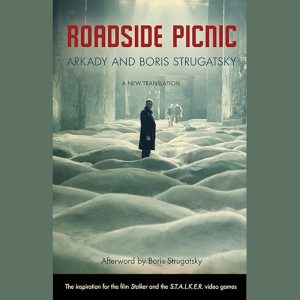
I came to Roadside Picnic the way a lot of people my age did: sideways, through the video game S.T.A.L.K.E.R. and the Tarkovsky film that preceded it. The novel behind both of those adaptations turned out to be something quieter and stranger than either of them, a short, punishing book about a man named Red Schuhart who keeps going back into a place he knows will destroy him because there's nothing else that makes sense anymore.
The Strugatsky brothers wrote this in the early 1970s under Soviet censorship, which makes what they managed to say about human futility and institutional exploitation all the more remarkable. Robert Forster's narration for the Random House Audio edition brings the book's terse, working-class voice to life in a seven-hour-and-eight-minute listen that feels longer in the best way, the way a piece of fiction that actually matters always does.
The Review
The novel's central conceit, that aliens visited Earth for 48 hours and left, scattering incomprehensible artifacts the way a picnicker leaves garbage behind, is one of the most elegant ideas in science fiction. It reframes the entire genre's question. We're not asking what the aliens want. We're asking what the ants do with the discarded food wrappers. Humanity is the ant.
Forster reads Red with an appropriate flatness, not affectless, but worn, the way a man sounds when he's made peace with the fact that his choices are mostly bad and he's going to make them anyway. The novel doesn't sentimentalize Red's situation, and Forster doesn't sentimentalize it either.
Why Roadside Picnic Works as an Audiobook
The audiobook format suits this material because the novel's prose is clipped and functional rather than lyrical. You're not lingering in sentences, you're moving through events with Red, accumulating the weight of what the Zone costs the people around him. Audio accelerates that accumulation in a useful way. By the time you reach the final chapter, the distance traveled feels correct.
One reviewer traces the word 'Stalker' in this novel back to Kipling's character Stalky, via the Strugatsky brothers' afterword, a piece of literary genealogy that adds unexpected depth to the book's history. That afterword, in which Arkady Strugatsky describes the bureaucratic battles involved in getting the novel published at all, is itself worth the price of admission.
The Caveats
The novel is told across multiple time periods in Red's life, and the audiobook moves through them without a great deal of signposting. Paying attention to his daughter Monkey's age is one of the clearest ways to track where you are in the timeline. The Zone itself changes between visits, and those changes accumulate meaning if you're tracking them rather than treating each visit as a self-contained episode.
This is not a comfort listen. The novel ends in a moment of desperate, possibly irrational hope, Red's last monologue is one of the most discussed passages in science fiction, and whether you read it as transcendent or heartbreaking depends on how much the preceding seven hours have worn you down. Both readings are available. The Strugatskys leave it open.
Should You Listen to Roadside Picnic?
Essential for readers interested in Soviet science fiction, in the history of speculative fiction outside the American tradition, or in the philosophical end of the genre. It's an excellent companion to Ursula Le Guin's work, she famously championed this novel, and to other books that use alien contact as a way of asking questions about what humanity actually is.
It's also worth noting that the novel is short by contemporary standards, the print edition runs under 200 pages, and the seven-hour runtime reflects a measured audio pace rather than padding. Forster takes his time with Red's internal voice, and that patience is part of what makes the ending register correctly when it arrives.
Less suited to listeners who want plot-driven science fiction with a resolved ending. The novel is short by contemporary standards but dense with implication. It rewards attention and punishes distraction.