At a Glance
- Voice: Ramón De Ocampo holds a first-person account the author did not read, which buys steadiness and costs the evidence a survivor's own voice would carry.
- Big ideas: coming out, family rejection, homelessness, first love and betrayal, survival
- Atmosphere: Raw, close and unconsoling
- Worth it?: A short, concrete memoir that earns every bit of its distress, though the listing never tells you it closes a three-book account.
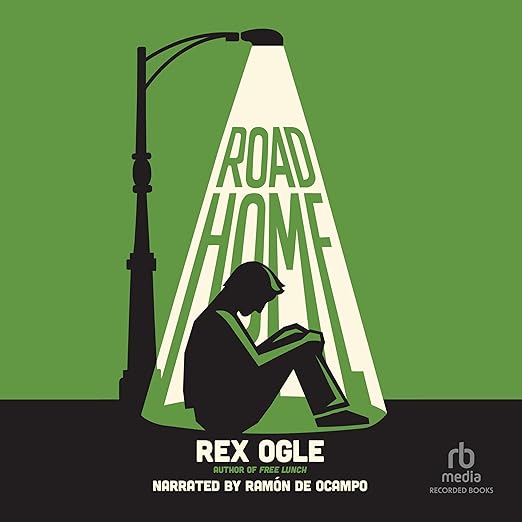
An ultimatum with a deadline attached is how this audiobook opens: you can be gay, or you can live here, not both, and twenty-four hours to decide. Rex Ogle was a teenager when his father set those terms on a hot summer afternoon. He waited for a reprieve that never came, and the following day he left with nowhere to go, driving to New Orleans because the only phone number in his possession belonged to a man he had met briefly and kissed once. Recorded Books put the memoir out in June 2024 at six hours and fifty-nine minutes, and that compression matters, since what follows takes in a first love that turns to betrayal, an assault, hunger, and a stretch of homelessness.
A Closer Look at Road Home
Ogle writes the sequence without the retrospective cushioning most survival memoirs supply. The description reaches the crisis on the highway bridge above the Mississippi River by its second paragraph, roughly where a more careful book would still be establishing sympathy, and the effect is a narrative that will not let you read forward from a position of safety. The copy places it alongside two earlier memoirs it names, Free Lunch and Punching Bag, so this is plainly not a debut, and the confidence shows in how little the prose stops to explain itself. What arrives instead is reconstruction: the ultimatum, the drive, the man in New Orleans, the falling through. In audio, where skimming is not really available, that directness lands harder.
Most useful of everything written about this book on its own page is an inventory. Writing in October 2025, one five-star lists the father's terms in full, stay home, be straight, pay for your own therapy, go to church, date a girl, then counts what left the house: a backpack, a duffel bag, and a hundred and seventeen dollars. That entry has understood the method. Ogle keeps totting up what is countable, and the countable things end up carrying the weight an emotional vocabulary would otherwise have to lift. A memoir about being cast out could be written entirely in feeling. This one is written in dollars, miles, and phone numbers.
What Makes Road Home Worth Hearing
Nobody in this column pretends the experience is comfortable. One July 2024 entry, five stars, opens with a tissue warning in capital letters, repeats it at the end for emphasis, and works through a string of adjectives that do not usually cohabit: beautiful, touching, hopeful, hauntingly honest, vulnerable, at times languishing and painful. Holding those together is exactly the achievement. Plenty of books about queer teenagers being thrown out settle on either despair or uplift and stay parked. Ogle refuses the choice, and that July entry is describing the refusal, not a mood swing. If you want to know what the listening actually feels like, the list is more accurate than any single adjective I could offer you.
Ramón De Ocampo takes the reading credit, which is worth pausing over on a first-person memoir. Ogle is not the voice you hear. Recent memoir has trained listeners to expect the author in the booth, and the substitution changes the contract: what you get is a performance of the account in place of testimony from the person who lived it. On this material that cuts both ways. A professional reader can hold a line about assault steady where its author might not, and steadiness is worth a great deal across seven hours of escalating harm. What is lost is the small, involuntary evidence of survival that hearing the actual person carries, which in this genre is not a trivial loss.
Things to Know Before Starting Road Home
Parents and teachers should know what is inside before handing this to a fourteen-year-old. The description itself lists betrayal, assault, and homelessness, then puts a teenager on a highway bridge at a moment of desperate choice, and not one line of the page attaches a warning to any of it. The teen and young adult shelf is wide enough to hold both middle school and college, so the label settles nothing at all. My own read is that the real ceiling is proximity and not maturity: a listener who has recently been put out of a house, or who is frightened of being put out of one, will meet their own situation here with no notice whatsoever.
The record also conceals its own shape. Both series fields sit empty and the tag reads Biographies, so nothing on the page tells you where this volume falls in a sequence. The column's only four-star, from May 2024, fills the gap the publisher left: it identifies the first memoir as the middle school years, the second as high school, and this one as the summer that followed, and it calls the book the final installment. That ordering is genuinely useful information, and it should not have to arrive from a customer. Anyone starting here will find the book entirely legible on its own terms, and will also be beginning a three-book account at its end without ever being told so.
Who Rex Ogle Is Writing For
Two audiences will get the most from this. Young listeners who are queer and unsure of their own household will find an account that neither flinches nor moralizes, which is rarer in the category than the shelf suggests. Adults who work with teenagers, teachers, librarians, counselors, get seven hours of specific and usable detail about what happens in the weeks after a young person loses an address, including the parts that are administrative and dull instead of dramatic. And anyone who has already read the two earlier memoirs the description names will want this one for the obvious reason.
Pass if you are looking for something to lift a bad week, because it will not, and pass if you need a memoir to close in resolution, since the description promises survival and stops carefully short of promising anything beyond it. Buyers hoping for the author's own voice should know before checkout that they will not get it here. What remains is a short, unpadded, unusually concrete account of an experience far more common than the shelf of books about it would suggest, delivered in under seven hours by a writer who has already proved across two earlier titles that he will not soften a detail for anybody's comfort.
Before You Listen
Can this audiobook be followed without the two earlier memoirs?
Completely. The account begins the day the ultimatum lands and assumes nothing before it. Both earlier titles are flagged in the description as companions, and it hands you whatever context you need in one sentence, so starting here costs you continuity but never comprehension.
What age is this audiobook actually written for?
The shelf says teen and young adult, and the harshest material argues for older teens at minimum. One September 2025 entry makes the opposite point too, calling it not just a story for the young, and adult listeners clearly make up a real share of the people writing about it.
How long does it take to get through?
Just under seven hours, short for a memoir carrying this much. The compression is part of why it hits: nothing is padded, the drive to New Orleans arrives early, and the events keep moving, so plan for longer sittings than a seven-hour runtime usually demands.
Does it end hopefully?
The description calls it a story of survival and declines to promise more. It speaks of a young adulthood scarred by trauma and illuminated by strength and compassion, which is a careful formulation. Expect endurance and clear sight at the close, and do not expect repair.